
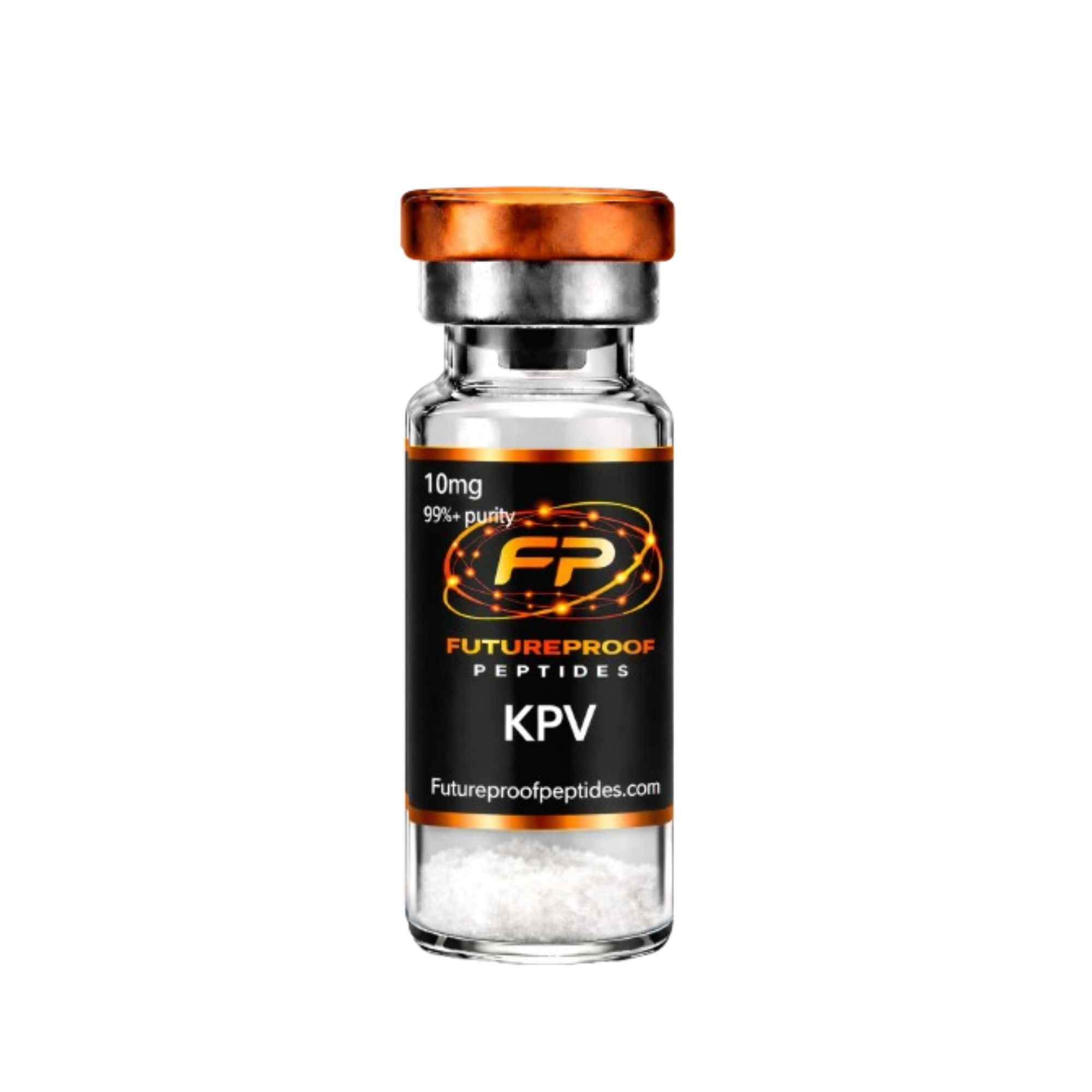
KPV 10mg Research Peptide
KPV 10mg is a synthetic tripeptide studied in laboratory research involving inflammatory signalling, cellular communication, and biological responses associated with the melanocortin system. KPV consists of three amino acids: lysine, proline, and valine. The sequence is commonly written as Lys-Pro-Val, giving the compound its name.
KPV is derived from the C-terminal portion of alpha-melanocyte-stimulating hormone, commonly abbreviated as α-MSH. Unlike the complete α-MSH molecule, KPV represents a much smaller peptide fragment. Researchers have therefore investigated whether this short sequence can be used to study specific biological pathways associated with inflammatory regulation without introducing the full parent peptide.
Our KPV 10mg format is supplied for laboratory research and analytical applications. The product is provided as a lyophilised peptide powder, allowing researchers to work with a defined quantity when designing controlled experimental studies.
Research involving KPV has primarily examined cellular and molecular responses. Areas of interest include inflammatory signalling, epithelial biology, gastrointestinal models, immune-related pathways, and interactions involving transcription factors such as NF-κB.
The available evidence remains largely preclinical. Findings from cell and animal models should not be interpreted as proof of safety or effectiveness in humans.
What Is KPV?
KPV is a short synthetic peptide consisting of three amino acids:
- Lysine (K)
- Proline (P)
- Valine (V)
Together, these amino acids form the sequence Lys-Pro-Val, commonly referred to as KPV.
The peptide is associated with α-MSH, a naturally occurring melanocortin peptide involved in several biological signalling pathways. Researchers became interested in KPV because certain biological effects associated with α-MSH appear to involve regions of the molecule that contain the KPV sequence.
This has led to laboratory investigations designed to determine how KPV behaves independently and which cellular pathways may respond to its presence.
The small size of KPV makes it particularly interesting for peptide research. Short peptide fragments can sometimes interact with biological systems differently from larger parent molecules, creating opportunities to investigate individual signalling mechanisms.
Research on KPV 10mg therefore focuses less on broad claims about the whole body and more on identifying specific molecular and cellular responses under controlled conditions.
KPV And Alpha-MSH Research
Alpha-MSH is a melanocortin peptide involved in several signalling processes. It has been studied extensively in connection with pigmentation, energy regulation, immune signalling, and inflammatory responses.
KPV represents a short sequence derived from α-MSH. Researchers have investigated whether this fragment contributes to some of the anti-inflammatory signalling associated with the larger peptide.
This relationship is important because it provides a way to examine a specific peptide sequence rather than studying α-MSH as a complete molecule.
Research models have explored how KPV may influence cellular responses following exposure to inflammatory stimuli. These investigations can involve cultured cells, epithelial models, and animal systems.
The objective is to understand whether KPV affects signalling pathways involved in the regulation of inflammatory mediators.
Importantly, the presence of a relationship between KPV and α-MSH does not mean that the two compounds have identical biological activity. The molecular environment, experimental conditions, concentration, and model used can all influence the observed response.
For this reason, KPV research should be considered independently from research involving full-length α-MSH.
Why Is KPV Studied?
One of the primary reasons researchers study KPV is its relationship with inflammatory signalling.
Inflammation is a complex biological process involving multiple signalling molecules, receptors, transcription factors, and cellular responses. Rather than being controlled by a single pathway, inflammatory activity can involve numerous interconnected systems.
KPV has therefore been investigated as a research tool for examining selected components of these systems.
Research areas associated with KPV include:
- Inflammatory signalling
- Cellular stress responses
- NF-κB-related pathways
- Epithelial cell activity
- Gastrointestinal research models
- Immune signalling
- Peptide-mediated cellular communication
- α-MSH-related biological pathways
These areas provide researchers with different ways to examine how a small peptide sequence interacts with cellular processes.
The purpose of this research is not simply to determine whether KPV produces an observable effect. Researchers may also examine the underlying mechanisms responsible for a response.
This distinction is important because understanding mechanism can help clarify how individual signalling pathways contribute to biological processes.
KPV And Inflammatory Signalling
Inflammatory signalling is one of the most widely discussed areas of KPV research.
When cells encounter inflammatory stimuli, they can activate signalling pathways that result in the production of inflammatory mediators. One important pathway involves nuclear factor kappa B, commonly known as NF-κB.
NF-κB is a transcription factor involved in regulating the expression of numerous genes associated with immune and inflammatory responses.
Laboratory research has examined whether KPV influences signalling associated with NF-κB activation.
This research is valuable because NF-κB is involved in many different cellular processes. Understanding how small peptide fragments interact with this pathway may help researchers better characterise inflammatory signalling at the molecular level.
Studies involving KPV may therefore measure changes in inflammatory markers, gene expression, cellular responses, or signalling activity.
The results depend heavily on the experimental model. A response observed in cultured cells does not necessarily produce the same outcome in an animal model or human biological system.
For that reason, research findings should always be interpreted according to the model in which they were generated.
Cellular Signalling Research
Cells communicate through complex networks of receptors, enzymes, transcription factors, and signalling molecules.
Short peptides such as KPV are useful research subjects because they provide researchers with relatively simple molecular structures for studying biological communication.
KPV research can involve observing changes in cells following controlled exposure to the peptide.
Researchers may examine:
- Cellular signalling activity
- Gene expression
- Inflammatory mediator production
- Cellular stress responses
- Changes in epithelial behaviour
- Interactions with signalling pathways
These measurements can provide information about how cells respond to specific molecular signals.
The goal is to separate direct observations from assumptions about broader biological effects.
For example, if an experiment identifies a change in a specific inflammatory marker, that observation can provide evidence that the pathway was altered under those experimental conditions. It does not automatically establish that the same change would occur throughout a human body.
This careful distinction is particularly important when evaluating experimental peptides.
KPV And NF-κB
NF-κB is a central transcription factor involved in inflammatory and immune-related signalling.
Under certain conditions, activation of NF-κB can increase the expression of genes involved in inflammatory responses.
Researchers have examined KPV in models where NF-κB signalling is stimulated or otherwise manipulated.
These experiments can help determine whether the peptide changes the activity of the pathway or modifies downstream cellular responses.
The relationship between KPV and NF-κB is therefore an important area of mechanistic research.
Rather than describing KPV as a proven treatment for inflammation, it is more accurate to describe the compound as a research subject used to investigate molecular pathways associated with inflammatory regulation.
This distinction helps ensure that scientific findings are not presented as established therapeutic outcomes.
Gastrointestinal Research
Another area of interest involves gastrointestinal and intestinal research models.
The gastrointestinal tract contains a large number of specialised cells that interact with nutrients, microorganisms, immune signals, and environmental factors.
Because inflammatory signalling can influence intestinal function, researchers have examined compounds that may alter cellular responses within gastrointestinal models.
KPV has been included in experimental work investigating inflammatory responses involving intestinal epithelial cells and related systems.
These models can help researchers study:
- Epithelial cell responses
- Inflammatory signalling
- Barrier-related cellular activity
- Interactions between peptides and intestinal cells
- Responses to inflammatory stimuli
Laboratory research in this area can provide information about cellular mechanisms that would be difficult to isolate in more complex biological systems.
However, experimental gastrointestinal findings should not be interpreted as evidence that KPV is an established treatment for digestive conditions.
Human clinical evidence remains an important requirement before therapeutic conclusions can be drawn.
KPV And Epithelial Research
Epithelial cells form protective layers throughout the body, including within the gastrointestinal tract and other tissues.
These cells are important in maintaining physical and biological barriers between internal tissues and the external environment.
Research involving KPV has investigated cellular responses in epithelial models.
Researchers may examine how cells behave after exposure to inflammatory stimuli and whether peptide-related signalling changes can be detected.
Potential measurements can include:
- Cellular viability
- Inflammatory signalling
- Gene expression
- Barrier-related markers
- Cellular stress responses
- Molecular signalling activity
Such research can provide a clearer understanding of how small peptides interact with epithelial systems.
The results may also help researchers identify pathways that deserve further investigation.
KPV And Cellular Stress
Cells can experience stress when exposed to changes in their environment.
Examples include oxidative conditions, inflammatory stimuli, nutrient changes, temperature changes, and other experimental challenges.
Research involving KPV can examine how cells respond under these conditions.
The purpose is to determine whether exposure to the peptide is associated with measurable changes in cellular signalling.
These experiments may involve controlled changes to the cellular environment followed by measurement of molecular markers.
The resulting information can help researchers understand whether KPV influences particular stress-related pathways.
However, cellular stress research is highly dependent on experimental conditions.
Conclusions should therefore remain specific to the model and conditions used rather than being extended automatically to human physiology.
KPV And Immune-Related Research
Inflammatory signalling and immune activity are closely connected.
Immune cells communicate through cytokines, chemokines, receptors, transcription factors, and other molecular signals.
KPV has attracted research interest because of its connection with pathways involved in inflammatory regulation.
Laboratory models may examine whether KPV changes the response of cells exposed to inflammatory triggers.
Researchers can compare untreated control groups with groups exposed to KPV and evaluate measurable differences.
This approach allows researchers to investigate whether particular signalling pathways are affected.
The findings can contribute to a broader understanding of peptide-mediated regulation of inflammatory processes.
Again, these observations are primarily experimental and should not be interpreted as evidence that KPV can diagnose, prevent, or treat an inflammatory disease.
Research Into Peptide Structure
The simple structure of KPV makes it useful for studying the relationship between peptide sequence and biological activity.
KPV contains only three amino acids, making it substantially smaller than many commonly studied peptides.
Researchers can use short peptides to investigate how individual sequences contribute to biological signalling.
This can involve comparing KPV with:
- Longer peptide sequences
- Related α-MSH fragments
- Modified peptide structures
- Other short-chain peptides
- Control sequences
Comparative experiments can help determine whether a biological response is associated with the KPV sequence itself or with another component of a larger peptide.
This type of research is important in peptide pharmacology because structure can influence stability, receptor interaction, cellular uptake, and biological activity.
KPV In Combination Research
KPV may also appear in research involving multi-component formulations or peptide combinations.
When multiple compounds are studied together, researchers can investigate whether the observed response differs from the response produced by an individual compound.
This type of work can involve:
- Single-compound controls
- Combination groups
- Different experimental concentrations
- Time-dependent observations
- Molecular pathway analysis
The purpose is to determine whether components produce independent, additive, or interacting effects.
If KPV is included in a blend, researchers must account for the biological properties of every component.
This makes appropriate controls particularly important.
A result observed after exposure to a blend cannot automatically be attributed to KPV alone.
KPV 10mg Research Format
Our KPV 10mg product is supplied in a lyophilised format intended for laboratory research.
Lyophilisation, commonly referred to as freeze-drying, is widely used for peptide materials because removing water can improve stability during storage when appropriate conditions are maintained.
The dry format also allows researchers to prepare the material according to their validated laboratory procedures.
Before any experimental preparation, researchers should review the applicable product documentation, analytical information, and laboratory protocols.
The product should be handled by appropriately trained personnel using procedures suitable for the intended research application.
Why A 10mg Format?
The 10mg format provides a defined quantity of KPV for laboratory studies.
A consistent quantity can be useful when researchers are comparing different experimental conditions or conducting repeated analytical work.
A defined vial format can support:
- Controlled study design
- Batch-to-batch comparison
- Repeat testing
- Analytical assessment
- Laboratory preparation
- Controlled experimental workflows
The appropriate quantity for a particular experiment depends entirely on the validated study protocol.
No universal amount should be assumed for every research application.
Preparation And Laboratory Handling
The KPV 10mg vial is supplied in dry form and may require preparation before certain laboratory applications.
Any preparation should be performed according to an appropriate laboratory protocol.
Researchers should use compatible materials, appropriate equipment, and validated procedures.
Important handling considerations include:
- Maintaining appropriate environmental conditions
- Protecting the material from unnecessary heat
- Minimising exposure to moisture
- Avoiding unnecessary temperature fluctuations
- Using consistent preparation procedures
- Following applicable laboratory safety requirements
Where a prepared solution is produced, its stability should be assessed according to the specific formulation, container, storage conditions, and validated laboratory procedures.
Storage and handling requirements can vary depending on the final experimental formulation.
Stability Considerations
Peptide stability can be influenced by temperature, light, moisture, pH, concentration, container material, and repeated handling.
For this reason, KPV should be stored according to the product’s applicable specifications and batch documentation.
Researchers should avoid unnecessary temperature changes and excessive handling.
Repeated freeze-thaw cycles can affect some peptide formulations, so validated procedures should be followed when frozen storage is required.
The dry lyophilised format can provide a practical starting point for controlled laboratory preparation, but appropriate storage remains important.
Quality Control
Quality control is an important part of peptide research.
Researchers should consider analytical information such as:
- Peptide identity
- Purity
- Batch information
- Physical appearance
- Analytical testing
- Certificate of Analysis where available
The exact analytical profile of a specific batch should take priority over generic information found on third-party websites.
Laboratory researchers may use appropriate analytical techniques to confirm identity and purity depending on the purpose of the study.
Maintaining accurate batch records can also help researchers reproduce experimental conditions.
Research Reproducibility
Reproducibility is essential when studying experimental peptides.
A reliable study should maintain consistent conditions wherever possible.
Factors such as peptide batch, preparation method, storage conditions, concentration, exposure time, experimental model, and analytical method can influence results.
Researchers should document these factors carefully.
This allows results to be compared between experiments and helps identify whether differences are caused by the compound itself or by changes in experimental conditions.
For KPV 10mg, consistent documentation can be particularly useful when the peptide is included in repeated cellular or analytical experiments.
Limitations Of Current Research
Although KPV has generated scientific interest, the available evidence has important limitations.
Much of the research is preclinical and involves cell-based or animal models.
These models are valuable for understanding biological mechanisms, but they cannot automatically establish human safety or effectiveness.
There is also a difference between demonstrating pathway activity and demonstrating a clinically meaningful outcome.
For example, observing a change in NF-κB-related signalling in a laboratory model provides information about molecular activity. It does not by itself establish that KPV produces a therapeutic anti-inflammatory effect in people.
Additional research would be required to determine how experimental findings translate into human biology.
Human Research Considerations
Human research involving experimental peptides requires careful evaluation.
Researchers must consider appropriate study design, ethical oversight, safety monitoring, and validated analytical procedures.
The existence of laboratory studies does not mean that a compound has been approved for medical use.
KPV should therefore be distinguished from approved medicines or established therapeutic products.
Information presented about KPV is intended to describe scientific research areas rather than provide medical recommendations.
Safety And Research Limitations
Long-term safety information for experimental KPV applications remains limited.
The available evidence does not establish a comprehensive long-term safety profile for human use.
Responses in experimental systems can vary depending on concentration, exposure duration, biological model, and preparation method.
For this reason, research involving KPV should remain within appropriately controlled laboratory environments.
Researchers should consult applicable safety documentation and institutional procedures before handling experimental materials.
KPV Research And Future Investigation
Continued research may help clarify how short peptide sequences interact with inflammatory and cellular signalling systems.
Potential areas for further investigation include:
- Molecular mechanisms of KPV activity
- NF-κB-related signalling
- Epithelial cell responses
- Gastrointestinal research models
- Cellular stress responses
- Peptide structure-activity relationships
- Combination research
- Stability and formulation studies
Future studies may also help determine which findings are reproducible across different experimental models.
As the scientific literature develops, researchers can compare new findings with existing molecular and cellular evidence.
Frequently Asked Questions
What is KPV?
KPV is a synthetic tripeptide consisting of lysine, proline, and valine. It is associated with a sequence derived from α-MSH and has been studied primarily in relation to inflammatory and cellular signalling.
What does KPV stand for?
KPV represents the three amino acids in its sequence: lysine (K), proline (P), and valine (V).
Is KPV a peptide?
Yes. KPV is a short peptide containing three amino acids.
Why is KPV studied?
KPV is studied because of its relationship with α-MSH and its potential involvement in cellular pathways associated with inflammatory signalling.
What is NF-κB?
NF-κB is a family of transcription factors involved in regulating genes associated with immune and inflammatory responses. KPV research has examined its relationship with NF-κB-related signalling.
Is KPV the same as α-MSH?
No. KPV is a three-amino-acid sequence associated with α-MSH, while α-MSH is a larger melanocortin peptide.
What research areas involve KPV?
Research areas include inflammatory signalling, epithelial biology, gastrointestinal models, cellular stress, immune-related pathways, and peptide structure-function studies.
What is KPV 10mg?
KPV 10mg refers to a research product containing 10mg of KPV in the supplied vial format. The product is intended for laboratory research and analytical applications.
How is KPV supplied?
KPV 10mg is supplied as a lyophilised peptide powder. Laboratory preparation should follow validated procedures appropriate to the intended research application.
Does KPV have established clinical benefits?
No. Research findings involving KPV should not be presented as established clinical benefits. Much of the available evidence remains preclinical.
Is KPV approved for human use?
The product described here is supplied for research purposes and is not intended for human consumption, diagnosis, treatment, or therapeutic use.
Research Use Only
Our KPV 10mg product is intended strictly for laboratory research and analytical applications.
It is not intended for human consumption, veterinary use, diagnosis, treatment, prevention, or therapeutic application.
The information provided on this page is educational and describes areas investigated in scientific research. Experimental findings should be interpreted according to the specific model, methodology, and conditions under which they were obtained.
Researchers should review applicable product documentation, safety information, institutional procedures, and relevant scientific literature before conducting laboratory work.
Summary
KPV is a small synthetic tripeptide consisting of lysine, proline, and valine. Its relationship with α-MSH has made it an interesting subject in peptide and inflammatory signalling research.
Studies have examined KPV in connection with inflammatory pathways, NF-κB-related signalling, epithelial cell responses, gastrointestinal models, and broader cellular communication.
The small size of the peptide also makes it useful for research investigating how short amino acid sequences can influence biological pathways.
Our KPV 10mg vial provides a defined lyophilised format for controlled laboratory research. Appropriate storage, preparation, analytical testing, and documentation are important for maintaining consistency between experimental studies.
As research continues, additional work may help clarify the molecular mechanisms associated with KPV and determine how findings from experimental models relate to more complex biological systems.
KPV 10mg KPV 10mg KPV 10mg KPV 10mg KPV 10mg KPV 10mg KPV 10mg KPV 10mg KPV 10mgKPV 10mg KPV 10mg KPV 10mg KPV 10mg KPV 10mg KPV 10mg KPV 10mg KPV 10mg KPV 10mg KPV 10mg KPV 10mg KPV 10mg KPV 10mg KPV 10mg KPV 10mg KPV 10mg


