
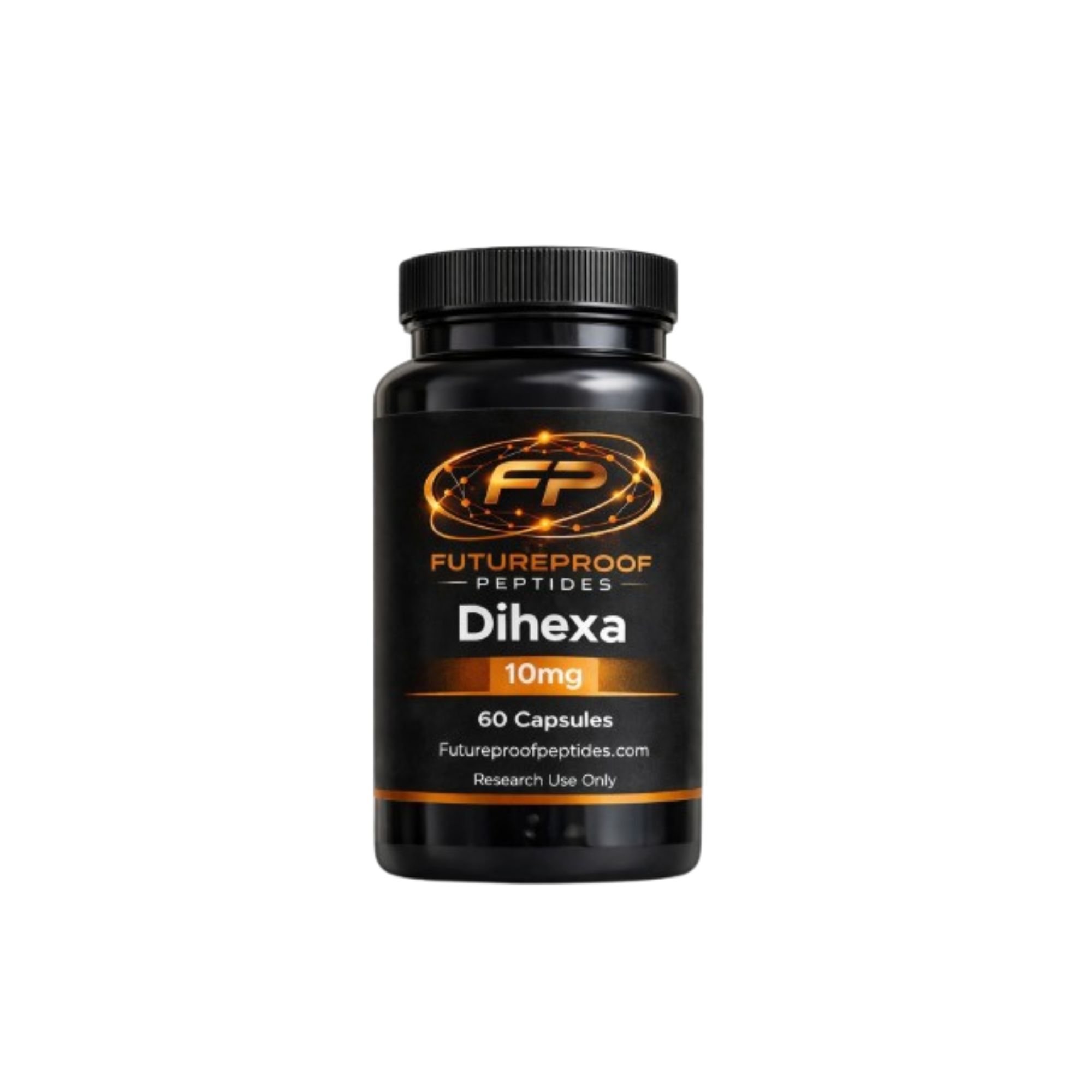
Dihexa 10mg Capsules – Advanced Research Compound for Neuroscience Studies
Dihexa 10mg Capsules are a research formulation containing Dihexa, an experimental small-molecule compound derived from angiotensin IV. Dihexa has attracted scientific interest because of its relationship with neurotrophic signalling, hepatocyte growth factor (HGF), c-Met pathways, neuronal connectivity, and experimental models investigating learning and memory.
Unlike conventional peptide research materials, Dihexa is a small molecule. Its chemical characteristics have made it an interesting subject within neuroscience and molecular biology research, particularly in experimental models focused on communication between neurons and mechanisms involved in maintaining neural connections.
The ability of Dihexa to cross the blood-brain barrier has also contributed to scientific interest, allowing researchers to investigate its activity in models involving central nervous system pathways.
Our Dihexa 10mg Capsules are supplied for laboratory research and scientific investigation only. The capsule format provides a convenient solid presentation for controlled research environments without requiring reconstitution.
For research use only. Not for human use. Not for veterinary use.
What Is Dihexa 10mg Capsules?
Dihexa 10mg Capsules contain Dihexa, an experimental small-molecule compound developed from research involving angiotensin IV.
Dihexa is structurally related to angiotensin IV research and has been investigated because of its potential interaction with pathways involving hepatocyte growth factor, commonly abbreviated as HGF.
HGF is a multifunctional growth factor involved in cellular communication and biological processes associated with:
- Cellular growth
- Tissue development
- Cell migration
- Cellular signalling
- Neural development
- Neuronal communication
In neuroscience research, the HGF/c-Met signalling pathway has received attention because of its involvement in neuronal growth, survival, differentiation, and connectivity.
Dihexa provides researchers with an experimental compound for investigating these pathways under controlled laboratory conditions.
Dihexa and Angiotensin IV Research
Dihexa originated from research into angiotensin IV and related biological signalling.
Angiotensin IV is part of the renin-angiotensin system, a complex biological network involved in several physiological processes.
Research into angiotensin IV identified potential relationships between this peptide and neurological processes, encouraging scientists to investigate modified compounds with different pharmacological properties.
Dihexa subsequently became an experimental research compound of interest because of its relationship with signalling pathways associated with HGF and c-Met.
This makes Dihexa particularly relevant to research examining how molecular signalling can influence neural systems.
How Dihexa Works in Research
The mechanism of Dihexa research is commonly discussed in relation to hepatocyte growth factor (HGF) and its receptor, c-Met.
HGF is a signalling protein that interacts with c-Met and can activate intracellular pathways involved in cellular growth, movement, differentiation, and survival.
In neurological research, these pathways can be investigated in relation to neuronal development and connectivity.
Researchers studying Dihexa may therefore examine:
- HGF signalling
- c-Met receptor activity
- Neuronal connectivity
- Synaptic pathways
- Cellular signalling
- Neural adaptation
- Neurotrophic processes
Rather than viewing Dihexa research as focusing on one isolated cognitive function, scientists can investigate how several cellular signalling processes interact.
What Is HGF?
Hepatocyte growth factor, or HGF, is a multifunctional protein involved in communication between cells.
Although its name comes from its original identification in relation to liver cells, HGF has biological activity in numerous tissues.
The HGF signalling system has been investigated in connection with:
- Cell growth
- Cell migration
- Tissue development
- Regeneration research
- Neuronal development
- Synaptic activity
- Cellular survival
The relationship between HGF and the nervous system is particularly relevant to experimental Dihexa research.
Dihexa and c-Met Signalling
c-Met is the receptor for hepatocyte growth factor.
When HGF interacts with c-Met, downstream signalling pathways can influence several cellular processes.
Research into Dihexa has therefore focused on whether the compound can influence HGF/c-Met-associated signalling.
This is important because c-Met signalling has been investigated in models involving:
- Neuronal growth
- Neuronal survival
- Axonal development
- Synaptic organisation
- Cellular communication
- Neural plasticity
The connection between these processes and Dihexa is one of the primary reasons the compound remains an interesting subject within experimental neuroscience.
Why Researchers Study Dihexa
Interest in Dihexa 10mg Capsules research comes largely from the compound’s potential relationship with pathways involved in neural connectivity.
Researchers are interested in understanding how neurons communicate and how connections between neurons are established and maintained.
Areas of investigation can include:
- Neurotrophic signalling
- HGF activity
- c-Met pathways
- Neuronal connectivity
- Synaptic communication
- Learning-related pathways
- Memory-related models
- Cellular signalling
These investigations are designed to improve understanding of the molecular biology underlying neural function.
Dihexa and Brain Signalling Research
Brain signalling involves an extremely complex network of neurons and supporting cells.
Neurons communicate through electrical and chemical signals, while molecular pathways regulate how these cells develop, adapt, and maintain connections.
Dihexa research has generated interest because of its relationship with pathways associated with neuronal connectivity.
Experimental work may therefore examine:
- Neuronal communication
- Synaptic development
- Cellular signalling
- Neurotrophic pathways
- Neural plasticity
- Connectivity between neurons
Studying these processes can help researchers understand how molecular signals contribute to the organisation of neural networks.
Blood-Brain Barrier and Dihexa Research
The blood-brain barrier is a highly selective protective system separating circulating blood from the central nervous system.
Many compounds have difficulty crossing this barrier, which can make central nervous system research challenging.
Dihexa has attracted attention because experimental research indicates that it can cross the blood-brain barrier.
This characteristic makes it particularly interesting for research involving central nervous system pathways.
Researchers can investigate compounds capable of reaching the brain to better understand how molecular signalling influences neurological systems.
However, the ability of an experimental compound to cross the blood-brain barrier does not establish therapeutic effectiveness or safety in humans.
Dihexa and Cognitive Research
Cognitive function involves multiple biological systems working together.
Learning, memory, attention, and information processing depend on complex interactions between neurons, neurotransmitters, receptors, and intracellular signalling pathways.
Dihexa has therefore been investigated in experimental models associated with cognitive processes.
Research may examine:
- Learning behaviour
- Memory-associated pathways
- Neural connectivity
- Synaptic signalling
- Neurotrophic activity
- Cellular adaptation
The purpose of these models is to investigate underlying mechanisms rather than establish Dihexa as a proven cognitive treatment.
Dihexa and Memory Research
Memory formation depends on the ability of neural networks to adapt and maintain functional connections.
The hippocampus and other brain regions participate in different aspects of memory formation and retrieval.
Because Dihexa has been investigated in relation to neurotrophic signalling and neuronal connectivity, it has attracted interest in experimental memory models.
Researchers may study relationships between:
- Neural connectivity
- Synaptic function
- HGF signalling
- c-Met activity
- Neurotrophic pathways
- Memory-associated behaviour
These models can provide information about how molecular pathways contribute to neural adaptation.
Dihexa and Neuroplasticity
Neuroplasticity describes the ability of the nervous system to change its structure and function in response to internal and external conditions.
This includes changes involving:
- Synaptic connections
- Neural pathways
- Receptor activity
- Gene expression
- Cellular signalling
- Neuronal structure
Research into Dihexa has generated interest because HGF/c-Met signalling has been associated with processes relevant to neuronal development and plasticity.
This makes the compound relevant to experimental investigations into how molecular signalling may influence neural networks.
Dihexa and Neuronal Connectivity
Neuronal connectivity is central to nervous-system function.
Individual neurons rarely operate in isolation. Instead, they communicate through complex networks of synaptic connections.
Research into Dihexa may therefore investigate how HGF-related signalling affects:
- Neuronal growth
- Synaptic connections
- Cellular communication
- Neural network organisation
- Neuronal survival
- Structural adaptation
Understanding these processes can provide researchers with additional insight into the molecular mechanisms that regulate the nervous system.
Dihexa and Synaptic Research
Synapses are specialised communication points between neurons.
Changes in synaptic structure and activity are important areas of neuroscience research because they contribute to learning, memory, adaptation, and information processing.
Experimental Dihexa research may examine how signalling pathways associated with HGF and c-Met relate to synaptic processes.
Potential research measurements include:
- Synaptic density
- Neuronal structure
- Cellular signalling
- Receptor activity
- Neural connectivity
- Molecular markers
This provides a more detailed way of investigating the biological mechanisms associated with neural communication.
Dihexa and Neurotrophic Signalling
Neurotrophic signalling involves molecular systems that influence neuronal survival, development, and adaptation.
HGF is one of several growth factors that can participate in these processes.
Because Dihexa has been studied in relation to HGF/c-Met signalling, researchers have considered its potential relevance to neurotrophic research.
This can include investigations into:
- Neuronal survival
- Neural growth
- Cellular differentiation
- Synaptic development
- Neural connectivity
- Cellular adaptation
The field remains experimental, and additional research is required to fully characterise the biological activity of Dihexa.
Dihexa and Cellular Communication
Cells communicate through a variety of signalling molecules and receptors.
Growth factors such as HGF can activate receptor systems that transmit information from outside the cell to intracellular signalling networks.
Dihexa research provides an opportunity to investigate these mechanisms in experimental settings.
Researchers can examine:
- Receptor activation
- Intracellular signalling
- Protein phosphorylation
- Cellular responses
- Gene expression
- Changes in cellular structure
These measurements can help establish relationships between molecular signalling and biological outcomes.
Potential Research Applications of Dihexa
The experimental applications of Dihexa 10mg Capsules can cover several areas of laboratory neuroscience.
Neuroscience Research
Investigation of cellular and molecular pathways involved in nervous-system function.
Neurotrophic Research
Study of growth-factor signalling and neuronal development.
HGF Research
Investigation of hepatocyte growth factor and related biological pathways.
c-Met Research
Study of c-Met receptor signalling and downstream cellular responses.
Cognitive Research
Experimental investigation of learning- and memory-associated models.
Synaptic Research
Study of neuronal connections and synaptic communication.
Neuroplasticity Research
Investigation of cellular mechanisms associated with neural adaptation.
Blood-Brain Barrier Research
Study of compounds and molecular systems capable of reaching central nervous system environments.
Why Choose Dihexa 10mg Capsules?
The Dihexa 10mg Capsules format offers researchers a ready-to-handle solid formulation.
Unlike lyophilised peptide products that may require reconstitution, capsules provide a defined presentation for appropriate laboratory research applications.
Potential advantages for research workflows include:
- Ready-to-handle format
- No reconstitution requirement
- Defined 10mg quantity
- Convenient storage
- Easy sample identification
- Suitable for controlled experimental designs
Researchers should nevertheless follow the appropriate laboratory procedures for handling, storage, and analytical evaluation.
Dihexa 10mg Capsules and Research Consistency
Consistency is an important consideration in scientific experimentation.
Research materials should be clearly identified and stored under appropriate conditions to reduce unnecessary variation.
When working with Dihexa 10mg Capsules, laboratories may document:
- Batch information
- Material identity
- Quantity
- Storage conditions
- Experimental conditions
- Analytical measurements
- Observation periods
Good documentation can improve reproducibility and make it easier to compare findings across experiments.
Storage and Handling
Dihexa 10mg Capsules should be stored according to the product-specific laboratory storage requirements.
As a general research-handling principle, the capsules should be protected from:
- Excessive heat
- Moisture
- Direct sunlight
- Contamination
- Unstable environmental conditions
Keep the packaging appropriately sealed when the material is not being evaluated.
Researchers should consult the applicable product documentation and Safety Data Sheet before handling the material.
Stability Considerations
Small-molecule research compounds can be affected by environmental conditions.
Temperature, moisture, light exposure, and storage duration can all be relevant when evaluating material stability.
For long-term research projects, laboratories may monitor:
- Chemical integrity
- Purity
- Degradation
- Storage stability
- Batch consistency
- Formulation characteristics
Validated analytical methods can be used where appropriate to assess material integrity during a research project.
Safety and Research Limitations
Dihexa remains an experimental research compound, and its human safety profile has not been established.
Most scientific interest has focused on laboratory and preclinical research.
Consequently, experimental findings should not be interpreted as evidence that Dihexa is safe, effective, or appropriate for human consumption.
Important research limitations include:
- Limited long-term human data
- Differences between experimental models
- Limited understanding of prolonged exposure
- Variation between research protocols
- Uncertainty surrounding potential adverse effects
Researchers should use appropriate risk-management procedures and consult relevant safety documentation before conducting experiments.
Is Dihexa a Peptide?
No. Dihexa is a small-molecule compound, not a conventional peptide.
Although it originated from research involving angiotensin IV, its chemical structure and handling characteristics distinguish it from lyophilised research peptides.
This distinction is important when planning laboratory experiments because preparation, storage, solubility, and analytical procedures may differ from those used for peptide materials.
Does Dihexa Cross the Blood-Brain Barrier?
Experimental research has reported that Dihexa can cross the blood-brain barrier.
This characteristic has contributed to interest in the compound for central nervous system research.
However, blood-brain barrier penetration alone does not demonstrate a clinical benefit or establish safety in humans.
Is Dihexa Studied for Memory?
Yes. Dihexa has been investigated in experimental models involving learning, memory, and neuronal connectivity.
Researchers are particularly interested in the molecular pathways that may connect neurotrophic signalling with neural network function.
These findings remain experimental and should not be interpreted as evidence of an established memory-enhancing effect in humans.
Is Dihexa Studied for Cognitive Function?
Dihexa has attracted interest in experimental cognitive research because of its relationship with neuronal signalling and neurotrophic pathways.
Studies may investigate learning, memory, synaptic function, and neural connectivity.
However, these are research applications and do not establish Dihexa as a proven cognitive-enhancement compound.
What Is HGF?
HGF stands for hepatocyte growth factor.
It is a multifunctional signalling protein involved in cellular communication, growth, migration, development, and other biological processes.
HGF is particularly relevant to Dihexa research because of the compound’s reported relationship with HGF/c-Met signalling.
What Is c-Met?
c-Met is a receptor tyrosine kinase that functions as the primary receptor for HGF.
Activation of HGF/c-Met signalling can influence several intracellular pathways associated with cell growth, migration, survival, and differentiation.
Researchers investigate this signalling system in numerous biological fields, including neuroscience.
What Is the Difference Between Dihexa and Peptides?
Dihexa is a small molecule, while peptides are chains of amino acids.
This difference affects properties such as:
- Molecular structure
- Solubility
- Stability
- Absorption
- Handling
- Analytical testing
The Dihexa 10mg Capsules format therefore differs from conventional lyophilised peptide formulations.
Does Dihexa Require Reconstitution?
The capsule format does not require the same reconstitution process associated with lyophilised peptide powders.
This makes Dihexa 10mg Capsules convenient for laboratory workflows where a solid formulation is preferred.
Researchers should nevertheless follow the specific experimental protocol and applicable laboratory procedures.

Dihexa 10mg Capsules Dihexa 10mg Capsules Dihexa 10mg Capsules Dihexa 10mg Capsules Dihexa 10mg Capsules Dihexa 10mg Capsules Dihexa 10mg Capsules Dihexa 10mg Capsules Dihexa 10mg Capsules Dihexa 10mg Capsules Dihexa 10mg Capsules Dihexa 10mg Capsules Dihexa 10mg Capsules Dihexa 10mg Capsules Dihexa 10mg Capsules Dihexa 10mg Capsules
Product Specifications
Product Name: Dihexa 10mg Capsules
Research Compound: Dihexa
Compound Type: Synthetic small molecule
Research Origin: Derived from angiotensin IV research
Quantity: 10mg
Format: Capsules
Primary Research Areas: Neuroscience, HGF signalling, c-Met pathways, neuroplasticity, neuronal connectivity, cognitive research
Research Focus: Cellular signalling and neurological pathways
Reconstitution: Not required for capsule presentation
Intended Use: Laboratory research and scientific investigation
Human Use: Not intended
Veterinary Use: Not intended
Final Research Summary
Dihexa 10mg Capsules provide a defined small-molecule research formulation for laboratories investigating neuroscience, neurotrophic signalling, cellular communication, and molecular pathways associated with neuronal connectivity.
Derived from research involving angiotensin IV, Dihexa has become a subject of scientific interest because of its relationship with hepatocyte growth factor (HGF) and c-Met signalling.
Research has examined areas including neuronal connectivity, synaptic pathways, neuroplasticity, learning and memory models, cellular signalling, and central nervous system research. The reported ability of Dihexa to cross the blood-brain barrier has further contributed to its use as an experimental research compound in neurological models.
The capsule format provides a convenient solid presentation without the reconstitution requirements associated with many lyophilised peptide products.
As with all experimental research compounds, findings should be interpreted within the specific conditions under which they were generated. Laboratory and preclinical observations cannot automatically be translated into established human benefits or safety conclusions.


