
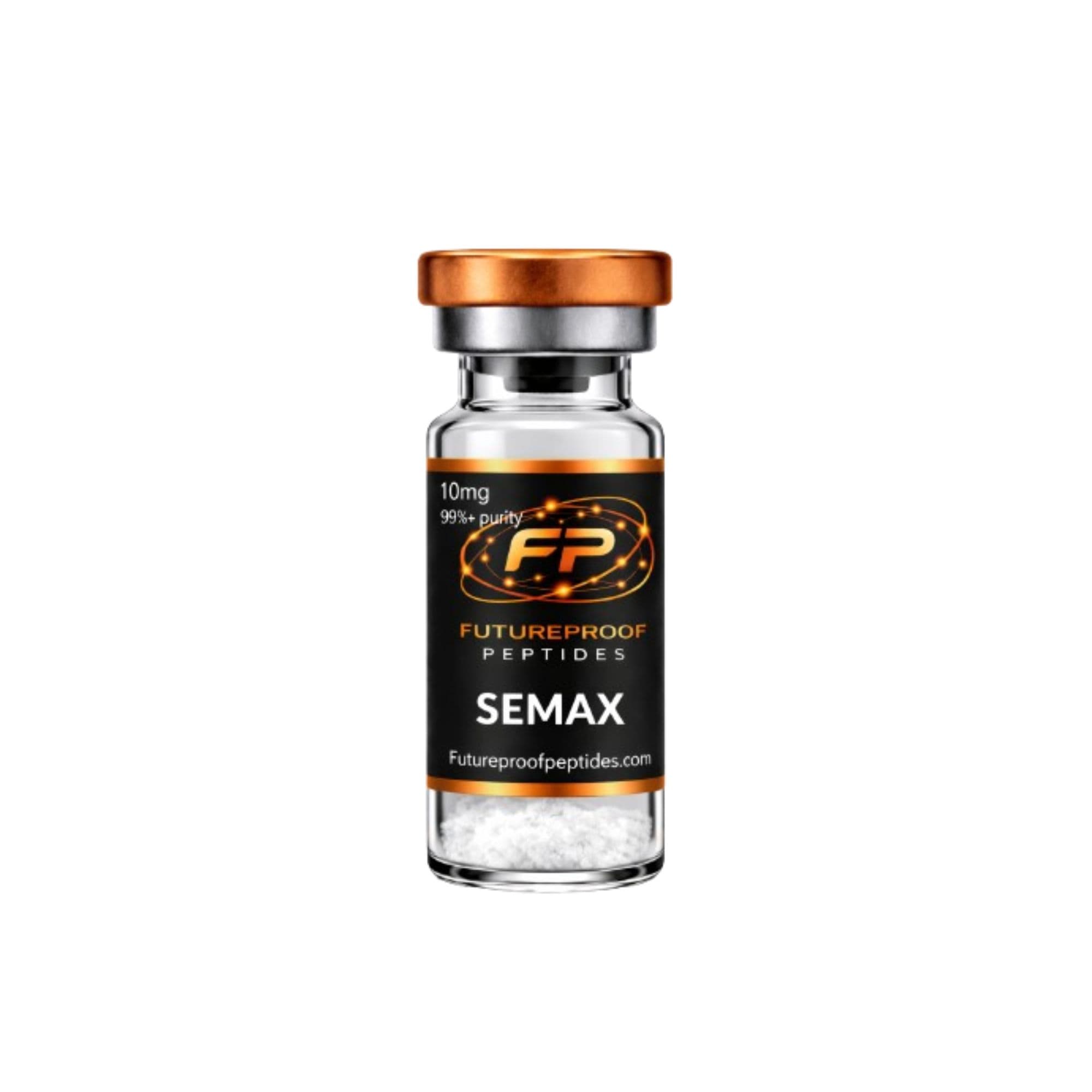
Semax 10mg – Powerful Research Peptide for Advanced Neural Signalling Studies
Our Semax 10mg vial is a synthetic research peptide studied for its relationship with neurological signalling, cognitive processes, neural communication, and cellular responses within the central nervous system.
Semax has attracted scientific interest because of its potential interaction with signalling pathways involved in brain function and cellular communication. Researchers use experimental models to investigate how peptide-based compounds may influence neural processes and how biological systems respond when these pathways are exposed to controlled conditions.
Unlike compounds primarily studied for metabolic or peripheral signalling, Semax 10mg is associated with neuroscience and neuropeptide research. Scientific investigations have examined areas involving learning, memory, neuronal signalling, stress-related pathways, and the ability of neural systems to adapt to changing conditions.
The compound continues to be investigated in laboratory and scientific research settings as researchers work to better understand the complex communication systems that regulate brain activity.
Our Semax 10mg product is supplied as a lyophilised research material intended exclusively for laboratory research, analytical testing, and scientific investigation. It is not intended for human consumption, veterinary use, diagnosis, treatment, or therapeutic application.
What Is Semax?
Semax is a synthetic peptide originally developed from research involving adrenocorticotropic hormone-related sequences. Its structure has made it an interesting compound for scientists investigating peptide signalling within neurological systems.
Semax 10mg is studied in relation to neural communication and cellular processes involved in brain function. Researchers are interested in how peptide signalling may influence communication between neurons and how those signals can affect broader cellular responses.
Rather than viewing brain activity as a single process, modern neuroscience examines a network of interconnected signalling pathways.
Research involving Semax therefore looks at questions such as:
- How neurons communicate with one another
- How signalling pathways respond to stimulation
- How neural systems adapt over time
- How cellular signalling changes under different conditions
- How peptide compounds interact with neurological pathways
- How cognitive processes can be investigated in experimental models
These areas make Semax 10mg relevant to research involving neurobiology, peptide chemistry, cellular signalling, and behavioural neuroscience.
Understanding Neural Signalling
The nervous system depends on continuous communication between cells.
Neurons transmit information through electrical and chemical signals, while supporting cells contribute to the environment required for normal neural activity.
Researchers studying Semax 10mg are interested in how peptide-associated signalling may interact with these complex systems.
Neural signalling can involve numerous biological components, including:
- Neurotransmitters
- Receptors
- Peptides
- Intracellular signalling molecules
- Gene-expression pathways
- Cellular stress responses
Because these systems interact with one another, studying one signalling compound can provide researchers with information about wider biological networks.
Semax research therefore focuses on understanding how neural systems communicate, adapt, and maintain stability under controlled experimental conditions.
Why Is Semax Researched?
Interest in Semax 10mg has developed around its relationship with neurological signalling and experimental models involving cognition and neural function.
Researchers have investigated Semax in models examining:
- Learning and memory
- Neural communication
- Cognitive processes
- Cellular signalling
- Stress-response pathways
- Neuroprotective mechanisms
- Brain adaptation
- Neurotransmitter-related activity
These areas represent scientific research questions rather than established therapeutic applications.
Research models can help scientists determine how a peptide interacts with neurological systems and whether observed changes are consistent across different experimental conditions.
Semax And Cognitive Research
Cognitive research examines how the brain receives, processes, stores, and retrieves information.
Learning and memory are particularly complex processes involving multiple brain regions and signalling pathways.
Semax 10mg has been investigated in experimental models examining aspects of cognitive function. Researchers have explored how peptide-related signalling may interact with pathways involved in learning, memory formation, and information processing.
Laboratory research may examine:
- Learning behaviour
- Memory retention
- Information processing
- Neural adaptation
- Communication between brain regions
- Changes in signalling pathways
The purpose of these studies is to better understand the underlying biological mechanisms associated with cognitive processes.
Results from experimental models should not automatically be interpreted as evidence of cognitive enhancement in humans.
Semax And Neurobiology
Neurobiology focuses on the structure and function of the nervous system.
Semax is of interest within this field because it provides researchers with an experimental compound for investigating peptide-associated neurological signalling.
Studies may examine how Semax 10mg interacts with cellular systems involved in:
- Neuronal communication
- Signal transmission
- Cellular adaptation
- Neural stress responses
- Neurochemical signalling
- Brain-related cellular pathways
This type of research contributes to the broader understanding of how small peptides can interact with complex neurological systems.
Semax And Cellular Communication
Cells communicate through highly organised signalling networks.
Within the brain, communication occurs through neurotransmitters, neuropeptides, hormones, receptors, and intracellular signalling pathways.
Researchers investigating Semax 10mg examine how peptide exposure may affect these networks under controlled conditions.
This can involve observing:
- Receptor activity
- Intracellular signalling
- Gene-expression changes
- Cellular responses
- Neural communication
- Adaptation following repeated exposure
Understanding these processes is important because changes in one signalling pathway can influence several other biological systems.
Semax And Stress-Response Research
Stress responses are another area of interest within Semax research.
The nervous system continuously responds to internal and external changes. When conditions change, cells activate signalling pathways designed to help maintain biological stability.
Researchers investigate how neural systems respond to stress and whether peptide-associated signalling contributes to cellular adaptation.
Semax 10mg may therefore appear in experimental models examining:
- Cellular stress responses
- Neural adaptation
- Oxidative stress pathways
- Neuroendocrine communication
- Changes in neuronal activity
- Cellular resilience
These models help scientists understand how neurological systems respond when exposed to different environmental or metabolic conditions.
Semax And Neuroprotective Research
Neuroprotection is a broad research field concerned with mechanisms that may help preserve neuronal structure and function under stressful conditions.
Scientists investigate how neurons respond to oxidative stress, metabolic changes, inflammation, and other potentially disruptive conditions.
Research involving Semax 10mg has contributed to experimental investigations of neurological cellular responses.
Potential areas of observation include:
- Neuronal survival pathways
- Cellular stress responses
- Oxidative balance
- Mitochondrial activity
- Neural signalling
- Cellular adaptation
These investigations remain experimental and should not be interpreted as proof that Semax provides clinical neuroprotection.
Semax And Gene Expression
Modern peptide research increasingly examines how signalling molecules may influence gene expression.
Gene expression describes how information encoded within DNA is used to produce functional cellular components.
Researchers investigating Semax have examined whether peptide-associated signalling can influence expression patterns within experimental models.
This may involve studying:
- Cellular response genes
- Neural signalling genes
- Stress-response pathways
- Neurotrophic signalling
- Metabolic pathways
- Cellular maintenance processes
The objective is to determine how changes in signalling can influence downstream cellular activity.
Semax And Neurotrophic Signalling
Neurotrophic factors are proteins involved in the growth, maintenance, and function of neurons.
Researchers are interested in how peptide compounds may interact with pathways associated with neurotrophic signalling.
Semax research has included investigation into signalling associated with neurotrophic factors such as brain-derived neurotrophic factor, commonly abbreviated as BDNF.
This area of research is particularly relevant because neurotrophic signalling plays a role in:
- Neuronal maintenance
- Synaptic communication
- Learning and memory
- Neural development
- Cellular adaptation
Research involving Semax 10mg can therefore provide an experimental framework for studying relationships between peptide signalling and neurotrophic pathways.
Semax And Neurotransmitter Research
Neurotransmitters are chemical messengers that allow neurons to communicate.
Examples include:
- Dopamine
- Serotonin
- Glutamate
- GABA
- Acetylcholine
- Norepinephrine
Researchers may study how peptide-associated signalling interacts with neurotransmitter systems.
The objective is not necessarily to change one neurotransmitter directly. Instead, scientists may investigate how broader signalling networks influence neurotransmitter activity and communication.
This makes Semax relevant to experimental neuroscience models examining complex interactions between peptide signalling and neurochemical systems.
Semax And Brain Adaptation
The brain is capable of adapting to changing environments and repeated experiences.
This adaptability involves changes in neuronal connections, signalling pathways, gene expression, and cellular activity.
Researchers studying Semax 10mg are interested in how peptide-related signalling may interact with these adaptive processes.
Experimental models may examine changes occurring after:
- Repeated stimulation
- Environmental changes
- Metabolic stress
- Neural challenges
- Altered signalling conditions
Observing these responses can provide researchers with a better understanding of how neural systems maintain function while adapting to changing conditions.
Current Research Areas
Scientific work involving Semax 10mg spans several areas of neuroscience.
These include:
- Cognitive research
- Neural signalling
- Peptide pharmacology
- Neurobiology
- Behavioural neuroscience
- Cellular stress research
- Neurotrophic signalling
- Neurochemical research
- Gene-expression studies
- Brain adaptation models
Each research area provides a different perspective on how peptide signalling may interact with neurological systems.
Semax In Laboratory Models
Laboratory models provide researchers with controlled environments where variables can be monitored carefully.
Depending on the purpose of the study, Semax may be investigated using cellular, biochemical, animal, or other validated research models.
Researchers can measure different outcomes depending on the experimental design.
For example, a study may investigate:
- Changes in signalling molecules
- Cellular activity
- Gene expression
- Behavioural observations in approved animal models
- Neurochemical markers
- Cellular stress indicators
The controlled nature of these models allows researchers to compare results across different conditions.
Semax And Peptide Chemistry
Beyond biological research, Semax 10mg can also be relevant to peptide chemistry.
Synthetic peptides are studied to understand how their amino acid sequences influence:
- Molecular structure
- Stability
- Solubility
- Biological interactions
- Degradation
- Analytical characteristics
Researchers may use analytical methods to verify peptide identity and purity.
This makes Semax relevant not only to neuroscience but also to laboratories working in analytical chemistry and peptide characterisation.
Analytical Characterisation
Consistent research requires reliable characterisation of experimental materials.
Laboratories working with Semax 10mg may use analytical methods to investigate properties such as:
- Molecular identity
- Purity
- Peptide composition
- Stability
- Degradation products
- Physical characteristics
Techniques such as high-performance liquid chromatography and mass spectrometry may be used depending on the laboratory’s validated analytical methods.
Reliable characterisation helps researchers determine whether the material being studied meets the requirements of a particular experiment.
Semax 10mg Lyophilised Format
Our Semax 10mg vial is supplied as a lyophilised peptide powder.
Lyophilisation, also known as freeze-drying, is commonly used for research peptides because it can improve stability during appropriate storage and transportation conditions.
The dry format allows laboratories to maintain the material until it is required for a validated experimental procedure.
Any preparation or reconstitution should be performed by appropriately qualified laboratory personnel using validated procedures suitable for the intended research application.
No human-use dosing instructions are provided for this product.
Storage And Stability
Proper storage is important when working with peptide research materials.
The Semax 10mg vial should be stored according to the product’s validated storage specifications and applicable laboratory procedures.
Research laboratories should minimise unnecessary exposure to:
- Excessive heat
- Moisture
- Direct sunlight
- Temperature fluctuations
- Repeated freeze-thaw cycles
After preparation, laboratories should follow their own validated stability and storage procedures.
Storage requirements may vary according to formulation, container, preparation method, and experimental conditions.
Side Effects And Limitations
Available research does not establish a complete long-term safety profile for Semax.
Published investigations have examined different biological responses, but results can vary depending on the model, experimental conditions, concentration, exposure period, and analytical methods used.
Researchers should therefore evaluate published findings within the context of the specific study from which they originate.
The existence of experimental findings does not establish Semax as an approved treatment, cognitive enhancer, or therapeutic product.
Why Choose Semax 10mg For Research?
The Semax 10mg format provides laboratories with a defined quantity of research material for controlled scientific investigation.
A measured vial format can be useful for:
- Pilot research
- Analytical testing
- Peptide characterisation
- Cellular signalling studies
- Neuroscience research
- Comparative experiments
- Stability studies
- Method-development work
The 10mg designation describes the quantity supplied and should not be interpreted as a recommended human-use amount.

What is Semax 10mg?
Semax 10mg is a synthetic research peptide supplied as a lyophilised formulation for laboratory research involving neural signalling, cognitive processes, cellular communication, and related neuroscience pathways.
What is Semax researched for?
Semax is researched in areas including neural communication, cognitive models, neurobiology, cellular signalling, stress responses, and neurotrophic pathways.
Is Semax a synthetic peptide?
Yes. Semax is a synthetic peptide investigated within neuroscience and peptide research.
Why are researchers interested in Semax?
Researchers are interested in Semax because its structure and biological activity provide opportunities to investigate peptide-associated signalling within neurological systems.
Does Semax research involve cognitive function?
Yes. Experimental studies have investigated Semax in relation to learning, memory, information processing, and other cognitive research models.
Is Semax studied in relation to BDNF?
Research has examined relationships between Semax-associated signalling and neurotrophic pathways, including pathways involving BDNF.
Is Semax an approved treatment?
The research material described on this page is supplied for laboratory research and should not be interpreted as an approved therapeutic product.
What format is Semax 10mg supplied in?
Our Semax 10mg product is supplied as a lyophilised peptide powder.
How should Semax be stored?
Storage should follow the supplier’s validated specifications and recognised laboratory procedures. The material should be protected from excessive heat, moisture, direct sunlight, and unnecessary temperature fluctuations.
Is Semax 10mg intended for human use?
No. Our Semax 10mg product is supplied exclusively for laboratory research, analytical testing, and scientific investigation. It is not intended for human or veterinary use.
Research Use Only
Our Semax 10mg vial is intended exclusively for laboratory research, analytical testing, peptide characterisation, and scientific investigation.
The information provided on this page is educational and summarises areas of scientific interest surrounding Semax and neurological peptide research.
Semax should only be handled by appropriately qualified personnel following recognised laboratory procedures and applicable research requirements.
This product is not intended for human consumption, veterinary use, diagnosis, treatment, prevention, or therapeutic application.


