
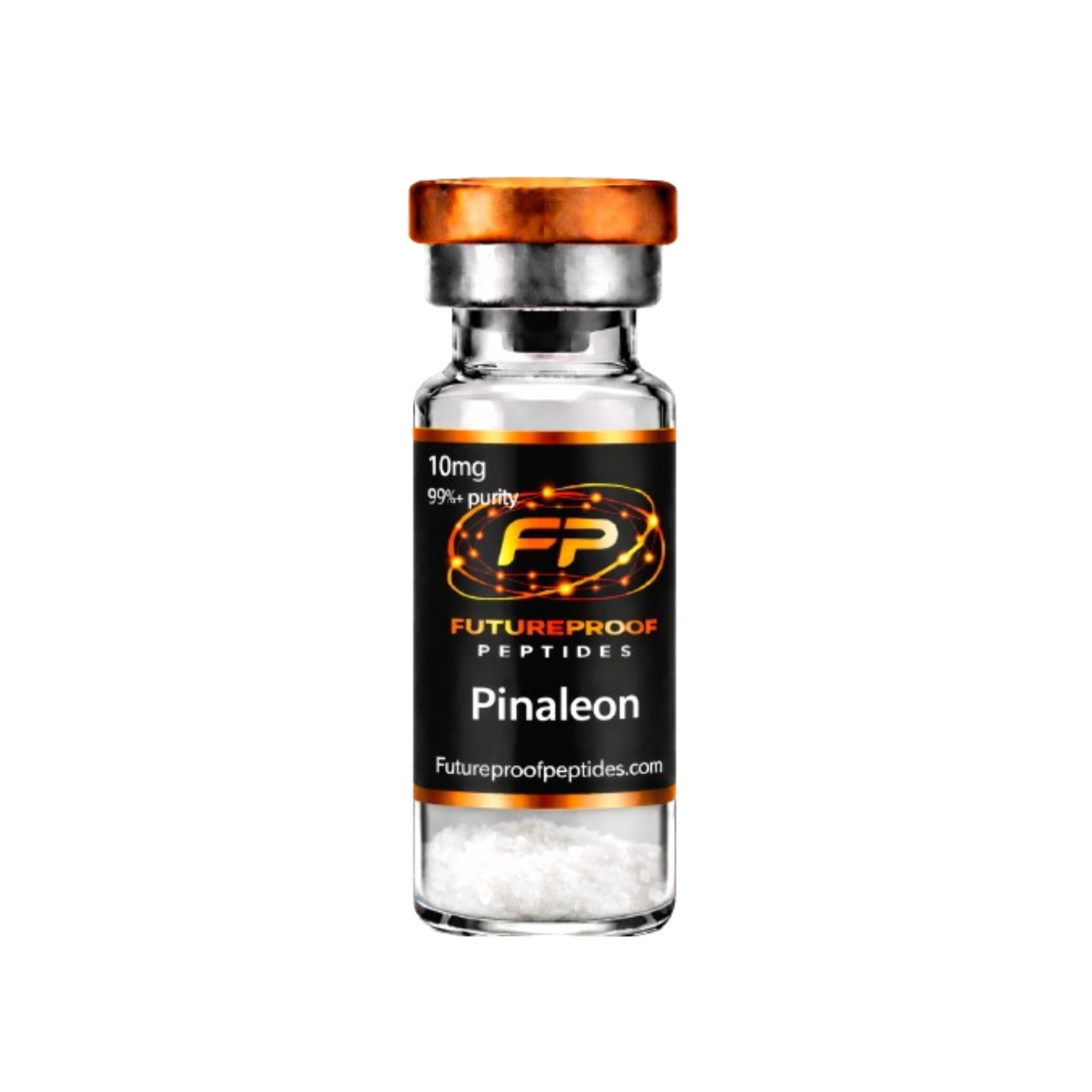
Pinealon 10mg Research Peptide
Our Pinealon 10mg vial contains a synthetic tripeptide composed of three amino acids: glutamic acid, aspartic acid, and arginine. The sequence is commonly represented as Glu-Asp-Arg or EDR.
Pinealon 10mg is primarily discussed within research involving peptide bioregulators, neurological signalling, cellular communication, gene-expression pathways, and age-related cellular processes.
The compact structure of Pinealon 10mg makes it an interesting research subject for investigators studying how short peptide sequences may interact with cellular systems.
Research involving Pinealon has explored biological processes associated with nervous-system function, cellular stress responses, gene regulation, and age-related changes.
The scientific interest surrounding Pinealon 10mg comes from its proposed relationship with cellular regulation rather than from one single biological target.
Researchers can therefore investigate Pinealon using different experimental models to examine how cells respond under controlled conditions.
This product is supplied as a lyophilised research peptide for laboratory and analytical applications.
Pinealon 10mg is supplied strictly for research use only and is not intended for human or veterinary use.
What Is Pinealon 10mg?
Pinealon 10mg is a synthetic tripeptide consisting of three amino acids:
- Glutamic acid (Glu)
- Aspartic acid (Asp)
- Arginine (Arg)
Together, these amino acids form the short sequence Glu-Asp-Arg.
Pinealon is associated with the broader field of peptide bioregulator research. Peptide bioregulators are studied because short peptide sequences may participate in biological communication and cellular regulation.
The relatively small size of Pinealon makes it useful for research investigating how short-chain peptides interact with cellular systems.
Rather than functioning like a large structural protein, a small peptide can be investigated in relation to signalling, molecular recognition, and cellular responses.
Research involving Pinealon 10mg therefore focuses on understanding the biological processes associated with this specific peptide sequence.
Pinealon 10mg And Peptide Bioregulator Research
Peptide bioregulator research examines how short peptides may influence cellular activity and biological regulation.
This area of science has attracted interest because peptides can interact with biological systems in highly specific ways.
Researchers investigating Pinealon 10mg may examine cellular responses associated with:
- Gene expression
- Cellular communication
- Neuronal signalling
- Oxidative stress
- Cellular resilience
- Age-related molecular changes
- Nervous-system biology
The term “bioregulator” should not be interpreted as evidence of an established therapeutic effect.
It describes a research area concerned with biological regulation and cellular signalling.
The scientific objective is to identify measurable mechanisms and determine whether observed effects are reproducible.
Why Is Pinealon 10mg Researched?
The main scientific interest in Pinealon 10mg concerns its potential relationship with neurological and cellular regulatory pathways.
Researchers have investigated whether short peptides can influence cellular responses associated with ageing and environmental stress.
Pinealon has consequently been studied in experimental models involving:
- Neuronal function
- Cognitive processes
- Cellular stress
- Gene expression
- Oxidative balance
- Age-related changes
- Biological timing systems
These research areas overlap with several disciplines, including molecular biology, neuroscience, biochemistry, and ageing research.
One important feature of Pinealon research is that investigators may examine multiple biological markers rather than focusing exclusively on one outcome.
This approach can help scientists understand how different cellular systems interact.
Pinealon 10mg And Neurological Research
The nervous system contains highly specialised cells that require complex communication mechanisms to maintain normal activity.
Neurons communicate through electrical signals, neurotransmitters, receptors, intracellular pathways, and gene-expression processes.
Research involving Pinealon 10mg has therefore attracted attention within neurological and cellular research.
Experimental studies can investigate how peptide-related signalling influences cellular responses under controlled conditions.
Researchers may examine:
- Neuronal signalling
- Cellular communication
- Gene expression
- Cellular stress responses
- Neuronal survival pathways
- Age-related neurological changes
The purpose of this research is to understand molecular mechanisms.
It does not establish that Pinealon is a treatment for neurological or cognitive disorders.
Pinealon 10mg And Gene Expression Research
Gene expression is another important area associated with Pinealon research.
Gene expression refers to the process through which information encoded in DNA is used to produce functional RNA and proteins.
Cells constantly adjust gene expression in response to their environment.
Changes in nutrient availability, oxidative stress, signalling molecules, cellular damage, and developmental processes can all influence gene-expression patterns.
Researchers have investigated whether peptide bioregulators such as Pinealon 10mg are associated with changes in the expression of selected genes.
These experiments can involve comparing gene-expression profiles under different conditions.
The objective is to determine whether specific cellular pathways show measurable changes following experimental exposure.
Importantly, changes in gene expression do not mean that the DNA sequence itself has been altered.
Gene regulation and genetic modification are fundamentally different processes.
Pinealon 10mg And Cellular Communication
Cells communicate through highly interconnected signalling networks.
These networks allow cells to respond to environmental conditions and coordinate biological processes.
Small peptides can be investigated as potential signalling molecules or signalling modifiers.
Research involving Pinealon 10mg can therefore explore how cells respond when exposed to the peptide under controlled conditions.
Potential areas of observation include:
- Cellular signalling pathways
- Protein expression
- Gene activity
- Cellular stress responses
- Molecular communication
- Changes in cellular behaviour
Such research can help investigators determine whether specific molecular pathways respond consistently to Pinealon.
Pinealon 10mg And Oxidative Stress Research
Oxidative stress is another area of scientific interest.
Cells naturally generate reactive oxygen species as part of normal metabolism.
At controlled levels, these molecules can participate in signalling.
Excessive oxidative stress, however, can place additional demands on cellular defence mechanisms.
Researchers therefore investigate how cells respond to oxidative conditions.
Pinealon 10mg has attracted interest in experimental models examining cellular responses to oxidative stress and age-associated molecular changes.
Laboratory studies may measure markers associated with oxidative balance, cellular damage, and protective pathways.
These experiments can help researchers understand whether particular peptide-related signalling mechanisms are associated with measurable cellular responses.
Pinealon 10mg And Cellular Ageing Research
Cellular ageing involves numerous biological processes.
These include changes in gene expression, mitochondrial activity, protein homeostasis, oxidative balance, DNA maintenance, and cellular signalling.
Because Pinealon has been studied within the peptide bioregulator field, researchers have investigated whether it interacts with pathways associated with age-related cellular changes.
Pinealon 10mg may therefore be relevant to experimental studies examining:
- Cellular ageing
- Gene regulation
- Oxidative stress
- Neuronal ageing
- Cellular maintenance
- Stress-response pathways
These areas remain subjects of scientific investigation.
Pinealon should not be described as a proven anti-ageing treatment.
Laboratory observations are not equivalent to demonstrated clinical benefits.
Pinealon 10mg And Cognitive Research
Cognitive biology involves numerous interconnected systems.
Memory, learning, attention, information processing, and other cognitive functions depend on complex networks of neurons and supporting cells.
Experimental research has investigated peptide bioregulators in relation to cognitive and neurological models.
Pinealon 10mg has consequently attracted interest in research involving learning and memory-related pathways.
Animal and cellular models can provide researchers with controlled environments for examining biological changes associated with cognitive processes.
However, observations from experimental models cannot automatically establish cognitive effects in humans.
Human research requires separate evaluation using appropriately designed studies.
Pinealon 10mg And Memory Research
Memory formation and retention involve changes in neuronal communication and gene expression.
Researchers investigating memory biology may examine:
- Synaptic signalling
- Neuronal activity
- Gene expression
- Protein synthesis
- Cellular stress
- Neuroplasticity
Pinealon research has included experimental investigations related to these broader neurological processes.
The purpose of such work is to determine how peptide signalling may interact with biological mechanisms associated with learning and memory.
Results should remain specific to the experimental model.
A result observed in an animal study should not automatically be interpreted as evidence of the same outcome in humans.
Pinealon 10mg And The Pineal Gland
The name Pinealon is associated with research involving peptide fractions connected historically with the pineal gland and related peptide bioregulator research.
The pineal gland is an endocrine structure involved in biological timing and melatonin production.
Because biological timing is connected with neurological and endocrine signalling, researchers have investigated relationships between peptide signalling and circadian biology.
This provides another area where Pinealon 10mg may be studied within broader neuroendocrine research.
The connection should not be interpreted as evidence that Pinealon is itself a replacement for naturally occurring pineal hormones.
Research involving the pineal gland is broader than research involving Pinealon alone.
Pinealon 10mg And Circadian Rhythm Research
Circadian rhythms are approximately 24-hour biological cycles that influence many physiological processes.
These rhythms are regulated by complex networks involving the brain, endocrine signals, environmental cues, and molecular clock mechanisms.
Researchers investigate circadian biology to understand how cells and tissues coordinate activity over time.
Pinealon has been discussed in connection with research involving the pineal system and biological timing.
Studies may therefore explore whether peptide signalling interacts with pathways associated with circadian regulation.
Relevant research areas include:
- Biological timing
- Circadian signalling
- Pineal biology
- Neuroendocrine communication
- Cellular rhythms
These remain areas of scientific investigation.
Pinealon 10mg And Cellular Resilience
Cells encounter numerous environmental and metabolic challenges.
Examples include oxidative conditions, nutrient changes, metabolic stress, and changes in cellular signalling.
Cellular resilience refers broadly to the ability of cells to maintain function while responding to changing conditions.
Research involving Pinealon 10mg can examine whether peptide-related signalling is associated with measurable changes in cellular responses to stress.
Researchers may analyse molecular markers before and after controlled experimental conditions.
This can help identify pathways that may warrant further study.
Pinealon 10mg In Experimental Models
Different research models provide different types of information.
Cell-based studies allow researchers to investigate molecular pathways in controlled environments.
Animal studies can provide additional information about interactions between multiple biological systems.
Biochemical assays can isolate specific molecular interactions.
Researchers studying Pinealon 10mg may use one or more of these approaches depending on the scientific question.
The results from different models should not be treated as interchangeable.
A cellular response does not automatically predict a whole-organism response.
Likewise, animal research does not establish human clinical efficacy or safety.
Pinealon 10mg And Molecular Biology
Molecular biology provides several techniques for studying peptide-related cellular effects.
Researchers may examine:
- RNA expression
- Protein expression
- Enzyme activity
- Cellular signalling
- Oxidative markers
- Molecular stress responses
These measurements can help identify whether a peptide is associated with specific biological changes.
For Pinealon 10mg, molecular studies can be useful for determining whether observed effects are connected with particular signalling networks.
This type of evidence can contribute to understanding the biological mechanism of the peptide.
Pinealon 10mg And Age-Related Research
Age-related biological changes are complex and involve many interconnected mechanisms.
Researchers study ageing at several levels, including:
- Molecular ageing
- Cellular ageing
- Tissue changes
- Mitochondrial function
- Gene regulation
- Protein homeostasis
- Oxidative stress
Pinealon research fits into this broader field because of its association with cellular regulation and neurological research.
However, ageing research should not be reduced to a single peptide or pathway.
The biological ageing process involves numerous systems operating simultaneously.
Research Into Neuronal Stress
Neurons are particularly sensitive to changes in their metabolic environment.
They require substantial energy and rely heavily on coordinated cellular signalling.
Researchers studying neuronal stress may investigate how neurons respond to oxidative conditions, metabolic changes, or other experimental challenges.
Pinealon 10mg can be investigated within such research frameworks when the objective is to understand peptide-related cellular responses.
Measurements can include changes in molecular markers, cellular activity, or gene-expression patterns.
Pinealon 10mg And Protein Regulation
Proteins perform most of the functional work inside cells.
Their production is controlled partly through gene expression and RNA processing.
Researchers interested in peptide bioregulators may therefore examine whether experimental exposure is associated with changes in selected protein pathways.
This type of research can provide information about downstream effects of cellular signalling.
It can also help distinguish direct peptide interactions from secondary cellular responses.
Pinealon 10mg And Research Reproducibility
Reproducibility is essential when working with experimental peptides.
A reliable experiment should maintain consistent conditions wherever possible.
Factors that can influence results include:
- Peptide identity
- Purity
- Batch variation
- Storage conditions
- Experimental model
- Sample preparation
- Exposure conditions
- Analytical method
- Study duration
Researchers should document these variables carefully.
Using a defined Pinealon 10mg format can support consistent laboratory workflows when researchers require a measured quantity for comparative or repeated studies.
Pinealon 10mg Product Format
Our Pinealon 10mg vial is supplied as a lyophilised peptide powder.
Lyophilisation, or freeze-drying, is commonly used for peptide research materials because removing water can help maintain stability during appropriate storage.
The dry format also provides flexibility for laboratory preparation according to validated institutional protocols.
Researchers should follow the product documentation and their own approved laboratory procedures when handling the material.
No human-use administration protocol is provided.
Storage And Handling
Proper storage is important for maintaining peptide integrity.
Researchers should follow the storage specifications supplied with the product and applicable batch documentation.
General laboratory considerations include:
- Protecting the material from excessive heat
- Limiting unnecessary exposure to moisture
- Protecting the vial from unsuitable environmental conditions
- Avoiding unnecessary temperature fluctuations
- Minimising repeated freeze-thaw cycles where applicable
- Maintaining appropriate laboratory records
Stability can vary depending on formulation, temperature, container conditions, and preparation method.
Researchers should therefore rely on validated laboratory procedures rather than assuming identical stability across every formulation.
Quality Control For Pinealon 10mg
Quality control is an important consideration when conducting research involving peptides.
Researchers may evaluate:
- Peptide identity
- Purity
- Batch information
- Physical characteristics
- Analytical data
- Storage conditions
Analytical testing can help confirm that the research material corresponds to the intended compound.
Maintaining batch information is also important for reproducibility.
If experiments are repeated at a later date, researchers can compare results against the original batch and experimental conditions.
Limitations Of Pinealon Research
Although Pinealon has attracted scientific interest, important limitations remain.
Much of the available research involving peptide bioregulators is preclinical.
Cell-based and animal research can provide useful information about molecular mechanisms, but such findings do not automatically establish human safety or effectiveness.
Research involving cognitive, neurological, ageing, or cellular outcomes should therefore be interpreted carefully.
The existence of experimental evidence does not mean that a product is an approved medicine or therapeutic intervention.
Human Evidence And Pinealon 10mg
Human evidence should be considered separately from laboratory research.
Results obtained from cell cultures or animal models cannot automatically be extrapolated to people.
A compound may produce a measurable response in an experimental model without producing the same response in humans.
Therefore, Pinealon 10mg should be viewed as a research material rather than a product with established human medical applications.
Appropriately designed human studies would be required to establish clinical safety, efficacy, pharmacology, and appropriate use.
Frequently Asked Questions
What is Pinealon 10mg?
Pinealon 10mg is a research peptide containing the synthetic tripeptide Glu-Asp-Arg. It is studied within peptide bioregulator, neurological, cellular signalling, and ageing research.
What does Pinealon consist of?
Pinealon consists of three amino acids: glutamic acid, aspartic acid, and arginine.
Is Pinealon a peptide?
Yes. Pinealon is a short synthetic tripeptide.
Why is Pinealon 10mg researched?
Pinealon 10mg is researched in relation to cellular communication, gene expression, neurological signalling, oxidative stress, cognitive research, and age-related cellular processes.
Is Pinealon associated with the pineal gland?
Pinealon has historical associations with peptide bioregulator research involving the pineal system. The pineal gland itself is involved in biological timing and melatonin-related physiology.
Is Pinealon studied for cognitive research?
Yes. Experimental research has investigated peptide bioregulators in relation to learning, memory, and neurological pathways. These findings should not be interpreted as established cognitive benefits in humans.
Is Pinealon an anti-ageing treatment?
No established anti-ageing treatment claim should be made based on laboratory research. Pinealon is studied in relation to cellular and age-related biological processes.
What is the format of Pinealon 10mg?
Pinealon 10mg is supplied as a lyophilised peptide powder in a 10mg vial.
How should Pinealon 10mg be stored?
The product should be stored according to the applicable product specifications and laboratory procedures. Researchers should protect the material from unsuitable temperature, moisture, and environmental exposure.
Is Pinealon 10mg intended for human use?
No. Pinealon 10mg is supplied strictly for laboratory research and analytical applications and is not intended for human or veterinary use.
Can Pinealon research results be applied directly to humans?
No. Results from cell-based and animal studies cannot automatically be translated into human outcomes.
Pinealon 10mg Research Summary
Pinealon 10mg is a synthetic tripeptide consisting of glutamic acid, aspartic acid, and arginine.
Its short structure makes it an interesting subject for research involving peptide bioregulators and cellular communication.
Scientific interest in Pinealon 10mg includes neurological signalling, gene expression, cellular stress, cognitive research, circadian biology, and age-related molecular processes.
Researchers can investigate these pathways using controlled cellular, biochemical, and experimental models.
The connection between Pinealon and neurological research is particularly relevant because cellular communication within the nervous system involves complex interactions between signalling molecules, receptors, genes, proteins, and metabolic pathways.
Research into Pinealon 10mg may help scientists investigate selected parts of these systems.
However, experimental evidence should always be interpreted according to the study design.
Laboratory observations do not automatically establish clinical efficacy or safety.
Our Pinealon 10mg vial is supplied as a lyophilised research peptide for laboratory and analytical applications.
Researchers should follow appropriate storage, handling, documentation, and analytical procedures when working with the material.
Research Use Only Disclaimer
Pinealon 10mg is supplied strictly for laboratory research and analytical use only. It is not intended for human consumption, self-administration, diagnosis, treatment, prevention, or veterinary use.
The information provided is intended for educational and scientific research purposes and should not be interpreted as medical advice or evidence of a therapeutic indication.
Researchers are responsible for following applicable institutional, laboratory, regulatory, and safety requirements when handling experimental research materials.


