
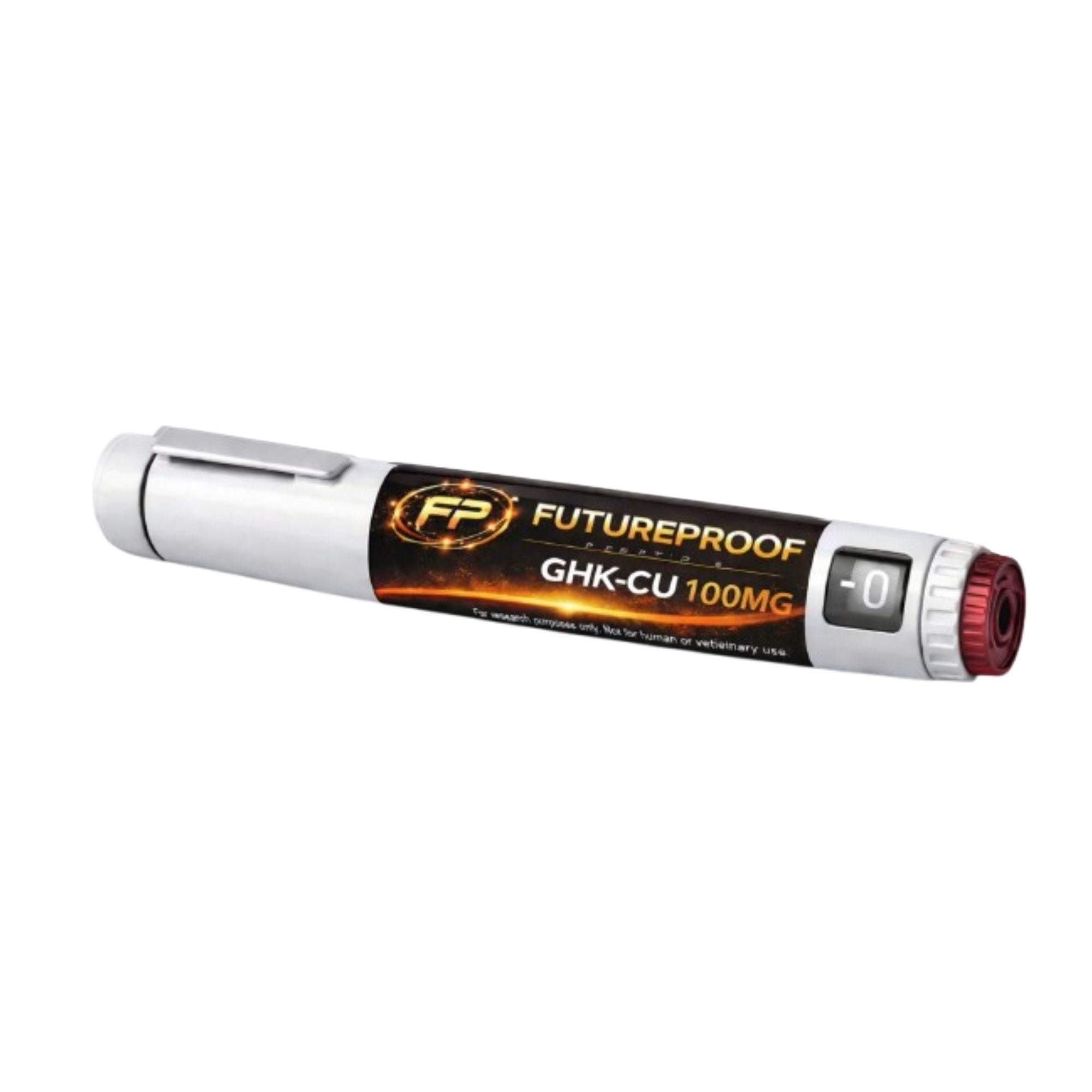
GHK-Cu 100mg Pen – Advanced Copper Peptide Research
The GHK-Cu 100mg Pen contains GHK-Cu, a copper-binding peptide complex that has been extensively investigated in cellular, connective-tissue, skin and extracellular matrix research.
GHK refers to glycyl-L-histidyl-L-lysine, a naturally occurring tripeptide identified in human biological fluids. When GHK binds copper ions, it forms the GHK-Cu complex, creating a research subject with connections to copper biology, cellular signalling and tissue-remodelling pathways.
Research involving GHK-Cu has examined processes including collagen synthesis, extracellular matrix organization, fibroblast activity, metalloproteinase regulation, angiogenesis and cellular responses associated with tissue remodelling.
The GHK-Cu 100mg Pen is supplied for laboratory research and analytical applications only. It is not intended for human consumption, veterinary use, diagnosis, treatment or therapeutic application.
What Is GHK-Cu?
GHK-Cu is a complex formed from the naturally occurring tripeptide GHK and copper.
The GHK sequence consists of three amino acids:
- Glycine
- Histidine
- Lysine
GHK has a strong affinity for copper ions and can form a copper-containing complex known as GHK-Cu. Scientific research has investigated the resulting complex in relation to cellular signalling and extracellular matrix biology.
This makes GHK-Cu different from a conventional peptide that functions primarily through a single receptor. Its research profile involves both peptide biology and copper-dependent biochemical processes.
Why Is GHK-Cu Researched?
Interest in the GHK-Cu 100mg Pen comes from the broad range of biological processes investigated with GHK-Cu.
Research has examined relationships involving:
- Extracellular matrix organization
- Collagen synthesis
- Fibroblast activity
- Elastin-related pathways
- Metalloproteinases
- Tissue remodelling
- Cellular migration
- Angiogenesis
- Oxidative stress
- Inflammatory signalling
- Skin biology
- Hair follicle biology
This broad research profile has made GHK-Cu an important subject in peptide and cellular biology research.
GHK-Cu and Extracellular Matrix Research
The extracellular matrix is a complex network surrounding cells that provides structural support and participates in cellular communication.
Collagen, elastin, glycosaminoglycans and proteoglycans are among the important components investigated within extracellular matrix research.
Studies have examined how GHK-Cu affects fibroblast activity and extracellular matrix production. Experimental work has reported changes in collagen synthesis and other matrix-associated components following exposure to GHK-Cu.
This makes the GHK-Cu 100mg Pen relevant to laboratories studying how copper-binding peptides interact with connective-tissue biology.
Collagen Research
Collagen is one of the most abundant structural proteins in the body and plays an important role in connective-tissue structure.
Early laboratory studies investigated GHK-Cu in cultured fibroblasts and reported stimulation of collagen synthesis.
Additional experimental work in animal wound models examined extracellular matrix accumulation and reported increases in collagen, glycosaminoglycans and related matrix components.
These findings provide a foundation for continued investigation into GHK-Cu and collagen-associated pathways.
However, laboratory findings should not be interpreted as evidence that every GHK-Cu formulation produces the same effects in humans.
Fibroblast Research
Fibroblasts are connective-tissue cells responsible for producing and organizing important extracellular matrix components.
Because of their central role in matrix biology, fibroblasts are frequently used in experimental studies involving GHK-Cu.
Research has investigated how GHK-Cu influences fibroblast activity, collagen production and matrix-remodelling mechanisms.
Some studies have also examined changes in metalloproteinases and their inhibitors, providing additional insight into how GHK-Cu may influence extracellular matrix turnover.
GHK-Cu and Tissue Remodelling
Tissue remodelling involves the continual restructuring of extracellular matrix components and cellular organization.
Research into GHK-Cu has investigated several components of this process, including:
- Collagen turnover
- Elastin-related pathways
- Glycosaminoglycans
- Fibroblast behaviour
- Metalloproteinase activity
- Cellular migration
- Vascular responses
A review of GHK research describes the peptide as a regulator of multiple pathways associated with tissue remodelling.
This makes tissue remodelling one of the central areas of interest surrounding GHK-Cu.
GHK-Cu and Copper Biology
Copper is an essential trace element involved in numerous biological processes.
Several enzymes involved in connective-tissue structure, antioxidant defence and cellular metabolism depend on copper.
GHK’s ability to bind copper provides researchers with an opportunity to investigate the interaction between peptide signalling and copper-dependent biological systems.
The resulting GHK-Cu complex is therefore studied not simply as a peptide, but as a peptide-metal complex with distinct biochemical characteristics.
Hair Follicle Research
GHK-Cu has also attracted interest in hair and follicle biology.
Research has examined whether copper-peptide-related signalling may influence the cellular environment surrounding hair follicles.
Investigators have studied areas such as:
- Dermal papilla cell biology
- Fibroblast activity
- Extracellular matrix signalling
- Vascular signalling
- Follicular tissue structure
- Cellular proliferation
However, hair-related research should be interpreted carefully because different copper-peptide compounds and experimental models are not necessarily interchangeable.
Some studies involving copper-peptide complexes have investigated human hair follicles or follicular cells in vitro and ex vivo, providing experimental evidence for continued research in this area.
GHK-Cu and Cellular Signalling
Modern peptide research increasingly examines networks of cellular signals rather than isolated biological targets.
GHK-Cu has been investigated in connection with several pathways involving extracellular matrix regulation, inflammatory signalling, oxidative processes and cellular responses.
Gene-expression research has also explored the broad effects of GHK-related signalling on different cellular systems.
These findings help explain why GHK-Cu appears in research involving multiple areas of cellular biology.
Angiogenesis Research
Angiogenesis is the formation of new blood vessels from existing vascular structures.
Researchers have investigated GHK and copper-containing peptide systems in experimental angiogenesis models.
Studies using engineered extracellular matrix systems have examined GHK-containing compositions and copper ions in relation to endothelial-cell responses and angiogenic activity.
Other research has examined relationships between GHK-Cu, fibroblasts and vascular signalling molecules.
These findings make angiogenesis another relevant area for laboratory investigation.
GHK-Cu and Oxidative Stress Research
Oxidative stress occurs when reactive molecules overwhelm or disrupt cellular antioxidant systems.
GHK and GHK-Cu have been investigated in experimental models involving oxidative and inflammatory pathways.
Reviews have proposed that GHK-Cu may influence several signalling systems associated with oxidative stress and cellular protection.
Further research is required to establish how these mechanisms translate between experimental models and human biology.
GHK-Cu and Inflammatory Signalling
Inflammatory signalling is closely connected to tissue remodelling.
Research has examined GHK-related effects on inflammatory mediators and pathways associated with tissue responses.
More recent reviews have continued to investigate the relationship between GHK-Cu and inflammatory signalling, while noting that the clinical evidence base remains relatively limited compared with the extensive preclinical literature.
This makes inflammatory signalling a useful area for controlled experimental investigation.
GHK-Cu and Skin Biology
Skin biology represents one of the most widely discussed research areas surrounding GHK-Cu.
Researchers have examined:
- Fibroblast activity
- Collagen production
- Extracellular matrix organization
- Skin-cell proliferation
- Tissue remodelling
- Oxidative responses
- Cellular signalling
A 2025 review noted that although GHK-Cu has been widely investigated in cosmetic and skin-related contexts, important questions remain regarding formulation, permeability and the strength of clinical evidence.
Consequently, research findings should be distinguished from established therapeutic or cosmetic claims.
What Does Current Research Show?
The scientific literature surrounding GHK-Cu contains both longstanding laboratory research and newer translational investigations.
Early studies established relationships between GHK-Cu and collagen synthesis, extracellular matrix accumulation and fibroblast activity.
More recent research continues to examine GHK-Cu in areas such as skin biology, angiogenesis, cellular signalling and tissue remodelling.
A 2026 systematic review identified 20 studies involving GHK-Cu in aesthetic applications, including 18 preclinical studies and 2 randomized controlled trials. The review reported encouraging findings but also emphasized methodological variation and the limited number of well-designed clinical studies.
This distinction is important when evaluating the scientific significance of GHK-Cu.
GHK-Cu 100mg Pen Research Format
The GHK-Cu 100mg Pen provides a pre-filled presentation of the research material.
A pen format may be useful for laboratories that have established workflows compatible with pre-filled research presentations and want to reduce certain preparation steps associated with conventional vial formats.
The specific handling procedure should always follow the product documentation and the laboratory’s validated procedures.
The pen presentation does not change the underlying scientific identity of GHK-Cu.
Research Quality and Analytical Considerations
Reliable laboratory research depends on appropriately characterized materials.
Important considerations for GHK-Cu research materials include:
- Identity
- Purity
- Copper-peptide composition
- Batch consistency
- Analytical documentation
- Packaging integrity
- Storage conditions
- Traceability
Researchers should review available batch-specific analytical documentation when evaluating a material for experimental use.
Purity alone does not establish biological activity, clinical effectiveness or suitability for every experimental model.
Storage and Laboratory Handling
The GHK-Cu 100mg Pen should be stored according to the specific product specification supplied with the relevant batch.
Laboratories should:
- Follow the manufacturer’s storage instructions.
- Protect the material from unsuitable environmental conditions.
- Maintain appropriate batch identification.
- Avoid unnecessary environmental exposure.
- Follow institutional laboratory procedures.
- Use validated handling practices appropriate for the experimental system.
Exact temperature and stability requirements should be determined from the product’s documentation rather than assumed from general peptide-storage recommendations.

Research Applications
The GHK-Cu 100mg Pen may be relevant to laboratory research involving:
Extracellular Matrix Biology
Investigating collagen, elastin, glycosaminoglycan and proteoglycan-related pathways.
Fibroblast Research
Studying fibroblast activity and extracellular matrix production.
Copper Biology
Examining interactions between copper ions, peptides and copper-dependent cellular processes.
Tissue Remodelling
Investigating how cells modify and reorganize extracellular matrix components.
Skin Biology
Studying cellular and molecular pathways associated with skin structure and remodelling.
Hair Follicle Research
Investigating follicular cells and the surrounding extracellular environment.
Angiogenesis
Examining endothelial responses and vascular signalling under controlled experimental conditions.
Cellular Signalling
Studying broader molecular responses associated with GHK-Cu exposure.
Frequently Asked Questions
What is GHK-Cu?
GHK-Cu is a copper-containing complex formed when the tripeptide glycyl-L-histidyl-L-lysine binds copper ions.
What is the GHK-Cu 100mg Pen researched for?
The GHK-Cu 100mg Pen may be used as research material for investigating extracellular matrix biology, collagen-related pathways, fibroblast activity, tissue remodelling, cellular signalling and hair follicle biology.
Is GHK-Cu naturally occurring?
GHK is a naturally occurring tripeptide that has been detected in human biological fluids. GHK can bind copper to form the GHK-Cu complex.
Is GHK-Cu a copper peptide?
Yes. GHK-Cu is commonly described as a copper-binding peptide complex.
Has GHK-Cu been studied in hair research?
Yes. Copper-peptide research has investigated hair follicles, dermal papilla cells and related cellular processes in laboratory and ex vivo models.
Has GHK-Cu been studied for collagen?
Yes. Experimental studies have investigated GHK-Cu in relation to collagen synthesis and extracellular matrix accumulation.
Is GHK-Cu clinically proven?
The evidence is not sufficient to describe every proposed application as clinically established. The research literature contains extensive preclinical work, while recent reviews note that well-designed clinical studies remain limited.
Is the GHK-Cu 100mg Pen intended for human use?
No. This product is supplied strictly for laboratory research and analytical purposes and is not intended for human or veterinary use.
Important Research Disclaimer
The GHK-Cu 100mg Pen is supplied strictly for laboratory research and analytical testing.
The information provided on this page summarizes areas investigated in scientific literature and is intended for educational and research-information purposes only.
This product is not intended for human consumption, veterinary use, diagnosis, treatment, prevention or cure of any disease or medical condition.
Experimental findings from cellular, animal, ex vivo or limited clinical studies should not automatically be interpreted as evidence of therapeutic effectiveness for a particular formulation.
Researchers are responsible for determining whether the material is suitable for their experimental model and for complying with applicable laws, regulations and institutional laboratory requirements.
Final Overview
The GHK-Cu 100mg Pen provides a convenient research presentation of GHK-Cu, a copper-binding peptide complex with a substantial scientific literature covering extracellular matrix biology, fibroblast activity, collagen-related processes, tissue remodelling and cellular signalling.
GHK-Cu research is particularly interesting because it combines peptide biology with copper-dependent biochemical processes. Experimental studies have investigated its effects on collagen synthesis, matrix organization, metalloproteinase activity and other cellular mechanisms.
Research has also expanded into angiogenesis, skin biology and hair follicle models, although the strength of evidence varies substantially between applications.
For qualified laboratories investigating copper-peptide biology, extracellular matrix pathways and cellular remodelling, the GHK-Cu 100mg Pen provides a research-focused format for controlled scientific investigation.
GHK-Cu 100mg Pen GHK-Cu 100mg Pen GHK-Cu 100mg Pen GHK-Cu 100mg Pen GHK-Cu 100mg Pen GHK-Cu 100mg Pen GHK-Cu 100mg Pen GHK-Cu 100mg Pen GHK-Cu 100mg Pen GHK-Cu 100mg Pen GHK-Cu 100mg Pen GHK-Cu 100mg Pen GHK-Cu 100mg Pen GHK-Cu 100mg Pen GHK-Cu 100mg Pen GHK-Cu 100mg Pen GHK-Cu 100mg Pen GHK-Cu 100mg Pen GHK-Cu 100mg Pen GHK-Cu 100mg Pen


