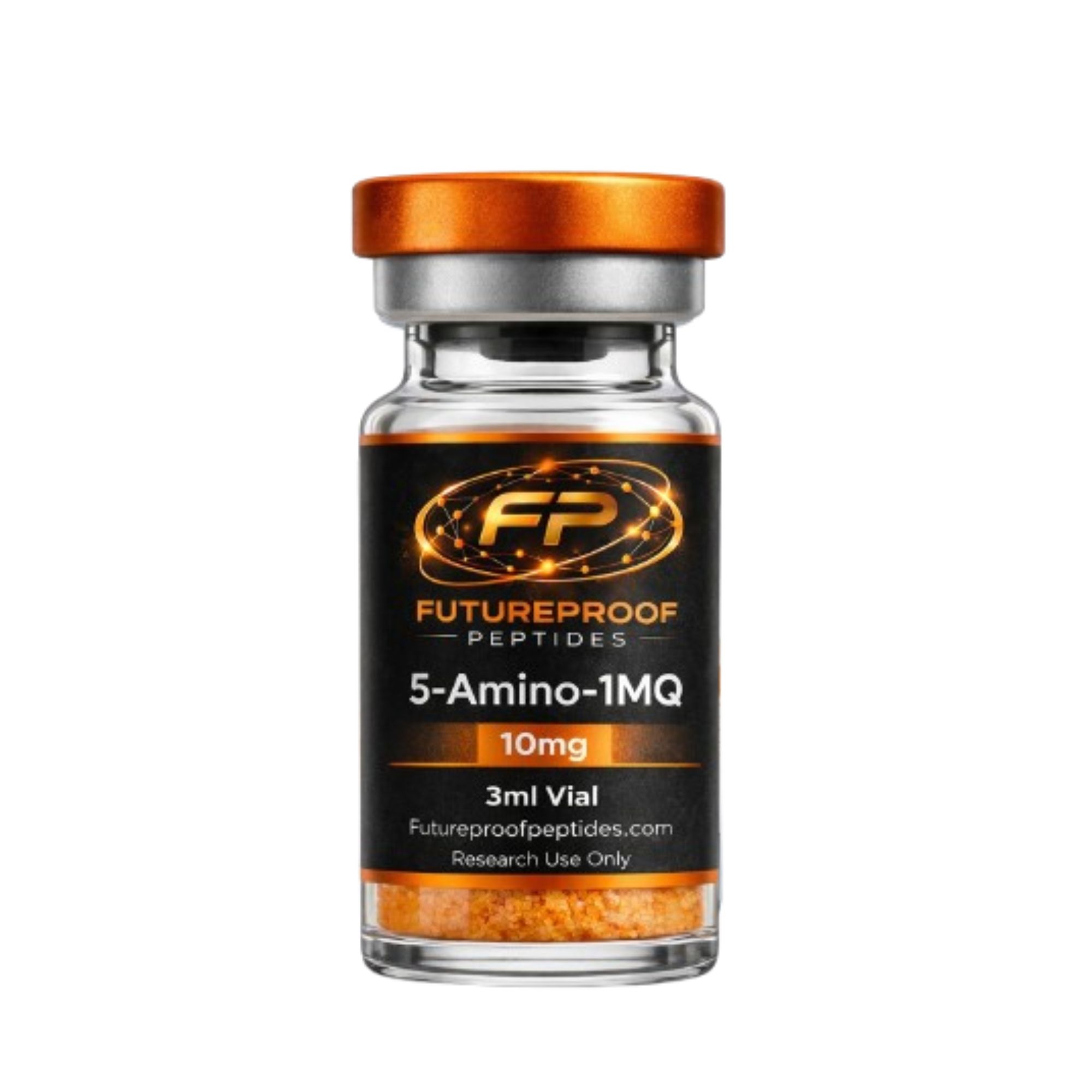
5-Amino-1MQ 10mg Vial
Our 5-Amino-1MQ 10mg Vial contains 5-Amino-1MQ, an experimental small-molecule compound investigated in laboratory research involving nicotinamide metabolism, NNMT activity, NAD+ pathways, and cellular energy regulation.
Although 5-Amino-1MQ is frequently discussed alongside research peptides, it is important to clarify that it is not a peptide. It is a chemically defined small molecule that has attracted scientific interest because of its interaction with the enzyme nicotinamide N-methyltransferase, commonly abbreviated as NNMT.
The 5-Amino-1MQ 10mg Vial is supplied for controlled laboratory and analytical research. It is not intended for human or veterinary use and should only be handled by appropriately qualified personnel following suitable laboratory procedures.
What Is 5-Amino-1MQ?
5-Amino-1MQ is a synthetic small molecule that has been investigated primarily as an NNMT inhibitor.
NNMT stands for nicotinamide N-methyltransferase. This enzyme participates in the metabolism of nicotinamide by transferring a methyl group from S-adenosylmethionine to nicotinamide.
This reaction produces a methylated form of nicotinamide known as 1-methylnicotinamide.
The pathway is scientifically interesting because nicotinamide is also involved in the cellular salvage pathway responsible for maintaining NAD+ availability.
Because of this relationship, researchers use 5-Amino-1MQ to investigate how changes in NNMT activity may affect interconnected metabolic pathways.
Is 5-Amino-1MQ A Peptide?
No.
The 5-Amino-1MQ 10mg Vial contains a small-molecule research compound rather than a peptide.
This distinction matters because small molecules and peptides have different chemical characteristics, analytical requirements, stability considerations, and laboratory handling procedures.
5-Amino-1MQ is therefore better categorized as an experimental metabolic research compound.
Its presence on peptide research websites reflects the broader category of experimental compounds being investigated in cellular and metabolic science.
What Is NNMT?
NNMT, or nicotinamide N-methyltransferase, is an enzyme involved in nicotinamide metabolism.
The enzyme uses S-adenosylmethionine as a methyl donor and converts nicotinamide into 1-methylnicotinamide.
Researchers are interested in this reaction because nicotinamide is also a precursor involved in the NAD+ salvage pathway.
NAD+ is an important cellular cofactor involved in numerous biological processes.
These include:
- Cellular energy metabolism
- Redox reactions
- Mitochondrial activity
- Enzyme function
- Cellular signalling
- Metabolic regulation
The relationship between NNMT and NAD+ metabolism is therefore one of the primary reasons 5-Amino-1MQ has become an interesting compound for laboratory investigation.
How Does 5-Amino-1MQ Work In Research?
The primary research interest surrounding 5-Amino-1MQ involves its ability to inhibit NNMT activity.
By reducing NNMT activity in an experimental model, researchers can investigate what happens to nicotinamide metabolism and related cellular pathways.
This provides an experimental method for examining the role of NNMT without directly supplying additional NAD+.
In simple terms, researchers can use 5-Amino-1MQ to investigate how changing one enzyme pathway affects a wider metabolic network.
Areas of interest include:
- NNMT enzyme activity
- Nicotinamide metabolism
- NAD+ availability
- Cellular energy pathways
- Adipose tissue metabolism
- Methylation pathways
- Metabolic signalling
These applications remain areas of scientific research rather than established therapeutic uses.
5-Amino-1MQ And NAD+ Research
One of the most interesting areas surrounding 5-Amino-1MQ research involves the relationship between NNMT and NAD+.
NAD+, or nicotinamide adenine dinucleotide, is an essential coenzyme found throughout biological systems.
It participates in electron-transfer reactions that are important for cellular metabolism.
Cells maintain NAD+ through several interconnected pathways.
One of these pathways involves recycling nicotinamide back toward NAD+ production.
Because NNMT consumes nicotinamide, scientists have investigated whether inhibiting NNMT can alter the availability of nicotinamide for other metabolic processes.
This creates an important research connection between NNMT activity and NAD+ metabolism.
5-Amino-1MQ And Nicotinamide Metabolism
Nicotinamide is a form of vitamin B3 and an important precursor within NAD+ metabolism.
Cells must carefully regulate nicotinamide because it participates in several biochemical pathways.
NNMT represents one route through which nicotinamide is metabolized.
When researchers investigate 5-Amino-1MQ and nicotinamide metabolism, they can examine what happens when this particular route is inhibited.
This approach helps scientists better understand how cells distribute metabolic resources between competing pathways.
The resulting observations may provide additional information about cellular metabolism and NAD+ regulation.
5-Amino-1MQ And Cellular Energy Research
NAD+ plays an important role in cellular energy metabolism.
It participates in oxidation-reduction reactions that help cells convert nutrients into usable energy.
Because NNMT can influence nicotinamide metabolism, researchers are interested in whether changes in NNMT activity affect broader cellular energy pathways.
This is one reason 5-Amino-1MQ 10mg Vial can be relevant to experimental research involving metabolic regulation.
Researchers may examine changes in:
- NAD+ availability
- Cellular metabolic activity
- Mitochondrial processes
- Nutrient utilization
- Energy-related signalling
- Metabolic adaptation
These investigations are generally performed using controlled laboratory or preclinical models.
Results observed in experimental systems should not automatically be interpreted as equivalent effects in humans.
5-Amino-1MQ And Adipose Tissue Research
Another major area of interest involves adipose tissue.
Adipose tissue is metabolically active and participates in energy storage, signalling, and broader metabolic regulation.
Researchers have investigated NNMT expression and activity within adipose tissue to better understand its potential role in metabolic processes.
Experimental research involving 5-Amino-1MQ has therefore examined changes in adipose tissue characteristics under controlled conditions.
Some preclinical models have reported changes involving fat-cell size, adipose tissue mass, and metabolic pathways following NNMT inhibition.
These findings have contributed to scientific interest in NNMT as a potential metabolic research target.
However, preclinical observations do not establish that 5-Amino-1MQ produces the same outcomes in humans.
Research Into Fat Cell Metabolism
Adipocytes, commonly known as fat cells, are involved in more than energy storage.
They participate in lipid metabolism and interact with numerous signalling systems.
Researchers investigating NNMT inhibition have examined how changes in this enzyme may affect adipocyte metabolism.
The 5-Amino-1MQ 10mg Vial can therefore be used as an experimental tool for studying relationships between NNMT activity and adipose biology.
Laboratory investigations may examine:
- Adipocyte development
- Lipid storage
- Lipogenesis
- Fat oxidation
- Cellular energy balance
- Metabolic signalling
The objective is to understand the underlying biology rather than establish a clinical outcome.
5-Amino-1MQ And Metabolic Research
Metabolic research involves examining how cells and tissues process nutrients and maintain energy balance.
NNMT is particularly interesting because it connects nicotinamide metabolism with methylation pathways.
This makes 5-Amino-1MQ research relevant to studies investigating multiple aspects of cellular metabolism.
Scientists can examine how an alteration in NNMT activity affects downstream and interconnected pathways.
Such experiments can help researchers identify relationships that may not be visible when individual pathways are studied in isolation.
Why Researchers Study NNMT Inhibition
Enzyme inhibition is an important research strategy.
By selectively reducing the activity of an enzyme, researchers can examine the biological consequences associated with that pathway.
NNMT provides an example of this approach.
The use of 5-Amino-1MQ for NNMT inhibition research allows investigators to explore how nicotinamide methylation influences cellular metabolism.
Researchers can then compare experimental systems with different levels of NNMT activity.
This type of comparison can provide information about the contribution of NNMT to metabolic processes.
Potential Research Applications
The 5-Amino-1MQ 10mg Vial may be relevant to several laboratory research areas.
These include:
- NNMT enzyme inhibition studies
- Nicotinamide metabolism research
- NAD+ pathway investigations
- Cellular energy research
- Adipose tissue studies
- Metabolic signalling research
- Methylation pathway research
- Mitochondrial biology investigations
- Preclinical metabolic models
The exact application depends on the experimental design and the laboratory protocol being followed.
Researchers should establish appropriate compatibility and handling requirements before beginning an experiment.
5-Amino-1MQ And Mitochondrial Research
Mitochondria are cellular structures responsible for many processes associated with energy production.
NAD+ participates in several reactions connected with mitochondrial metabolism.
Because 5-Amino-1MQ may alter pathways associated with nicotinamide availability, researchers have an interest in studying its broader relationship with cellular energy systems.
This does not mean that 5-Amino-1MQ directly acts as a mitochondrial compound.
Instead, its research relevance comes from the interconnected nature of metabolic pathways.
Studying these relationships can help researchers understand how enzyme activity influences wider cellular processes.
Understanding The Research Evidence
Much of the scientific interest surrounding 5-Amino-1MQ comes from laboratory and preclinical research.
Experimental models can provide valuable information about biochemical mechanisms.
However, findings from cells or animals cannot automatically be translated into established human effects.
This distinction is particularly important for experimental compounds that do not have extensive human research data.
The 5-Amino-1MQ 10mg Vial should therefore be considered a research material rather than a proven therapeutic product.
Safety And Research Limitations
5-Amino-1MQ remains an experimental research compound.
Its long-term safety profile in humans has not been established.
Available research has primarily focused on biochemical mechanisms, cellular pathways, and preclinical models.
Because of the limited human evidence, it would be inappropriate to provide definitive claims regarding human safety, effectiveness, or therapeutic benefits.
Researchers should review applicable safety documentation before handling the material.
Appropriate laboratory risk-management procedures should also be followed throughout storage, preparation, and experimentation.
Quality Control
Reliable research requires consistent experimental materials.
The 5-Amino-1MQ 10mg Vial is supplied as a defined small-molecule research format intended for controlled laboratory applications.
Researchers should consider factors such as compound identity, purity, batch information, and analytical documentation when evaluating research materials.
Where available, a Certificate of Analysis can provide useful information about the characteristics of an individual batch.
Maintaining batch records can also improve traceability and experimental reproducibility.
Storage And Handling
The 5-Amino-1MQ 10mg Vial should be stored according to the applicable product documentation and laboratory requirements.
For materials specified for frozen storage, maintaining an appropriate low-temperature environment can help preserve chemical stability.
The product should be protected from excessive heat, moisture, and direct light.
Researchers should also minimize unnecessary temperature fluctuations.
Laboratory personnel should inspect the vial and packaging before use.
Any damaged, compromised, or improperly stored material should be evaluated according to established laboratory quality procedures.
Why The 10mg Format Is Useful
A defined 10mg format can be convenient for research laboratories working with small-molecule compounds.
The 5-Amino-1MQ 10mg Vial provides a clearly specified quantity that can be incorporated into laboratory inventory and experimental planning.
A standardized format can also make material tracking easier.
Researchers can record batch information alongside experimental conditions, analytical results, and other relevant study documentation.
This approach supports better organization across repeated research projects.
Bacteriostatic Water And 5-Amino-1MQ
Unlike many lyophilized peptide products, 5-Amino-1MQ is a small molecule with its own chemical characteristics.
It should not automatically be assumed that bacteriostatic water or another aqueous diluent is appropriate.
Solubility and compatibility depend on the compound’s chemical properties and the requirements of the particular experimental method.
Researchers should therefore follow validated laboratory procedures and applicable technical documentation when preparing 5-Amino-1MQ for research.
This distinction is important when comparing 5-Amino-1MQ with conventional peptide research materials.

5-Amino-1MQ 10mg Vial 5-Amino-1MQ 10mg Vial 5-Amino-1MQ 10mg Vial 5-Amino-1MQ 10mg Vial 5-Amino-1MQ 10mg Vial 5-Amino-1MQ 10mg Vial 5-Amino-1MQ 10mg Vial 5-Amino-1MQ 10mg Vial 5-Amino-1MQ 10mg Vial 5-Amino-1MQ 10mg Vial 5-Amino-1MQ 10mg Vial
Frequently Asked Questions
What Is 5-Amino-1MQ?
5-Amino-1MQ is an experimental small-molecule compound primarily investigated for its ability to inhibit nicotinamide N-methyltransferase, or NNMT.
Is 5-Amino-1MQ A Peptide?
No. 5-Amino-1MQ is a synthetic small molecule rather than a peptide.
What Does NNMT Stand For?
NNMT stands for nicotinamide N-methyltransferase.
It is an enzyme involved in the metabolism of nicotinamide.
Why Is 5-Amino-1MQ Studied?
Researchers study 5-Amino-1MQ primarily to investigate NNMT activity, nicotinamide metabolism, NAD+ pathways, adipose tissue biology, and cellular metabolic processes.
What Is The Relationship Between 5-Amino-1MQ And NAD+?
NNMT consumes nicotinamide, which is also involved in the NAD+ salvage pathway.
Researchers therefore investigate whether inhibiting NNMT can alter nicotinamide availability and related NAD+ metabolism.
Is 5-Amino-1MQ A Weight-Loss Product?
No. The 5-Amino-1MQ 10mg Vial is supplied as a research compound.
Preclinical research involving NNMT inhibition should not be presented as evidence of an established weight-loss treatment in humans.
Is 5-Amino-1MQ Approved For Human Use?
The product is supplied for laboratory research only and is not intended for human or veterinary use.
How Should 5-Amino-1MQ Be Stored?
Storage should follow the applicable product documentation and laboratory requirements.
Protect the material from unsuitable temperatures, excessive moisture, direct light, and unnecessary environmental exposure.
Does 5-Amino-1MQ Need Reconstitution?
Because 5-Amino-1MQ is a small molecule rather than a conventional lyophilized peptide, preparation requirements depend on the experimental application and the compound’s validated solubility characteristics.
Researchers should follow an appropriate laboratory protocol rather than assuming peptide reconstitution methods apply.
Product Specifications
Product Name: 5-Amino-1MQ 10mg Vial
Compound: 5-Amino-1MQ
Category: Experimental small molecule
Research Target: Nicotinamide N-methyltransferase (NNMT)
Format: 10mg vial
Research Areas: Nicotinamide metabolism, NAD+ pathways, cellular metabolism, adipose tissue research, enzyme inhibition
Intended Purpose: Laboratory and analytical research
Human Use: Not intended for human use
Veterinary Use: Not intended for veterinary use
Research Use Only
Our 5-Amino-1MQ 10mg Vial provides researchers with a defined small-molecule material for laboratory investigation into NNMT activity, nicotinamide metabolism, NAD+ pathways, adipose tissue biology, and cellular energy processes.
The compound remains an area of experimental scientific research.
Current findings should be interpreted according to the specific laboratory model, experimental conditions, and available scientific evidence.
The 5-Amino-1MQ 10mg Vial is supplied exclusively for research, analytical testing, and scientific investigation.
It is not intended for human consumption, human administration, veterinary use, diagnosis, treatment, cure, or prevention of any disease.
All research materials should be handled by appropriately qualified personnel using suitable laboratory procedures and applicable safety practices.