
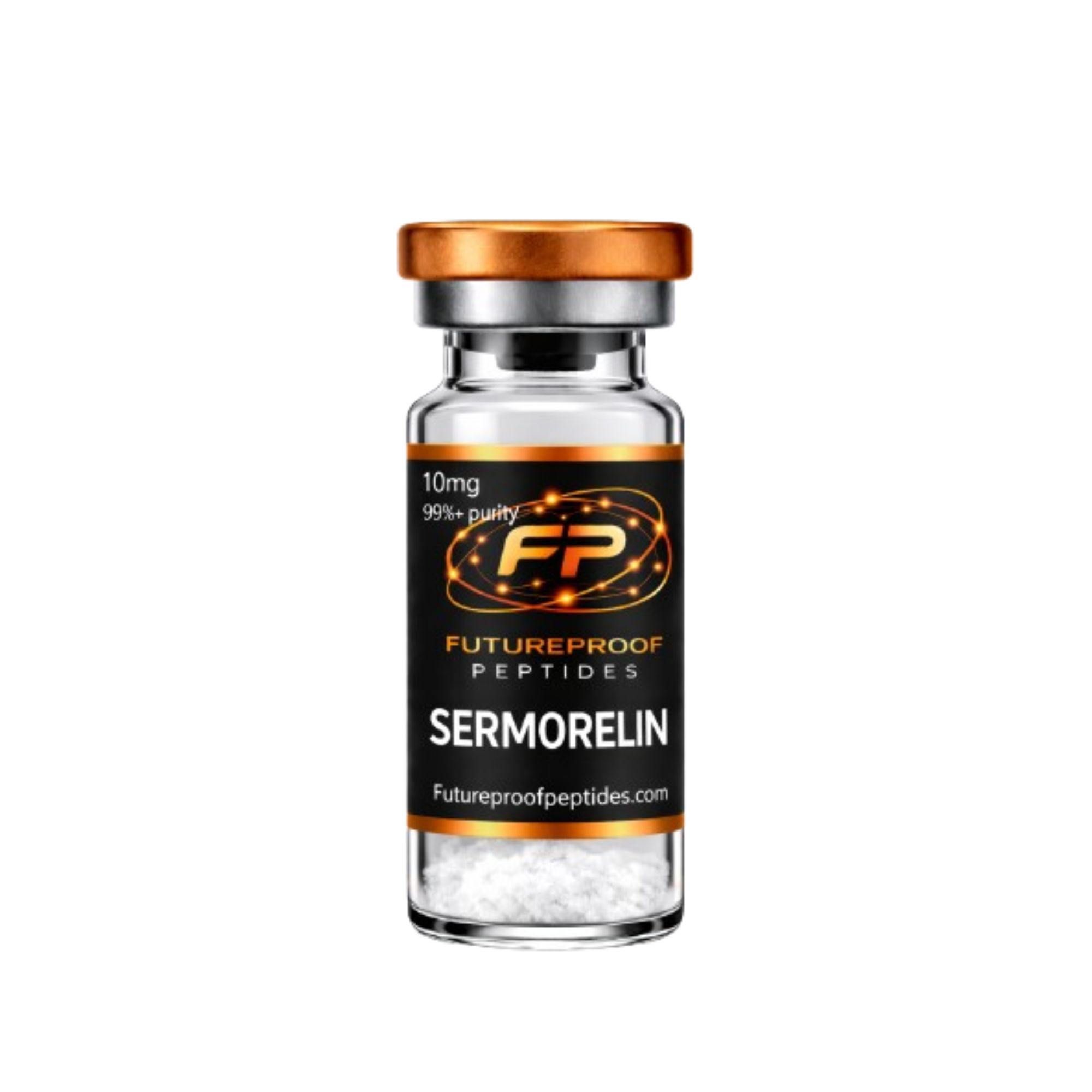
Sermorelin 10mg Vial – High-Purity Research Peptide for Hormone Signalling Studies
Our Sermorelin 10mg Vial contains high-purity Sermorelin acetate, a synthetic peptide supplied for laboratory research, analytical testing, and scientific investigation. Sermorelin is an analogue of growth hormone-releasing hormone (GHRH) and has been extensively investigated for its relationship with natural growth hormone signalling pathways.
Unlike recombinant growth hormone, Sermorelin does not consist of growth hormone itself. Instead, it represents a specific portion of the naturally occurring GHRH molecule, allowing researchers to investigate mechanisms involved in growth hormone regulation and pituitary signalling under controlled experimental conditions.
The Sermorelin 10mg Vial is supplied in lyophilised form to support controlled laboratory handling and storage. Its defined 10mg presentation makes it suitable for research projects where clearly measured quantities of peptide material are required.
Sermorelin research has been relevant to several scientific disciplines, including endocrinology, peptide pharmacology, hormone signalling, pituitary physiology, metabolic research, and age-related changes in endocrine function.
For research use only. Not for human use. Not for veterinary use.
What Is Sermorelin?
Sermorelin is a synthetic peptide analogue corresponding to the first 29 amino acids of naturally occurring growth hormone-releasing hormone.
Growth hormone-releasing hormone, commonly abbreviated as GHRH, is involved in the signalling process that regulates growth hormone secretion from the pituitary gland.
Because Sermorelin represents an active portion of GHRH, it provides researchers with a useful experimental material for studying this signalling pathway.
The distinction between Sermorelin and growth hormone is important. Sermorelin is not growth hormone and does not simply replace growth hormone within a biological system. Instead, research focuses on its interaction with pathways involved in endogenous growth hormone regulation.
This makes the Sermorelin 10mg Vial particularly relevant to laboratory studies investigating endocrine communication and hormone-release mechanisms.
Understanding Growth Hormone-Releasing Hormone
GHRH is a naturally occurring hypothalamic hormone involved in regulating growth hormone secretion.
The hypothalamus and pituitary gland work together as part of a complex endocrine communication system. GHRH is one of the signals involved in this process.
Researchers studying GHRH-related pathways may investigate:
- Growth hormone secretion
- Pituitary receptor activity
- Endocrine signalling
- Hormonal feedback mechanisms
- Hypothalamic-pituitary communication
- Changes in hormone secretion over time
Sermorelin provides an experimental way to examine specific aspects of this biological pathway without using the complete naturally occurring GHRH molecule.
Sermorelin 10mg Vial and GHRH Research
The Sermorelin 10mg Vial is particularly relevant to studies focused on GHRH-related signalling.
As a synthetic analogue containing the first 29 amino acids of GHRH, Sermorelin can be used in experimental models designed to investigate how this portion of the hormone interacts with relevant receptors and signalling systems.
Researchers may use Sermorelin-related models to examine:
- GHRH receptor signalling
- Pituitary hormone regulation
- Growth hormone secretion patterns
- Endocrine feedback
- Hormonal communication
- Receptor-response relationships
These investigations can help researchers better understand how the growth hormone axis functions under different experimental conditions.
How Sermorelin Works in Research
Sermorelin is studied primarily because of its relationship with the growth hormone-releasing hormone receptor.
The GHRH receptor is expressed on pituitary cells involved in growth hormone secretion. When GHRH-related signalling occurs, downstream cellular processes can influence the release of growth hormone.
Sermorelin research therefore provides an opportunity to investigate this receptor-mediated signalling process.
In simplified terms, researchers can examine how:
- GHRH-related signals are recognised
- Receptors respond to peptide stimulation
- Pituitary cells communicate
- Growth hormone secretion is regulated
- Hormonal feedback affects the system
The purpose of these investigations is to understand endocrine biology rather than establish Sermorelin as a treatment.
Why Researchers Study Sermorelin
Scientific interest in Sermorelin extends beyond growth hormone itself.
The growth hormone axis interacts with several other biological systems, making it an important area of endocrine research.
Research involving Sermorelin can contribute to investigations involving:
- Hormone regulation
- Pituitary physiology
- Endocrine signalling
- Metabolic processes
- Protein metabolism
- Body composition models
- Sleep-associated hormone secretion
- Age-related endocrine changes
Studying these systems together provides a broader understanding of how hormonal signals influence normal biological processes.
Sermorelin and Pituitary Research
The pituitary gland is sometimes described as a central component of the endocrine system because it produces and regulates several important hormones.
Growth hormone is one of the hormones associated with pituitary activity.
Because Sermorelin is connected with GHRH signalling, researchers can use it to study relationships between hypothalamic signals and pituitary hormone secretion.
Experimental research may investigate:
- Pituitary receptor activity
- Hormone-release patterns
- Cellular responses to GHRH-related signals
- Endocrine feedback mechanisms
- Changes in hormone secretion over time
These studies can help researchers better understand the communication between the hypothalamus and pituitary gland.
Sermorelin and Growth Hormone Research
Growth hormone, commonly abbreviated as GH, is involved in numerous biological processes.
Its activity is connected with growth, metabolism, protein synthesis, and interactions with other endocrine pathways.
Researchers studying Sermorelin may therefore examine how GHRH-related stimulation influences growth hormone release.
Potential areas of investigation include:
- Growth hormone secretion patterns
- Pulsatile hormone release
- Pituitary response
- Endocrine regulation
- Growth hormone receptor research
- Hormonal feedback
It is important to distinguish research observations from clinical claims. Findings generated in specific experimental models cannot automatically be applied to humans.
Sermorelin and Endocrine Signalling
Endocrine signalling involves communication between organs and tissues through hormones.
The growth hormone axis represents one example of this highly coordinated communication system.
Sermorelin research can be used to investigate how one signalling component influences the wider endocrine network.
Scientists may examine:
- Hormone concentrations
- Receptor activation
- Cellular responses
- Feedback loops
- Hormone secretion timing
- Changes associated with experimental conditions
This type of research can provide valuable information about how endocrine systems maintain physiological balance.
Sermorelin and Metabolic Research
Growth hormone signalling has relationships with metabolism, making the growth hormone axis relevant to metabolic research.
Scientists may investigate how changes in growth hormone activity relate to:
- Protein metabolism
- Lipid metabolism
- Energy utilisation
- Body composition
- Glucose-related pathways
- Cellular metabolic activity
Sermorelin can therefore appear in experimental models designed to investigate the relationship between endocrine signalling and metabolic processes.
These applications remain research-focused and should not be interpreted as established metabolic benefits.
Sermorelin and Body Composition Research
Body composition is influenced by numerous biological factors, including hormones, nutrition, physical activity, metabolism, and age.
Because growth hormone signalling participates in several physiological pathways, researchers have investigated the relationship between the growth hormone axis and body composition.
Sermorelin-related research may examine:
- Lean tissue models
- Adipose tissue biology
- Protein metabolism
- Hormonal regulation
- Changes in body composition over time
These models allow scientists to investigate relationships between hormone signalling and changes in biological composition.
Sermorelin and Sleep Research
Growth hormone secretion follows characteristic patterns and is influenced by several physiological factors, including sleep.
This has made the relationship between sleep and endocrine signalling an important area of scientific research.
Sermorelin can be included in experimental models designed to investigate:
- Hormone secretion patterns
- Sleep-associated endocrine activity
- Pulsatile growth hormone release
- Circadian influences
- Hypothalamic-pituitary communication
Research in this area helps scientists understand how physiological states can influence hormone signalling.
Sermorelin and Age-Related Research
The activity of the growth hormone axis can change throughout life.
Researchers have therefore investigated age-related differences in endocrine signalling and growth hormone secretion.
Sermorelin provides an experimental tool for studying these mechanisms in controlled research models.
Areas of interest include:
- Age-associated changes in hormone secretion
- Pituitary responsiveness
- GHRH signalling
- Endocrine regulation
- Hormonal feedback mechanisms
- Changes in metabolic signalling
These studies contribute to broader research into how endocrine systems change throughout the lifespan.
Sermorelin and Peptide Pharmacology
Peptide pharmacology examines how peptide molecules interact with biological targets.
Sermorelin is useful within this field because its structure allows researchers to investigate a defined portion of the GHRH signalling pathway.
Laboratory investigations may evaluate:
- Peptide-receptor interactions
- Biological activity
- Stability
- Concentration-response relationships
- Molecular signalling
- Experimental pharmacokinetics
The information obtained from these studies can help scientists better understand peptide-mediated signalling.
Structural Characteristics of Sermorelin
Sermorelin is a synthetic peptide consisting of 29 amino acids corresponding to the biologically active N-terminal region of GHRH.
Its peptide structure is important because amino-acid sequence determines many of the molecule’s biological and chemical characteristics.
Researchers studying Sermorelin may therefore consider:
- Amino-acid composition
- Peptide structure
- Molecular stability
- Receptor interaction
- Purity
- Analytical identity
High-quality research material is important when conducting these experiments because impurities or degradation can introduce unwanted variables.
Why Choose a Sermorelin 10mg Vial?
The Sermorelin 10mg Vial provides a defined quantity of research material in a lyophilised presentation.
A clearly identified quantity can be useful when laboratories are designing experiments requiring controlled material preparation and consistent documentation.
Potential research advantages include:
- Defined 10mg quantity
- Lyophilised presentation
- Controlled laboratory preparation
- Convenient storage before experimental preparation
- Suitable for analytical evaluation
- Useful for repeatable research workflows
The appropriate handling procedure will depend on the laboratory protocol and intended analytical application.
Lyophilised Sermorelin Format
The Sermorelin 10mg Vial is supplied as a lyophilised powder.
Lyophilisation, also known as freeze-drying, is commonly used for research peptides because removing water from the formulation can help support stability during storage.
Before an experimental solution is prepared, laboratories should follow their validated preparation procedures and applicable product documentation.
Important considerations include:
- Maintaining appropriate storage conditions
- Protecting the material from moisture
- Minimising unnecessary environmental exposure
- Using appropriate laboratory equipment
- Following validated preparation procedures
Laboratory Preparation
Sermorelin supplied as a lyophilised research material may require laboratory preparation before it can be used in certain experimental applications.
Preparation should be performed by appropriately trained personnel following the laboratory’s validated procedures.
The specific diluent, concentration, preparation method, and experimental conditions should be determined by the applicable research protocol rather than relying on generic instructions.
This approach helps maintain consistency and reduces unnecessary experimental variation.
Quality and Purity
Quality control is an important part of peptide research.
The identity and purity of research material can influence experimental outcomes, particularly when investigating receptor activity or concentration-dependent responses.
For this reason, researchers may evaluate characteristics such as:
- Peptide identity
- Purity
- Concentration
- Molecular characteristics
- Batch consistency
- Stability
- Analytical profile
The Sermorelin 10mg Vial is intended for research workflows where material quality and consistency are important considerations.
Storage and Handling
Unopened lyophilised Sermorelin should be stored according to the validated storage conditions specified for the material.
As a general laboratory principle, research peptide products should be protected from:
- Excessive heat
- Direct light
- Moisture
- Unnecessary temperature fluctuations
- Contamination
Once material has been prepared for an experiment, laboratories should follow their established storage and handling procedures.
Avoiding unnecessary temperature cycling can help reduce the possibility of degradation during a research project.
Research Applications of Sermorelin
The Sermorelin 10mg Vial can be relevant to several areas of scientific investigation.
Endocrinology Research
Studies investigating hormonal signalling and endocrine regulation.
Pituitary Research
Research examining pituitary responses to GHRH-related signalling.
Growth Hormone Research
Experimental models investigating growth hormone secretion and regulation.
Peptide Pharmacology
Research into peptide-receptor interactions and molecular activity.
Metabolic Research
Studies examining relationships between endocrine signals and metabolic pathways.
Hormone Signalling Research
Investigation of communication between the hypothalamus, pituitary gland, and peripheral tissues.
Age-Related Research
Experimental studies examining changes in endocrine function across different stages of life.
Sermorelin Research and Experimental Consistency
Reproducibility is a major consideration in laboratory science.
When researchers evaluate hormone-signalling compounds, small differences in material quality, preparation, storage, or experimental conditions can influence results.
For this reason, researchers may document:
- Product name
- Batch identification
- Quantity
- Storage conditions
- Preparation conditions
- Experimental environment
- Analytical measurements
- Observation periods
Consistent documentation can help researchers compare results between experiments and identify potential sources of variation.
Safety and Research Limitations
Sermorelin research includes laboratory and clinical literature, but an individual research product should not be presented as an approved treatment or as suitable for self-administration.
The safety profile of any experimental research material depends on its specific formulation, purity, handling, exposure conditions, and intended research model.
Researchers should consult applicable safety documentation and conduct appropriate risk assessments before working with the material.
Potential limitations of Sermorelin research include:
- Differences between experimental models
- Variability in study conditions
- Limited applicability of laboratory findings to humans
- Dependence on experimental protocol
- Potential differences between formulations
- Need for additional long-term investigation in specific research contexts
Is Sermorelin Growth Hormone?
No. Sermorelin is not growth hormone.
Sermorelin is a synthetic analogue of GHRH and is studied for its relationship with the signalling pathway that regulates growth hormone secretion.
This distinction is important when interpreting scientific literature because Sermorelin and growth hormone are different biological materials with different structures and mechanisms.
What Is Sermorelin Acetate?
Sermorelin acetate is the acetate salt form of Sermorelin.
The active peptide is associated with GHRH-related signalling and is commonly investigated in endocrine and peptide research.
The acetate form is used as the presentation for certain research materials and should be evaluated according to its specific product specifications and analytical documentation.
What Is the Difference Between Sermorelin and GHRH?
GHRH is a naturally occurring hormone involved in regulating growth hormone secretion.
Sermorelin is a synthetic peptide corresponding to the first 29 amino acids of GHRH.
This makes Sermorelin a useful research compound for studying specific aspects of GHRH-related signalling without using the full-length naturally occurring hormone.
Does Sermorelin Affect Growth Hormone Signalling?
Sermorelin has been investigated specifically because of its relationship with growth hormone-releasing hormone signalling.
Research focuses on how the peptide interacts with GHRH-associated receptor pathways and how those signals influence pituitary growth hormone secretion.
The precise response depends on the experimental model and research conditions.
Why Is Sermorelin Used in Laboratory Research?
Sermorelin is useful in laboratory research because it provides researchers with a defined synthetic peptide for studying GHRH-related signalling.
It can be relevant to research involving:
- Endocrinology
- Growth hormone regulation
- Pituitary physiology
- Peptide pharmacology
- Metabolic signalling
- Hormone receptor activity
- Age-related endocrine research
Product Specifications
Product Name: Sermorelin 10mg Vial
Active Research Material: Sermorelin acetate
Compound Type: Synthetic peptide
Peptide Class: GHRH analogue
Quantity: 10mg
Presentation: Lyophilised powder
Primary Research Area: Growth hormone and endocrine signalling
Additional Research Areas: Pituitary physiology, peptide pharmacology, metabolic research, hormone regulation
Intended Use: Laboratory research and analytical testing
Human Use: Not intended
Veterinary Use: Not intended
Final Research Summary
The Sermorelin 10mg Vial provides a defined lyophilised research formulation for laboratories investigating growth hormone regulation, GHRH signalling, pituitary physiology, and broader endocrine pathways.
Sermorelin is a synthetic 29-amino-acid analogue corresponding to the biologically active portion of naturally occurring growth hormone-releasing hormone. This makes it distinct from growth hormone itself and provides researchers with an experimental material for investigating how GHRH-related signalling communicates with the pituitary gland.
Research involving Sermorelin extends into several areas, including growth hormone secretion, endocrine regulation, metabolic research, peptide pharmacology, sleep-associated hormone signalling, body composition models, and age-related changes in endocrine function.
The Sermorelin 10mg Vial is supplied as a lyophilised powder, providing a practical format for controlled laboratory handling and preparation according to validated research procedures.
As with all research materials, experimental findings should be interpreted according to the specific model, methodology, and conditions under which they were generated. Research observations should not be presented as established therapeutic benefits or recommendations for human use.
Sermorelin 10mg Vial Sermorelin 10mg Vial Sermorelin 10mg Vial Sermorelin 10mg Vial Sermorelin 10mg Vial Sermorelin 10mg Vial Sermorelin 10mg Vial Sermorelin 10mg Vial Sermorelin 10mg Vial Sermorelin 10mg Vial Sermorelin 10mg Vial Sermorelin 10mg Vial


