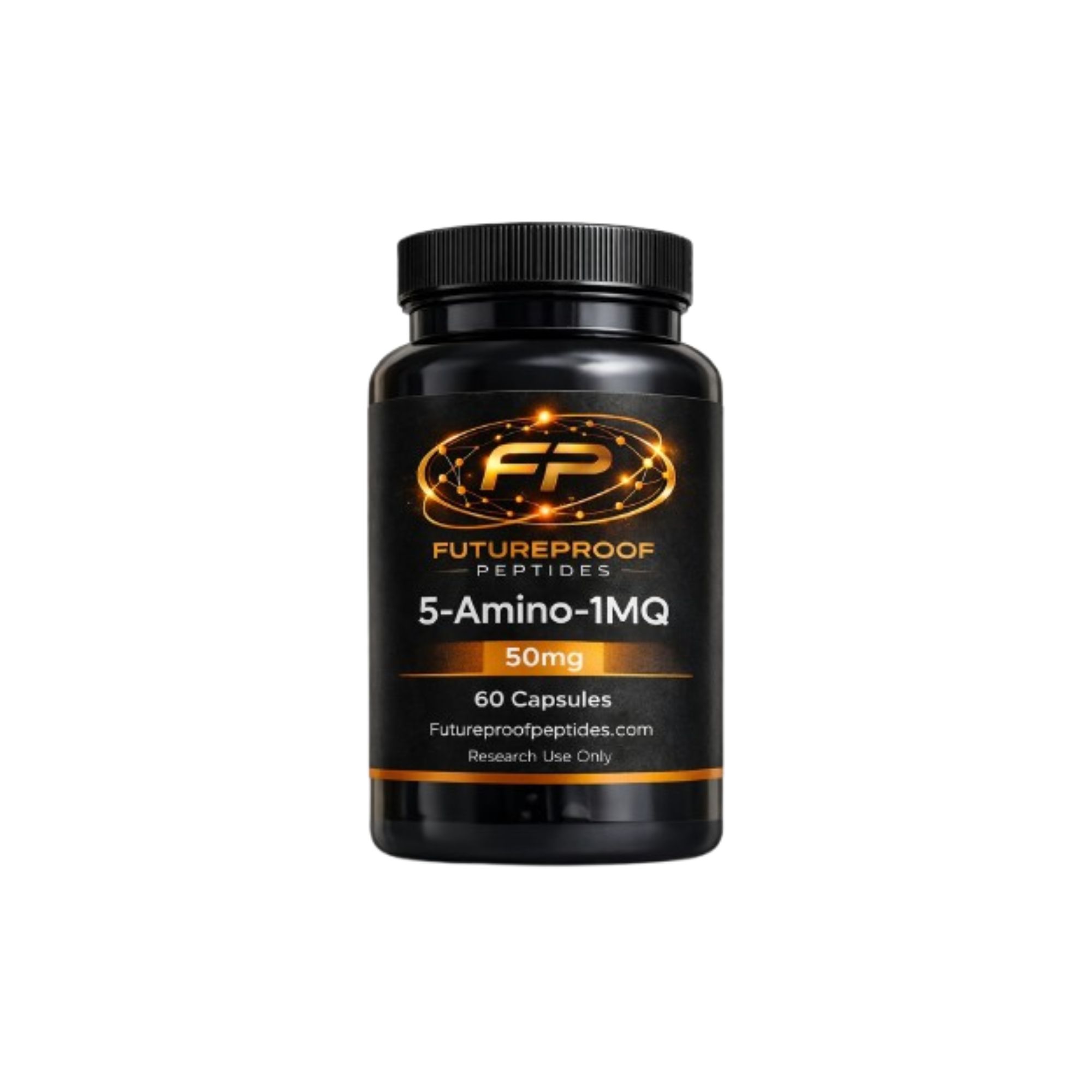
5-AMINO-1MQ 50mg Capsules – Advanced NNMT Research Compound
5-AMINO-1MQ 50mg Capsules contain 5-amino-1-methylquinolinium, an experimental small-molecule compound investigated primarily for its relationship with nicotinamide N-methyltransferase (NNMT), nicotinamide metabolism, NAD+ biology, adipose tissue function, and cellular metabolic pathways.
Although 5-Amino-1MQ is frequently discussed alongside research peptides and other experimental compounds, it is important to clarify that 5-Amino-1MQ is not a peptide. It is a chemically defined small molecule that researchers study primarily as an NNMT inhibitor.
Interest in 5-AMINO-1MQ 50mg Capsules has grown because NNMT is involved in the metabolism of nicotinamide, a molecule connected to the NAD+ salvage pathway. Researchers have therefore investigated whether altering NNMT activity can influence intracellular NAD+ availability and metabolic processes within adipose tissue.
Preclinical research has examined 5-Amino-1MQ in cultured cells and animal models, including experimental models of diet-induced obesity. Areas of investigation have included adipocyte size, white adipose tissue mass, lipogenesis, energy metabolism, and changes in intracellular NAD+ concentrations.
The capsule presentation provides a convenient solid format for laboratory research and analytical applications where a defined quantity of small-molecule material is required.
For research use only. Not for human or veterinary use.
What Is 5-AMINO-1MQ?
5-Amino-1MQ is a synthetic small molecule investigated for its ability to inhibit the enzyme nicotinamide N-methyltransferase, commonly abbreviated as NNMT.
NNMT is an enzyme involved in nicotinamide metabolism. It catalyses the transfer of a methyl group from S-adenosylmethionine, or SAM, to nicotinamide, producing 1-methylnicotinamide (1-MNA).
This biochemical reaction is particularly interesting to researchers because nicotinamide is also connected with the NAD+ salvage pathway.
NAD+, or nicotinamide adenine dinucleotide, is an important cellular coenzyme involved in:
- Energy metabolism
- Redox reactions
- Mitochondrial function
- Cellular signalling
- Enzyme activity
- Metabolic regulation
By studying NNMT inhibition, researchers can investigate how changes in nicotinamide metabolism may influence NAD+ availability and related cellular processes.
Is 5-Amino-1MQ a Peptide?
No. 5-Amino-1MQ is not a peptide.
It is a synthetic small-molecule compound.
This distinction is important because small molecules and peptides can have significantly different chemical characteristics, including differences in:
- Molecular structure
- Molecular weight
- Solubility
- Stability
- Analytical testing
- Formulation
- Laboratory handling
The 5-AMINO-1MQ 50mg Capsules format therefore differs from conventional lyophilised research peptides.
Understanding this distinction also helps researchers select appropriate analytical techniques and laboratory procedures for evaluating the material.
What Is NNMT?
Nicotinamide N-methyltransferase, or NNMT, is an enzyme involved in the metabolism of nicotinamide.
NNMT uses SAM as a methyl donor and converts nicotinamide into 1-methylnicotinamide.
This pathway has become an area of metabolic research because nicotinamide is also involved in NAD+ recycling.
Researchers are interested in understanding how changes in NNMT activity may influence:
- Nicotinamide metabolism
- NAD+ availability
- Cellular energy metabolism
- Adipocyte biology
- Mitochondrial processes
- Metabolic signalling
5-Amino-1MQ provides an experimental approach for investigating these relationships.
How 5-Amino-1MQ Works in Research
The primary research interest surrounding 5-Amino-1MQ comes from its activity as an NNMT inhibitor.
By inhibiting NNMT, researchers can investigate what happens when the conversion of nicotinamide into 1-MNA is reduced.
This provides an experimental model for studying how nicotinamide may be redistributed within cellular metabolic pathways.
In simplified terms, researchers can examine whether NNMT inhibition influences:
- Intracellular nicotinamide availability
- NAD+ metabolism
- Adipocyte metabolism
- Lipid storage
- Energy utilisation
- Cellular metabolic signalling
The purpose of this research is to understand the biological role of NNMT and its associated pathways rather than establish 5-Amino-1MQ as a clinical treatment.
Why Researchers Study 5-Amino-1MQ
The growing scientific interest in 5-AMINO-1MQ 50mg Capsules is closely associated with research into metabolism and adipose tissue.
NNMT expression has been investigated in adipose tissue, and researchers have explored whether changes in NNMT activity can affect how fat cells store and process energy.
Preclinical experiments have therefore examined 5-Amino-1MQ in models involving:
- White adipose tissue
- Adipocyte biology
- Fat storage
- Lipogenesis
- Fat oxidation
- Energy expenditure
- NAD+ metabolism
- Metabolic adaptation
These areas are especially relevant to researchers studying the molecular mechanisms underlying metabolic regulation.
5-Amino-1MQ and White Adipose Tissue
White adipose tissue is a metabolically active tissue that stores energy in the form of triglycerides.
Adipose tissue also participates in endocrine signalling and communicates with other organs through hormones and signalling molecules.
Because NNMT has been investigated in adipose tissue, researchers have used 5-Amino-1MQ to explore whether inhibiting the enzyme changes adipocyte behaviour.
Research models may examine:
- Adipocyte size
- White adipose tissue mass
- Lipid storage
- Lipogenesis
- Cellular energy metabolism
- Metabolic signalling
These studies can provide insight into the molecular pathways controlling how adipose tissue stores and uses energy.
5-Amino-1MQ and Adipocyte Research
Adipocytes are specialised cells responsible for storing and releasing energy.
Their size, number, lipid content, and metabolic activity can change in response to nutritional and hormonal conditions.
Researchers have investigated whether NNMT inhibition influences adipocyte characteristics.
Experimental observations have included investigations into:
- Fat-cell size
- Lipid accumulation
- Lipogenesis
- Energy expenditure
- Cellular NAD+ levels
- Metabolic gene expression
This makes 5-Amino-1MQ an interesting tool for studying the relationship between enzyme activity and adipocyte metabolism.
5-Amino-1MQ and NAD+ Metabolism
One of the most important research areas involving 5-AMINO-1MQ 50mg Capsules is the relationship between NNMT and NAD+ metabolism.
NAD+ is an essential cellular cofactor involved in energy transfer and numerous enzymatic reactions.
Cells maintain NAD+ through several interconnected pathways. The NAD+ salvage pathway is particularly important because it allows cells to recycle nicotinamide into NAD+.
NNMT represents another route through which nicotinamide can be metabolised.
Researchers therefore investigate whether inhibiting NNMT changes the amount of nicotinamide available for NAD+ synthesis.
This creates an interesting experimental connection between:
- NNMT activity
- Nicotinamide metabolism
- NAD+ availability
- Cellular energy production
- Mitochondrial function
- NAD+-dependent enzymes
NAD+ and Cellular Energy Research
NAD+ participates in numerous cellular reactions.
It functions as an electron carrier during metabolic reactions and helps cells transfer energy through processes involving oxidation and reduction.
NAD+ is also required by several classes of enzymes involved in cellular signalling and maintenance.
Researchers studying 5-Amino-1MQ are therefore interested in whether changes in NNMT activity can influence the cellular NAD+ pool.
This research does not mean that 5-Amino-1MQ is an NAD+ supplement. Instead, the compound is used experimentally to investigate one of the pathways involved in nicotinamide metabolism.
That distinction is important when interpreting research findings.
5-Amino-1MQ and Intracellular NAD+
Preclinical research has examined intracellular NAD+ concentrations following NNMT inhibition.
In cultured adipocyte models, experimental NNMT inhibition has been associated with changes in intracellular NAD+ levels under specific laboratory conditions.
These observations are significant because they provide researchers with a way to investigate the relationship between nicotinamide metabolism and cellular NAD+ availability.
However, experimental changes in cellular NAD+ should not automatically be interpreted as evidence of improved metabolism or increased energy in humans.
The biological response depends on the experimental model, concentration, exposure period, cell type, and other laboratory conditions.
5-Amino-1MQ and Lipogenesis Research
Lipogenesis refers to the process through which cells synthesise and store lipids.
Adipocytes are highly specialised for lipid storage, making lipogenesis an important area of adipose tissue research.
Researchers have investigated whether NNMT inhibition affects lipogenic activity.
Laboratory models may measure:
- Lipid accumulation
- Fatty-acid synthesis
- Adipocyte differentiation
- Cellular triglyceride content
- Expression of metabolic genes
These measurements help scientists understand how metabolic enzymes influence the behaviour of fat cells.
5-Amino-1MQ and Fat Oxidation Research
Fat oxidation refers to the metabolic breakdown of fatty acids for energy.
The balance between lipid storage and lipid utilisation is an important component of cellular metabolism.
Because NNMT is involved in metabolic pathways, researchers have investigated whether inhibiting the enzyme influences processes related to fat utilisation.
Experimental research can examine:
- Fatty-acid oxidation
- Mitochondrial activity
- Energy expenditure
- Lipid metabolism
- Cellular fuel utilisation
These findings contribute to broader research into how cells regulate energy availability.
5-Amino-1MQ and Energy Expenditure
Energy expenditure describes the amount of energy used by an organism or biological system.
Researchers studying metabolic compounds may measure changes in energy expenditure to understand how experimental interventions influence whole-body metabolism.
In preclinical research, 5-Amino-1MQ has attracted attention because NNMT inhibition has been associated with metabolic changes in animal models.
However, observations in animals should not be presented as proof of increased energy expenditure in humans.
Further research is necessary to establish how these mechanisms translate across different biological systems.
5-Amino-1MQ and Diet-Induced Obesity Models
One of the better-known areas of preclinical 5-Amino-1MQ research involves diet-induced obesity models.
These models are used by researchers to investigate metabolic changes associated with long-term exposure to energy-dense diets.
Experimental studies have examined whether NNMT inhibition changes metabolic characteristics within these models.
Researchers have investigated outcomes including:
- Body-weight changes
- White adipose tissue mass
- Adipocyte size
- Food intake
- Lipid metabolism
- Energy expenditure
- Cellular NAD+ concentrations
An important observation from some preclinical research is that changes in body weight and adipose tissue were not necessarily accompanied by a corresponding reduction in food intake.
This has encouraged researchers to investigate metabolic mechanisms beyond appetite regulation.
Does 5-Amino-1MQ Suppress Appetite?
Appetite suppression is not considered the primary mechanism of 5-Amino-1MQ research.
Unlike compounds designed to interact with appetite-related hormone receptors, 5-Amino-1MQ is primarily investigated as an NNMT inhibitor.
Some animal research has observed changes in body weight and adipose tissue without a major reduction in food intake.
This distinction is scientifically important because it suggests that metabolic pathways may be contributing to the observations rather than simple changes in food consumption.
Nevertheless, these findings are based on preclinical models and should not be interpreted as evidence that 5-Amino-1MQ suppresses appetite in humans.
5-Amino-1MQ and Metabolic Research
The relationship between NNMT, nicotinamide, NAD+, and adipose tissue makes 5-Amino-1MQ particularly relevant to metabolic research.
Researchers can use the compound to investigate how a specific enzyme influences broader cellular pathways.
Research areas include:
- Cellular metabolism
- Adipose tissue biology
- NAD+ metabolism
- Nicotinamide metabolism
- Lipid storage
- Fatty-acid oxidation
- Mitochondrial function
- Energy expenditure
This broad research relevance has contributed to continued scientific interest in NNMT inhibitors.
5-Amino-1MQ and Mitochondrial Research
Mitochondria are responsible for producing much of the usable energy within cells.
Because NAD+ is involved in cellular energy metabolism, researchers have considered relationships between NNMT inhibition, NAD+ availability, and mitochondrial activity.
Experimental models may investigate:
- Mitochondrial respiration
- Cellular energy production
- Oxidative metabolism
- NAD+/NADH balance
- Fatty-acid utilisation
- Metabolic adaptation
These investigations help researchers understand whether changes in nicotinamide metabolism influence wider cellular energy pathways.
5-Amino-1MQ and Cellular Signalling
NAD+ is involved in more than energy metabolism.
It is also required by several NAD+-dependent enzymes involved in cellular signalling and regulation.
For this reason, changes in NAD+ availability may have downstream implications for multiple cellular processes.
Researchers studying 5-Amino-1MQ can therefore investigate relationships between:
- NNMT inhibition
- NAD+ availability
- Enzyme activity
- Cellular signalling
- Metabolic regulation
- Cellular stress responses
This provides a broader framework for understanding why NNMT has become an area of interest in molecular biology.
Why White Adipose Tissue Is Important
White adipose tissue is much more than a passive energy-storage compartment.
It plays important roles in:
- Energy storage
- Hormonal communication
- Lipid metabolism
- Nutrient handling
- Metabolic signalling
Changes in adipocyte size and behaviour can therefore provide valuable information about metabolic health in experimental models.
By investigating NNMT within adipose tissue, researchers can examine how this enzyme contributes to the balance between nutrient storage and utilisation.
The 5-AMINO-1MQ 50mg Capsules research format provides a defined compound for investigating these pathways under controlled conditions.
5-Amino-1MQ Research vs Appetite-Targeted Compounds
The mechanism of 5-Amino-1MQ is different from that of compounds primarily investigated for appetite-related receptor signalling.
5-Amino-1MQ research centres on NNMT inhibition and metabolic pathways involving nicotinamide.
This creates a different research model focused on cellular metabolism rather than directly targeting appetite receptors.
Researchers can therefore use NNMT inhibition to investigate metabolic biology from another perspective.
Areas of comparison may include:
- Cellular metabolism
- Energy utilisation
- Adipocyte biology
- NAD+ metabolism
- Lipid storage
- Appetite-independent metabolic pathways
Quality Control for 5-Amino-1MQ
Quality control is particularly important when working with chemically defined small molecules.
Research outcomes can be affected by impurities, degradation products, incorrect concentration, or differences in chemical form.
For 5-AMINO-1MQ 50mg Capsules, researchers should consider relevant analytical documentation, including information relating to:
- Compound identity
- Chemical purity
- Quantity
- Batch information
- Chemical form
- Analytical testing
- Storage conditions
Where a Certificate of Analysis is supplied, researchers should use the batch-specific documentation as the primary reference for product specifications.
Capsule Format
The capsule presentation offers a convenient solid format for research environments.
Unlike many lyophilised peptide products, 5-AMINO-1MQ 50mg Capsules do not require the same type of peptide reconstitution process.
The defined capsule format can simplify material identification and storage within an organised research workflow.
Researchers should nevertheless handle the material according to applicable laboratory procedures and product documentation.
Storage and Handling
5-AMINO-1MQ 50mg Capsules should be stored according to the applicable product and batch documentation.
The material should generally be protected from environmental conditions that could compromise chemical stability, including:
- Excessive heat
- Direct sunlight
- Moisture
- Unstable temperature conditions
- Contamination
Keeping the original packaging appropriately sealed can help reduce unnecessary environmental exposure.
For extended research projects, laboratories should establish suitable storage and documentation procedures based on the characteristics of the specific material.
Research Applications
The 5-AMINO-1MQ 50mg Capsules format can be relevant to several areas of laboratory investigation.
NNMT Research
Studies examining the activity and biological significance of nicotinamide N-methyltransferase.
NAD+ Research
Investigation into relationships between nicotinamide metabolism and cellular NAD+ availability.
Adipose Tissue Research
Experimental studies examining white adipose tissue and adipocyte biology.
Metabolic Research
Research into energy utilisation, lipid metabolism, and metabolic regulation.
Mitochondrial Research
Investigation of cellular energy production and oxidative metabolism.
Cellular Signalling Research
Studies examining NAD+-dependent pathways and metabolic signalling.
Obesity Model Research
Preclinical investigation using experimental models of altered adipose tissue and energy balance.
Experimental Considerations
When using small-molecule compounds in research, researchers should carefully control experimental variables.
Important considerations can include:
- Compound identity
- Purity
- Experimental concentration
- Cell type or biological model
- Exposure duration
- Environmental conditions
- Analytical method
- Control groups
- Measurement techniques
Controlling these factors can improve reproducibility and make it easier to compare findings between experiments.
Safety and Research Limitations
5-Amino-1MQ remains an experimental research compound.
Although preclinical studies have produced interesting findings involving NNMT inhibition and metabolic pathways, these results do not establish the compound as safe or effective for human use.
Important limitations include:
- Limited human research
- Lack of established long-term safety data
- Differences between animal and human biology
- Differences between laboratory models
- Uncertainty surrounding prolonged exposure
- Potential formulation differences
Researchers should conduct appropriate risk assessments and consult applicable safety documentation before handling experimental materials.
Is 5-Amino-1MQ an NAD+ Supplement?
No.
5-Amino-1MQ is not an NAD+ supplement and does not simply provide NAD+ to cells.
Its research relevance comes from its ability to inhibit NNMT, an enzyme involved in nicotinamide metabolism.
Researchers investigate whether changing NNMT activity can alter the availability of nicotinamide for other metabolic pathways, including the NAD+ salvage pathway.
Is 5-Amino-1MQ a Peptide?
No. 5-Amino-1MQ is a synthetic small molecule.
Although it may be marketed alongside research peptides, its chemical structure and laboratory characteristics are fundamentally different from peptide compounds.
What Does NNMT Stand For?
NNMT stands for nicotinamide N-methyltransferase.
It is an enzyme that participates in nicotinamide metabolism by transferring a methyl group from SAM to nicotinamide.
The enzyme has become an important subject in metabolic research because of its relationship with nicotinamide and NAD+ pathways.
Why Is 5-Amino-1MQ Studied in Fat Cells?
NNMT has been investigated in adipose tissue, making fat cells an important experimental model.
Researchers study 5-Amino-1MQ to investigate whether inhibiting NNMT changes adipocyte metabolism, lipid storage, cellular NAD+ concentrations, and related metabolic processes.
Has 5-Amino-1MQ Been Studied in Animals?
Yes. Preclinical research has investigated 5-Amino-1MQ in animal models, including models designed to study diet-induced obesity and metabolic changes.
Researchers have examined outcomes such as adipose tissue mass, adipocyte size, body weight, food intake, and metabolic pathways.
These findings remain preclinical and cannot automatically be applied to humans.
Does 5-Amino-1MQ Increase NAD+?
Research has investigated whether NNMT inhibition with 5-Amino-1MQ can influence intracellular NAD+ concentrations.
Some experimental studies have reported increases in intracellular NAD+ under specific laboratory conditions.
However, the response depends on the experimental model and should not be interpreted as proof that the compound increases NAD+ in humans.
Product Specifications
Product Name: 5-AMINO-1MQ 50mg Capsules
Research Compound: 5-Amino-1MQ
Chemical Classification: Synthetic small molecule
Primary Target: Nicotinamide N-methyltransferase (NNMT)
Quantity: 50mg
Format: Capsules
Primary Research Areas: NNMT inhibition, NAD+ metabolism, adipose tissue research, metabolic biology
Additional Research Areas: Lipid metabolism, cellular energy, mitochondrial research, adipocyte biology
Reconstitution: Not required for capsule presentation
Intended Use: Laboratory research and scientific investigation
Human Use: Not intended
Veterinary Use: Not intended

5-AMINO-1MQ 50mg Capsules 5-AMINO-1MQ 50mg Capsules 5-AMINO-1MQ 50mg Capsules 5-AMINO-1MQ 50mg Capsules 5-AMINO-1MQ 50mg Capsules 5-AMINO-1MQ 50mg Capsules 5-AMINO-1MQ 50mg Capsules 5-AMINO-1MQ 50mg Capsules 5-AMINO-1MQ 50mg Capsules 5-AMINO-1MQ 50mg Capsules 5-AMINO-1MQ 50mg Capsules 5-AMINO-1MQ 50mg Capsules 5-AMINO-1MQ 50mg Capsules 5-AMINO-1MQ 50mg Capsules 5-AMINO-1MQ 50mg Capsules 5-AMINO-1MQ 50mg Capsules 5-AMINO-1MQ 50mg Capsules 5-AMINO-1MQ 50mg Capsules
Final Research Summary
5-AMINO-1MQ 50mg Capsules provide a defined small-molecule research formulation for scientific investigations involving NNMT inhibition, nicotinamide metabolism, NAD+ biology, adipose tissue, and cellular metabolic pathways.
5-Amino-1MQ is distinct from conventional research peptides because it is a synthetic small molecule. Its primary research interest comes from its interaction with nicotinamide N-methyltransferase (NNMT), an enzyme that metabolises nicotinamide into 1-methylnicotinamide.
Researchers are particularly interested in NNMT because nicotinamide is also connected with the NAD+ salvage pathway. Experimental inhibition of NNMT therefore provides a way to investigate relationships between nicotinamide metabolism, intracellular NAD+ availability, cellular energy metabolism, and adipose tissue biology.
Preclinical studies have investigated 5-Amino-1MQ in cultured adipocytes and animal models, including diet-induced obesity models. Areas of research have included white adipose tissue mass, adipocyte size, lipogenesis, fat oxidation, energy expenditure, food intake, and intracellular NAD+ concentrations.
The 5-AMINO-1MQ 50mg Capsules presentation provides a convenient solid format for controlled research environments and does not require the same reconstitution procedures used for lyophilised peptide powders.
As with all experimental compounds, research findings should be interpreted according to the specific model, methodology, concentration, exposure period, and analytical conditions used. Preclinical observations should not be presented as established human benefits, safety conclusions, or therapeutic recommendations.