
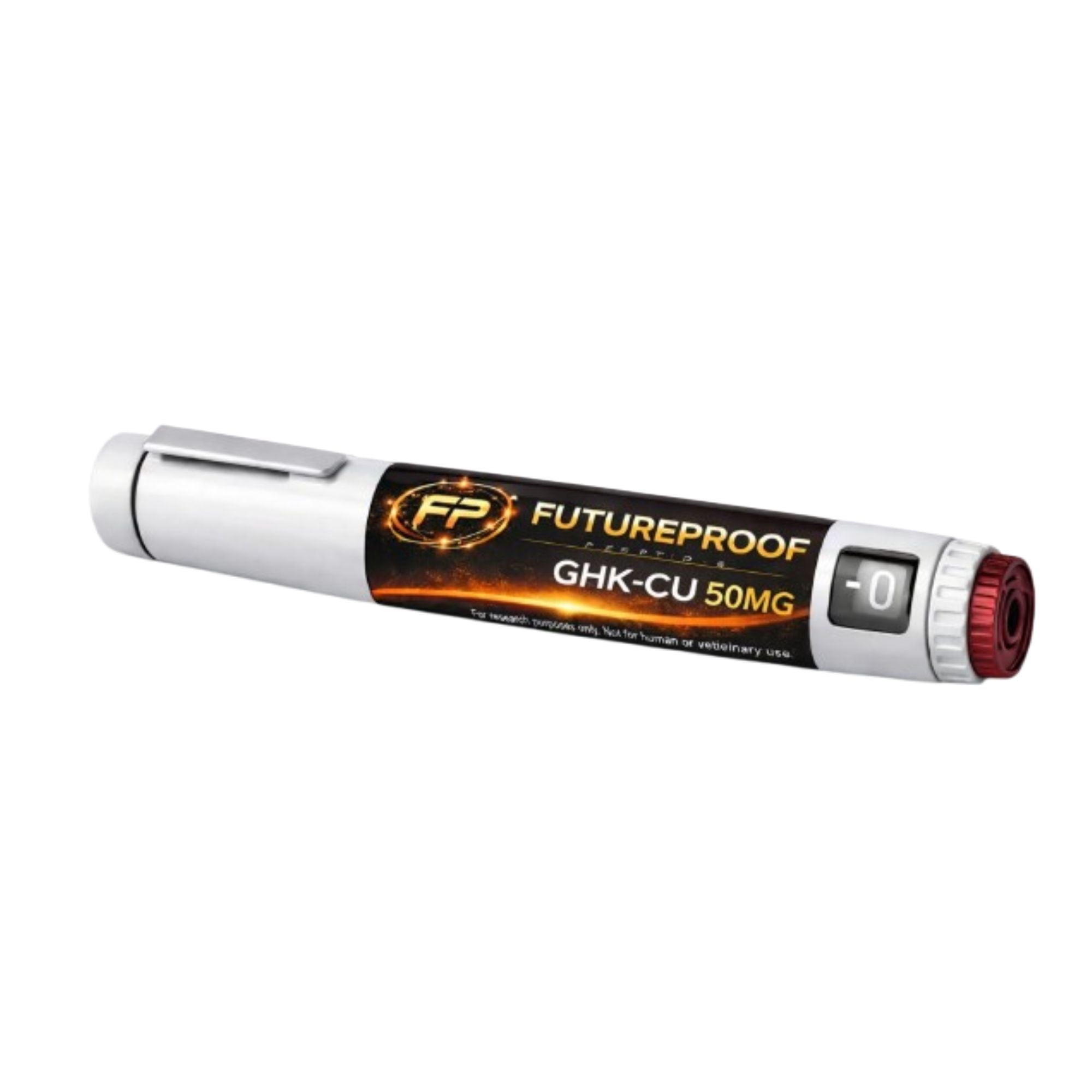
GHK-Cu 50mg Pen – Advanced Copper Peptide Research
The GHK-Cu 50mg Pen contains a pre-filled research presentation of GHK-Cu, providing laboratories with an alternative to conventional vial-based peptide materials. The pen format is designed for laboratories whose established workflows are compatible with a pre-filled research presentation and can provide a convenient approach to routine laboratory handling.
GHK-Cu is the copper complex of glycyl-L-histidyl-L-lysine, commonly abbreviated GHK. GHK is a naturally occurring tripeptide that has been identified in human plasma and other biological fluids. Research has demonstrated that GHK has a strong affinity for copper and forms a biologically relevant copper-peptide complex.
Scientific interest in GHK-Cu has expanded across several areas of peptide and cellular biology, including extracellular matrix organization, collagen-related pathways, fibroblast activity, tissue remodelling, cellular signalling and copper-dependent biological processes.
The GHK-Cu 50mg Pen is supplied exclusively for laboratory research and analytical testing. It is not intended for human consumption, veterinary use, diagnosis, treatment or therapeutic application.
What Is GHK-Cu?
GHK-Cu is formed when the tripeptide glycyl-L-histidyl-L-lysine binds copper ions.
The three amino acids that make up GHK are:
- Glycine
- Histidine
- Lysine
GHK has been detected naturally in human plasma, saliva and urine. Research has also reported that circulating GHK concentrations decline with age, which has contributed to scientific interest in the peptide’s relationship with age-associated biological changes.
When GHK binds copper, it forms the GHK-Cu complex. Researchers have investigated the chemical structure, copper-binding behaviour and biological activity of this complex using a variety of analytical techniques.
This combination of peptide biology and copper chemistry makes GHK-Cu an interesting subject for laboratory research.
Why Is GHK-Cu Researched?
The GHK-Cu 50mg Pen is relevant to research because GHK-Cu has been investigated across multiple interconnected biological systems.
Published research has examined areas including:
- Extracellular matrix organization
- Collagen synthesis
- Fibroblast activity
- Cellular signalling
- Copper transport
- Protein remodelling
- Tissue remodelling
- Oxidative stress
- Inflammatory signalling
- Angiogenesis
- Skin biology
- Hair follicle biology
Rather than being associated with one isolated biological pathway, GHK-Cu research covers a broad network of cellular and molecular processes.
GHK-Cu and Extracellular Matrix Research
The extracellular matrix is the network of proteins and other molecules surrounding cells. It provides structural support while also participating in cellular communication and tissue organization.
Collagen, elastin, glycosaminoglycans and proteoglycans are important components of the extracellular matrix.
Research involving GHK-Cu has investigated how the compound may influence the production and organization of these matrix components.
Experimental studies have examined GHK-Cu in fibroblast systems and reported effects involving collagen synthesis and extracellular matrix-associated molecules.
This makes extracellular matrix biology one of the major areas of scientific interest surrounding GHK-Cu.
Collagen Research
Collagen is a major structural protein within connective tissue.
GHK-Cu has been investigated in relation to collagen synthesis and extracellular matrix organization in experimental systems.
Earlier research involving fibroblast cultures reported stimulation of collagen production following exposure to GHK-Cu. Additional studies have investigated extracellular matrix accumulation and related structural components.
These findings have contributed to continuing interest in GHK-Cu and connective-tissue biology.
However, laboratory observations should not automatically be interpreted as evidence that a particular GHK-Cu formulation produces equivalent effects in humans.
Fibroblast Research
Fibroblasts are specialized connective-tissue cells responsible for producing many extracellular matrix components.
Because of their central role in matrix biology, fibroblasts are frequently used in experimental research involving GHK-Cu.
Researchers have investigated GHK-Cu in relation to:
- Fibroblast activity
- Collagen production
- Extracellular matrix organization
- Cellular proliferation
- Matrix remodelling
- Cellular signalling
Studies have also examined relationships between GHK-Cu and enzymes involved in extracellular matrix turnover.
GHK-Cu and Tissue Remodelling
Tissue remodelling is a continuous biological process involving the breakdown, production and reorganization of extracellular matrix components.
GHK-Cu research has explored several mechanisms associated with this process.
Investigators have studied:
- Collagen turnover
- Glycosaminoglycan production
- Fibroblast behaviour
- Matrix-associated proteins
- Metalloproteinase activity
- Cellular migration
- Vascular responses
A review of GHK research describes interactions with multiple pathways involved in tissue remodelling and cellular regulation.
These findings provide a scientific basis for continued laboratory investigation of copper-peptide biology.
GHK-Cu and Copper Biology
Copper is an essential trace element involved in numerous biochemical processes.
Several enzymes involved in connective-tissue structure, antioxidant defence and cellular metabolism depend on copper.
GHK’s strong affinity for copper makes the GHK-Cu complex particularly interesting from a biochemical perspective.
Research has examined the chemical behaviour of GHK-copper complexes using techniques including spectroscopy, calorimetry and other analytical methods. These studies demonstrate that GHK can form defined copper complexes under appropriate conditions.
This provides researchers with an opportunity to investigate how copper-binding peptides interact with biological systems.
GHK-Cu and Cellular Signalling
Cellular signalling involves communication between cells and the molecular pathways that control cellular responses.
GHK-Cu research has investigated signalling associated with:
- Extracellular matrix regulation
- Cellular growth
- Tissue remodelling
- Inflammatory responses
- Oxidative stress
- Copper metabolism
- Vascular biology
Research has suggested that GHK-related activity can influence the expression of numerous genes, although the biological significance of individual gene-expression changes requires careful experimental interpretation.
For this reason, GHK-Cu remains an interesting experimental subject for researchers studying complex cellular networks.
GHK-Cu and Gene Expression
One particularly interesting area of GHK research involves gene-expression analysis.
Researchers have investigated whether GHK can influence expression patterns involving genes associated with tissue structure, cellular signalling and inflammatory processes.
A published review described broad gene-regulatory effects associated with GHK and proposed potential relationships with tissue repair and cellular protection.
However, broad gene-expression observations should not be interpreted as proof of a therapeutic effect.
The biological response to GHK-Cu can depend on concentration, cellular environment, experimental model and other variables.
GHK-Cu and Oxidative Stress
Oxidative stress occurs when reactive molecules disrupt the balance between oxidative processes and cellular antioxidant systems.
GHK-Cu has been investigated in relation to oxidative and antioxidant pathways.
Reviews of GHK research have described experimental findings involving antioxidant and cell-protective mechanisms, providing a basis for further investigation into copper-peptide interactions with oxidative biology.
Additional research is necessary to establish the significance of these findings across different experimental models.
GHK-Cu and Inflammatory Signalling
Inflammatory signalling is closely connected to tissue remodelling and cellular stress.
Research has examined whether GHK-Cu influences molecular pathways involved in inflammatory responses.
Experimental literature has reported anti-inflammatory activity in cellular and animal models, although the strength of evidence varies across different applications.
This makes inflammatory biology another area in which laboratories may investigate GHK-Cu under controlled conditions.
GHK-Cu and Skin Biology
GHK-Cu is particularly well known within research involving skin and connective-tissue biology.
Studies have examined:
- Fibroblast activity
- Collagen production
- Extracellular matrix organization
- Cellular proliferation
- Tissue remodelling
- Oxidative pathways
- Inflammatory signalling
A recent systematic review identified a growing body of research investigating GHK-Cu in aesthetic and regenerative contexts, while also noting the limited number of standardized clinical studies.
This distinction is important when evaluating GHK-Cu research because extensive laboratory evidence does not necessarily establish clinical effectiveness.
GHK-Cu and Hair Follicle Research
Another area of scientific interest involves hair follicle biology.
Researchers have investigated copper-peptide activity in relation to follicular cells, connective tissue and the extracellular environment surrounding hair follicles.
Potential experimental areas include:
- Follicular cell activity
- Dermal papilla biology
- Extracellular matrix signalling
- Cellular proliferation
- Local vascular signalling
- Tissue organization
These findings remain experimental and should not be presented as evidence of an established hair-growth treatment.
GHK-Cu and Angiogenesis Research
Angiogenesis refers to the formation of new blood vessels from existing vascular structures.
Because vascular development is closely connected with tissue biology and extracellular matrix remodelling, angiogenesis is another area of interest within GHK-Cu research.
Experimental studies have investigated relationships between GHK-containing systems, endothelial responses and vascular signalling.
This provides researchers with opportunities to study how copper-peptide biology interacts with vascular and extracellular matrix systems.
Natural GHK and Age-Associated Research
One of the interesting characteristics of GHK is that it is naturally present in human biological fluids.
Research has reported that GHK concentrations decline with age. A review published in Biomedicines described average serum concentrations of approximately 200 ng/mL at age 20 compared with approximately 80 ng/mL at age 60.
This observation has contributed to interest in studying GHK and GHK-Cu in relation to ageing biology.
However, an age-associated decrease in a naturally occurring molecule does not by itself demonstrate that restoring that molecule produces a clinical benefit.
GHK-Cu 50mg Pen vs Conventional Vial
The main difference between the pen and vial presentations is the physical format and laboratory workflow.
| Feature | GHK-Cu 50mg Pen | GHK-Cu Vial |
|---|---|---|
| Presentation | Pre-filled pen format | Conventional vial |
| Preparation | Product-specific handling | May require additional laboratory preparation |
| Workflow | Designed for compatible pre-filled workflows | Traditional vial workflow |
| Handling | Simplified presentation | Additional handling may be required |
| Storage | Follow product documentation | Follow product documentation |
The appropriate format depends on the laboratory’s equipment, experimental design and validated handling procedures.
Convenient Research Presentation
A pre-filled research presentation may be useful for laboratories that have established workflows compatible with pen-based materials.
For repeated experimental work, a standardized presentation can help reduce variation in routine handling.
However, the pen format should not be interpreted as eliminating all laboratory preparation or quality-control requirements. Researchers should follow the documentation supplied with the specific product and maintain their normal institutional procedures.
Manufacturing and Quality
Reliable research depends on appropriately characterized laboratory materials.
Important quality considerations for the GHK-Cu 50mg Pen include:
- Peptide identity
- Copper-peptide characterization
- Purity
- Batch consistency
- Analytical testing
- Packaging integrity
- Traceability
- Storage stability
Where available, researchers should review batch-specific analytical documentation before incorporating research material into an experimental protocol.
Purity alone does not establish biological activity or clinical suitability.
Current Scientific Interest
GHK-Cu continues to receive scientific attention because of its combination of naturally occurring peptide biology and copper-binding activity.
Research has progressed from early investigations of the GHK-copper complex toward broader studies involving gene expression, extracellular matrix regulation, cellular signalling and tissue biology.
More recent systematic reviews continue to identify promising preclinical findings while emphasizing the need for better standardized clinical evidence.
This makes GHK-Cu an ongoing subject of investigation rather than a compound for which every proposed application has been clinically established.
Future Research
Advances in molecular biology, proteomics, transcriptomics and cellular analysis are creating new opportunities to study naturally occurring peptides in greater detail.
Future GHK-Cu research may help clarify:
- Copper-dependent signalling
- Peptide-metal interactions
- Extracellular matrix regulation
- Gene-expression changes
- Cellular responses to oxidative stress
- Tissue-remodelling mechanisms
- Age-associated molecular changes
Researchers can increasingly examine these processes at molecular and cellular levels rather than relying solely on broad physiological observations.
Research Applications
The GHK-Cu 50mg Pen may be relevant to laboratory research involving:
Copper-Peptide Biology
Investigating the chemical and biological characteristics of GHK-copper complexes.
Extracellular Matrix Research
Studying collagen, elastin, glycosaminoglycans and related structural pathways.
Fibroblast Research
Examining fibroblast behaviour and matrix production.
Cellular Signalling
Investigating molecular pathways influenced by copper-peptide interactions.
Skin Biology
Studying cellular and extracellular processes associated with skin structure.
Hair Follicle Research
Investigating follicular cells and their surrounding tissue environment.
Tissue Remodelling
Examining how extracellular matrix components are produced, degraded and reorganized.
Ageing Biology
Investigating the relationship between naturally occurring GHK levels and age-associated cellular changes.
Frequently Asked Questions
What is GHK-Cu?
GHK-Cu is a copper complex formed from the naturally occurring tripeptide glycyl-L-histidyl-L-lysine and copper ions.
What is the GHK-Cu 50mg Pen researched for?
The GHK-Cu 50mg Pen can be used as research material for investigating cellular signalling, extracellular matrix biology, collagen-related pathways, fibroblast activity, tissue remodelling and copper-dependent biological processes.
Is GHK naturally occurring?
Yes. GHK has been identified in human plasma, saliva and urine. Research indicates that circulating levels decrease with age.
Is GHK-Cu the same as GHK?
No. GHK is the tripeptide glycyl-L-histidyl-L-lysine, while GHK-Cu refers to the copper-containing complex formed when GHK binds copper.
Why does GHK bind copper?
GHK has a strong affinity for copper ions, and studies have characterized the formation and stability of GHK-copper complexes.
Has GHK-Cu been researched for collagen?
Yes. Experimental research has investigated GHK-Cu in relation to collagen synthesis and extracellular matrix activity.
Has GHK-Cu been studied in ageing research?
Yes. Researchers have investigated GHK because circulating levels decline with age and because experimental studies have examined its relationship with tissue remodelling and cellular signalling.
Is GHK-Cu clinically proven for anti-ageing?
No. Although there is substantial preclinical research, recent reviews emphasize that standardized clinical evidence remains limited.
Is the GHK-Cu 50mg Pen intended for human use?
No. This product is supplied strictly for laboratory research and analytical testing and is not intended for human or veterinary use.
Storage and Laboratory Handling
The GHK-Cu 50mg Pen should be stored according to the specific product documentation and batch requirements.
Laboratories should:
- Follow the supplied storage specifications.
- Protect the material from unsuitable environmental conditions.
- Maintain appropriate batch identification.
- Follow institutional laboratory procedures.
- Minimize unnecessary handling.
- Use validated procedures appropriate for the experimental system.
Exact storage requirements should always be determined from the current product documentation rather than assumed from general peptide-storage practices.

Important Research Disclaimer
The GHK-Cu 50mg Pen is supplied strictly for laboratory research and analytical testing.
The information provided on this page summarizes areas investigated in scientific literature and is intended for educational and research-information purposes only.
This product is not intended for human consumption, veterinary use, diagnosis, treatment, prevention or cure of any disease or medical condition.
Experimental findings from cellular, animal, ex vivo and limited clinical research should not automatically be interpreted as evidence of therapeutic effectiveness for a particular formulation.
Researchers are responsible for determining whether the material is appropriate for their experimental system and for complying with applicable laws, regulations and institutional laboratory requirements.
Final Overview
The GHK-Cu 50mg Pen provides a convenient research presentation of GHK-Cu, a copper-binding complex associated with the naturally occurring tripeptide glycyl-L-histidyl-L-lysine.
Scientific research has investigated GHK-Cu across a broad range of biological processes, including extracellular matrix organization, collagen synthesis, fibroblast activity, cellular signalling, copper biology and tissue remodelling.
GHK’s naturally occurring presence in human plasma and its reported decline with age have also contributed to interest in the peptide within ageing and cellular biology research.
Current research continues to explore how GHK-Cu interacts with complex cellular networks, while systematic reviews highlight the need for additional high-quality clinical evidence before broader biological claims can be established.
For qualified laboratories investigating copper-peptide chemistry, extracellular matrix biology and cellular signalling, the GHK-Cu 50mg Pen offers a research-focused presentation for controlled scientific investigation.
GHK-Cu 50mg Pen GHK-Cu 50mg Pen GHK-Cu 50mg Pen GHK-Cu 50mg Pen GHK-Cu 50mg Pen GHK-Cu 50mg Pen GHK-Cu 50mg Pen GHK-Cu 50mg Pen GHK-Cu 50mg Pen GHK-Cu 50mg Pen GHK-Cu 50mg Pen GHK-Cu 50mg Pen GHK-Cu 50mg Pen GHK-Cu 50mg Pen GHK-Cu 50mg Pen GHK-Cu 50mg Pen GHK-Cu 50mg Pen GHK-Cu 50mg Pen GHK-Cu 50mg Pen GHK-Cu 50mg Pen GHK-Cu 50mg Pen GHK-Cu 50mg Pen GHK-Cu 50mg Pen GHK-Cu 50mg Pen GHK-Cu 50mg Pen


