
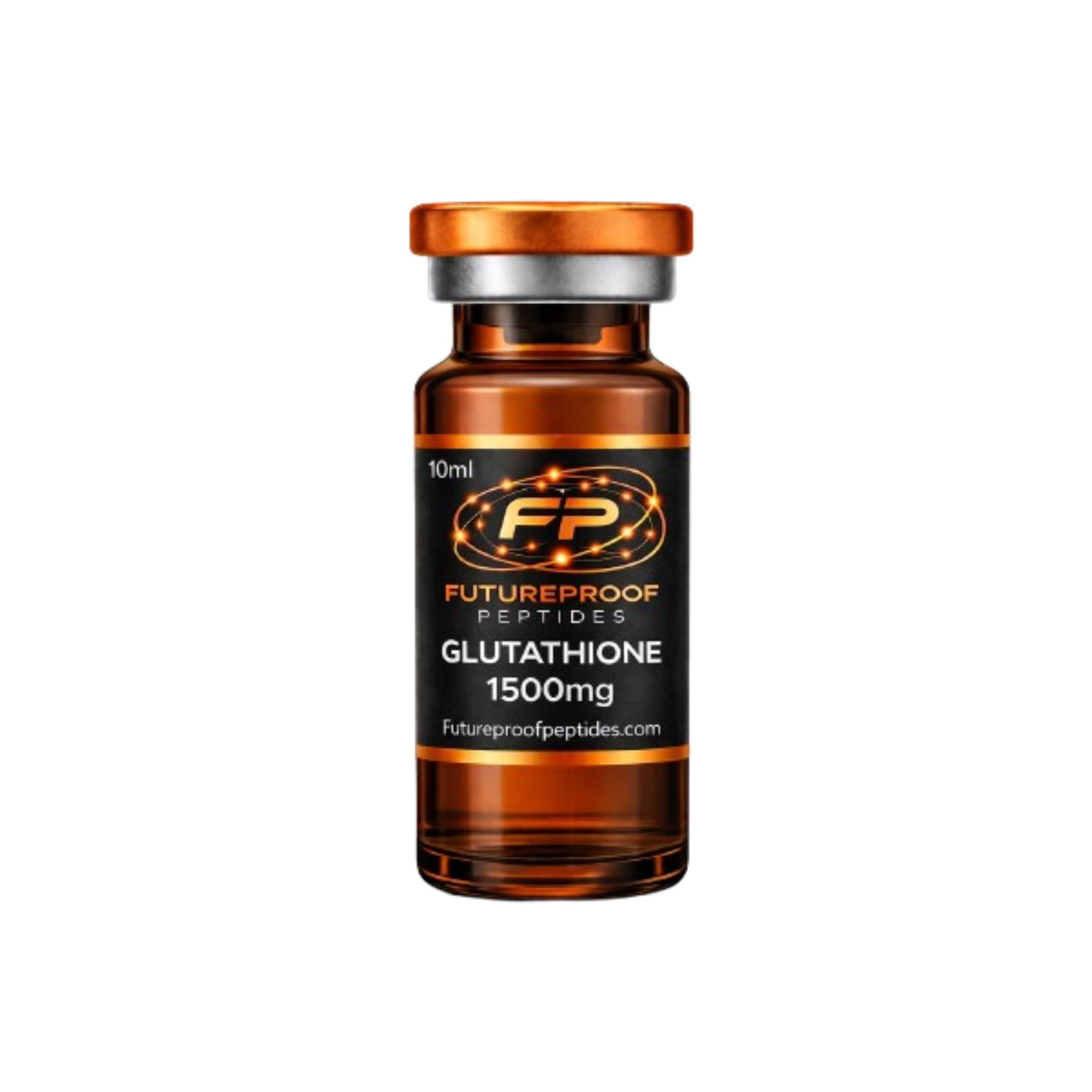
Glutathione 1500mg
Our Glutathione 1500mg vial is a research formulation designed for controlled laboratory investigations into glutathione metabolism, oxidative stress, cellular balance, and antioxidant-related pathways.
Glutathione is a naturally occurring tripeptide found throughout the body. It consists of three amino acids: glutamate, cysteine, and glycine.
Because of its important role in cellular redox systems, glutathione has become a widely studied compound in biochemical and cellular research.
The Glutathione 1500mg format provides a defined quantity for laboratory applications where controlled preparation, consistency, and repeatable testing are important.
This product is supplied strictly for research purposes and is not intended for human or veterinary use.
What Is Glutathione?
Glutathione is a small molecule composed of three amino acids: glutamate, cysteine, and glycine.
It is commonly described as a tripeptide because of its three-amino-acid structure.
Unlike many longer research peptides, glutathione has a relatively simple molecular structure. Despite this, it participates in numerous biological processes.
Glutathione is primarily present in its reduced form, known as GSH. It can also exist in an oxidized form known as GSSG.
The relationship between GSH and GSSG is particularly important in laboratory research.
Researchers can examine changes between these forms to better understand the redox state of cells and how biological systems respond to oxidative conditions.
Why Is Glutathione Studied?
Glutathione is widely studied because it is involved in several important cellular processes.
Research involving glutathione commonly examines:
- Oxidative stress
- Cellular redox balance
- Antioxidant pathways
- Glutathione metabolism
- Cellular signalling
- Mitochondrial function
- Protein regulation
- Detoxification pathways
- Cellular responses to stress
The wide range of biological processes associated with glutathione makes it relevant to many different areas of laboratory research.
Rather than being studied for one isolated function, glutathione is often investigated as part of a larger network of cellular processes.
Glutathione And Oxidative Stress
One of the main areas of Glutathione 1500mg research is oxidative stress.
Oxidative stress describes a situation where reactive molecules are produced faster than cellular systems can effectively maintain balance.
Reactive oxygen species are naturally generated during normal cellular activity.
They can also increase under certain experimental conditions.
Glutathione is part of the cellular antioxidant network that researchers study when investigating these processes.
By monitoring glutathione levels and related biomarkers, researchers can examine how cells respond to changes in their oxidative environment.
This makes glutathione particularly relevant to controlled studies involving cellular stress.
Reduced And Oxidized Glutathione
Glutathione exists mainly in two forms.
The reduced form is known as GSH, while the oxidized form is known as GSSG.
When GSH participates in certain reactions involving oxidizing compounds, it can become oxidized and form GSSG.
Cells have enzymatic systems that can convert GSSG back into GSH.
This creates a dynamic cycle that helps researchers understand the cellular redox environment.
Laboratory studies may therefore measure both GSH and GSSG instead of looking only at total glutathione.
The GSH-to-GSSG relationship can provide additional information about oxidative conditions within an experimental system.
Glutathione And Cellular Antioxidant Research
Glutathione is an important component of cellular antioxidant research.
It works alongside several enzymes and other antioxidant molecules.
Researchers commonly investigate the interaction between glutathione and enzymes such as glutathione peroxidase and glutathione S-transferases.
These systems are involved in different biochemical reactions associated with oxidative compounds and cellular metabolism.
Studying these interactions helps scientists understand how cells maintain their internal chemical balance.
The Glutathione 1500mg format can therefore be relevant to laboratory projects examining antioxidant-related pathways.
Glutathione Peroxidase
Glutathione peroxidases are enzymes that use glutathione during reactions involving peroxide compounds.
These enzymes are involved in the reduction of hydrogen peroxide and certain lipid hydroperoxides.
Researchers can study glutathione peroxidase activity alongside glutathione concentrations to investigate oxidative responses.
Experimental measurements may include:
- GSH concentration
- GSSG concentration
- GSH/GSSG ratio
- Glutathione peroxidase activity
- Hydrogen peroxide levels
- Lipid oxidation markers
These measurements can help provide a broader understanding of how cells respond to oxidative challenges.
Glutathione S-Transferase Research
Glutathione S-transferases are another group of enzymes associated with glutathione.
These enzymes participate in reactions involving glutathione conjugation.
Such reactions can be important in the metabolism of certain compounds within cells.
Research involving glutathione S-transferases can therefore provide information about cellular metabolism and the handling of reactive substances.
This is one reason glutathione continues to attract interest beyond traditional antioxidant research.
Glutathione And Cellular Redox Balance
Cellular redox balance refers to the controlled relationship between oxidation and reduction reactions occurring within cells.
These reactions are essential for normal cellular activity.
Energy production, metabolism, signalling, and protein regulation all involve chemical reactions that can influence the cellular redox environment.
Glutathione forms part of this system.
Researchers therefore examine glutathione concentrations and oxidation states when studying changes in cellular redox balance.
The Glutathione 1500mg research formulation can be incorporated into controlled experimental systems designed to investigate these processes.
Glutathione Metabolism
Glutathione is continuously synthesized, used, and recycled within cells.
Its production involves multiple enzymatic steps.
The first major step involves the formation of gamma-glutamylcysteine.
A second step adds glycine to produce glutathione.
The availability of the required amino acids and the activity of the enzymes involved can influence glutathione production.
Researchers studying glutathione metabolism may therefore examine both synthesis and degradation.
This provides a more complete picture of how cellular glutathione levels are maintained.
Glutathione And Mitochondrial Research
Mitochondria are responsible for producing much of the energy required by cells.
Because mitochondrial energy production involves oxidative metabolism, researchers are interested in the relationship between mitochondria and antioxidant systems.
Glutathione is present within cells and contributes to the management of the redox environment.
Studies may investigate how mitochondrial activity changes alongside glutathione status.
Areas of interest include:
- Mitochondrial function
- Cellular energy production
- Oxidative stress
- Redox regulation
- Mitochondrial antioxidant systems
These studies can help researchers understand the relationship between energy metabolism and cellular oxidative balance.
Glutathione And Cellular Stress
Cells can experience different forms of stress during laboratory experiments.
Researchers may expose cells to controlled environmental, metabolic, or oxidative conditions.
Glutathione levels can then be measured to determine how the cellular antioxidant system responds.
This can involve comparing baseline measurements with measurements taken after an experimental challenge.
Researchers may examine whether glutathione becomes depleted, whether GSSG increases, or whether cellular systems restore the reduced glutathione pool.
These observations can provide useful information about cellular adaptation.
Glutathione And Protein Function
Glutathione can interact with proteins through redox-related mechanisms.
Many proteins contain cysteine residues that can be chemically modified depending on the surrounding redox environment.
Because glutathione contains a reactive thiol group, it can participate in these processes.
Research into glutathione and protein regulation may therefore examine how changes in redox conditions affect protein activity and signalling.
This provides another reason why glutathione is studied in molecular and cellular biology.
Glutathione And Cellular Signalling
Glutathione is also associated with cellular signalling.
Changes in the redox environment can influence signalling proteins and other regulatory molecules.
Researchers investigate these relationships to better understand how oxidative conditions communicate with cellular pathways.
This research can involve measuring glutathione alongside signalling proteins, gene expression markers, or other biochemical indicators.
The purpose is to understand how cellular systems respond collectively rather than attributing an entire response to glutathione alone.
Glutathione Research And Ageing
Glutathione has attracted research interest in the field of ageing biology.
As organisms age, researchers observe changes in several cellular systems.
These can include changes in antioxidant capacity, mitochondrial activity, metabolism, and cellular redox balance.
Glutathione levels and glutathione-related enzyme activity have therefore been examined in ageing research.
However, these relationships are complex.
Changes in glutathione levels may be associated with multiple biological factors and should not automatically be interpreted as evidence of a specific anti-ageing effect.
Research continues to investigate these relationships under controlled conditions.
Glutathione And Inflammation Research
Another area of scientific interest involves the relationship between oxidative stress and inflammatory signalling.
Oxidative pathways and inflammatory pathways can interact with one another within cells.
Researchers therefore examine glutathione status alongside inflammatory markers.
Studies may investigate:
- Cytokine signalling
- Oxidative biomarkers
- Cellular redox status
- Antioxidant enzyme activity
- Cellular responses to inflammatory conditions
This research is intended to understand biological mechanisms and does not establish clinical benefits.
Glutathione And Tissue Research
Glutathione is present in many tissues and is therefore relevant to research involving different biological systems.
Researchers can investigate glutathione concentrations in specific tissues and compare them under different experimental conditions.
This can help identify whether particular tissues respond differently to oxidative or metabolic challenges.
Such research can involve tissue culture, biochemical assays, animal models, or other controlled experimental systems.
The findings depend heavily on the experimental model and should be interpreted within that context.
Why Choose A 1500mg Format?
The Glutathione 1500mg format provides a larger research quantity for laboratory workflows that require repeated testing or extended experimental observation.
A larger format may be convenient when researchers need to work with the same material across multiple stages of a study.
Potential applications include:
- Repeated laboratory analysis
- Extended research projects
- Biochemical testing
- Controlled cellular studies
- Comparative experiments
- Redox pathway investigations
The appropriate quantity depends on the specific research protocol.
This product does not provide instructions for human administration or dosing.
Laboratory Quality And Consistency
Consistency is an important part of reliable laboratory research.
Variations in material quality, preparation, storage, or experimental conditions can introduce unwanted differences between results.
Researchers should therefore maintain appropriate documentation and use validated procedures.
Where available, batch-specific documentation should be reviewed before beginning an experiment.
Important information may include:
- Product identity
- Batch information
- Purity information
- Manufacturing details
- Analytical testing
- Storage requirements
Maintaining appropriate records can improve reproducibility between experiments.
Preparation And Laboratory Handling
The Glutathione 1500mg vial is supplied in a dry formulation intended for laboratory preparation.
Preparation should be performed according to the laboratory’s validated procedures and the applicable product documentation.
The appropriate preparation method may depend on the intended research application.
Researchers should consider factors such as solvent selection, concentration, temperature, container compatibility, and stability.
Because different research applications may require different preparation conditions, laboratories should establish procedures appropriate to their specific experimental design.
Storage
The Glutathione 1500mg formulation should be stored according to the applicable product and batch documentation.
The material should be protected from excessive heat, moisture, and unnecessary exposure to light.
Stable storage conditions can help maintain the quality of the material before laboratory preparation.
Once prepared, laboratories should follow their validated storage and handling procedures.
Avoiding unnecessary temperature changes and inappropriate storage conditions can help support consistency during research.
Research Limitations
Although glutathione has been extensively studied, individual findings must always be considered within the context of the specific research model.
Results from cell culture experiments cannot automatically be applied to humans.
Similarly, findings from animal studies do not automatically establish human safety or effectiveness.
Glutathione also participates in numerous biological pathways, meaning that observed changes may involve several interacting mechanisms.
For this reason, researchers should evaluate glutathione alongside appropriate controls, biomarkers, and experimental measurements.

Research Use Only
Our Glutathione 1500mg vial is supplied strictly for laboratory research and analytical testing.
It is not intended for human consumption, self-administration, veterinary use, diagnosis, treatment, or prevention of disease.
The information provided is intended for educational purposes and describes scientific areas of interest rather than established therapeutic benefits.
Conclusion
Glutathione 1500mg provides a defined research format for laboratories studying glutathione metabolism, oxidative stress, cellular redox balance, antioxidant pathways, and related biochemical processes.
Glutathione is particularly interesting because it participates in a broad network of cellular mechanisms.
Its relationship with GSH and GSSG, antioxidant enzymes, mitochondrial function, protein regulation, and cellular signalling makes it relevant across numerous research fields.
The larger 1500mg format can also provide flexibility for laboratories conducting repeated experiments or extended analytical studies.
As scientific research continues, glutathione remains an important subject in investigations into cellular stress, metabolism, ageing biology, and redox regulation.
For reliable results, researchers should follow validated laboratory procedures, appropriate storage conditions, and documented handling practices.
Glutathione 1500mg is supplied for research use only and is not intended for human or veterinary use.
Glutathione 1500mg Glutathione 1500mg Glutathione 1500mg Glutathione 1500mg Glutathione 1500mg Glutathione 1500mg Glutathione 1500mg Glutathione 1500mg Glutathione 1500mg Glutathione 1500mg Glutathione 1500mg Glutathione 1500mg


