Retatrutide 40mg Pen – Powerful Research Peptide for Metabolic Studies
The Retatrutide 40mg Pen is an investigational research peptide associated with scientific studies into metabolic signalling, appetite-related pathways, energy balance, glucose regulation, and body-weight-related biological processes.
Retatrutide has attracted substantial scientific interest because of its distinctive triple-receptor mechanism.
Rather than being designed around a single metabolic receptor, retatrutide is being investigated for activity at three receptor systems: GLP-1, GIP, and glucagon.
This combination creates a particularly interesting model for researchers studying how multiple hormonal pathways interact.
The Retatrutide 40mg Pen provides a defined research format for controlled laboratory environments where investigators may be examining these interconnected biological pathways.
Retatrutide was originally developed by Eli Lilly and has progressed through clinical research programs investigating metabolic outcomes and safety.
Despite the attention surrounding the compound, retatrutide remains investigational. Research findings should therefore be distinguished from established medical treatments and approved pharmaceutical products.
This product is supplied strictly for research and laboratory purposes.
It is not intended for human consumption, self-administration, medical treatment, diagnosis, or veterinary use.
What Is Retatrutide?
Retatrutide is an investigational peptide-based triple receptor agonist.
Its research profile is defined by activity across three hormone receptor pathways:
- GLP-1 receptors
- GIP receptors
- Glucagon receptors
Each pathway has a different biological role.
GLP-1 signalling has been extensively studied in relation to appetite, gastrointestinal activity, glucose regulation, and endocrine signalling.
GIP is associated with nutrient-dependent hormonal signalling and insulin-related pathways.
Glucagon signalling is connected with glucose homeostasis, energy mobilisation, and metabolic activity.
The scientific interest in retatrutide comes from investigating these pathways simultaneously.
The Retatrutide 40mg Pen is therefore relevant to researchers studying multi-pathway metabolic pharmacology.
Instead of examining one receptor system in isolation, researchers can investigate how several interconnected pathways may influence overall metabolic signalling.
Understanding the Triple-Receptor Mechanism
The triple-receptor mechanism is one of the defining characteristics of the Retatrutide 40mg Pen.
Retatrutide is designed to activate GLP-1, GIP, and glucagon receptors.
These receptors participate in different but interconnected biological processes.
Studying their combined activity can help researchers investigate whether simultaneous signalling produces a different biological profile from compounds that act on fewer receptors.
This is an important area of modern metabolic research.
GLP-1 Receptor Activity
GLP-1 is an incretin hormone involved in several aspects of metabolic physiology.
GLP-1 receptor signalling has been investigated in relation to appetite, pancreatic signalling, gastrointestinal function, and glucose homeostasis.
Researchers studying the Retatrutide 40mg Pen can therefore be interested in the GLP-1 component of its receptor profile.
GLP-1 signalling may also influence gastric emptying and satiety-related processes.
However, retatrutide should not be considered simply another GLP-1 research compound.
Its research profile includes two additional receptor targets.
GIP Receptor Activity
GIP is another hormone involved in nutrient-responsive signalling.
GIP receptor activity has been studied extensively in connection with insulin secretion, nutrient metabolism, adipose biology, and broader metabolic regulation.
The presence of GIP activity makes retatrutide particularly interesting when researchers compare different combinations of incretin pathways.
The Retatrutide 40mg Pen can therefore be incorporated into research investigating how GIP signalling interacts with GLP-1 and glucagon pathways.
Glucagon Receptor Activity
Glucagon plays a major role in maintaining energy availability.
Glucagon receptor signalling has been studied in relation to hepatic glucose production, energy mobilisation, lipid metabolism, and energy expenditure.
The addition of glucagon receptor activity distinguishes retatrutide from many earlier incretin-focused research compounds.
This triple mechanism is one of the primary reasons retatrutide has become an important subject in metabolic research.
How Does Retatrutide Work?
The Retatrutide 40mg Pen contains an investigational compound designed to interact with three metabolic hormone receptor systems.
When these receptors are activated, downstream signalling can influence multiple biological processes.
Researchers are particularly interested in how these pathways interact rather than simply studying each receptor separately.
The three pathways can broadly be described as follows:
GLP-1
Research associates GLP-1 receptor signalling with appetite-related pathways, gastrointestinal processes, pancreatic function, and glucose regulation.
GIP
GIP receptor research focuses on nutrient-dependent endocrine signalling, insulin-related responses, and metabolic activity.
Glucagon
Glucagon receptor research investigates glucose homeostasis, energy mobilisation, and metabolic fuel utilisation.
Retatrutide combines these three areas within one investigational molecule.
This makes the Retatrutide 40mg Pen relevant to research involving multi-receptor pharmacology and complex metabolic signalling.
Why Is Retatrutide Being Researched?
The main research interest surrounding retatrutide comes from its ability to interact with multiple metabolic pathways.
Traditional metabolic research often focuses on individual receptor systems.
Retatrutide provides a model for investigating how three pathways may interact simultaneously.
Researchers can therefore examine questions involving:
- Appetite signalling
- Energy expenditure
- Glucose metabolism
- Hormonal regulation
- Nutrient signalling
- Body-weight-related pathways
- Metabolic adaptation
- Receptor pharmacology
- Endocrine communication
- Cellular metabolic responses
The Retatrutide 40mg Pen is particularly relevant to research environments examining the relationship between these systems.
This broader approach reflects the complexity of metabolic physiology.
Retatrutide and Appetite Research
Appetite is regulated by a complex network of hormonal and neurological signals.
No single biological pathway completely explains food intake or energy balance.
GLP-1 signalling is one important component of appetite-related research.
GIP and glucagon pathways may also contribute to metabolic communication.
Researchers are therefore investigating whether combined receptor activity can provide additional insight into appetite-related biological processes.
The Retatrutide 40mg Pen may be studied within experimental models examining how metabolic hormone signalling relates to food-intake behaviour.
Such research must account for numerous variables.
These can include energy requirements, environmental factors, neurological signalling, gastrointestinal activity, hormonal status, and experimental conditions.
Retatrutide and Energy Balance
Energy balance describes the relationship between energy intake and energy expenditure.
It is influenced by numerous biological systems.
These include:
- Food intake
- Basal metabolic activity
- Physical activity
- Thermogenesis
- Hormonal signalling
- Nutrient availability
- Fat metabolism
- Glucose metabolism
- Metabolic adaptation
Retatrutide is particularly interesting because its glucagon receptor activity provides an additional pathway for studying energy regulation.
The Retatrutide 40mg Pen can therefore be relevant to research examining how GLP-1, GIP, and glucagon signalling interact with energy balance.
This does not mean that experimental observations automatically translate into individual outcomes.
Research results must always be interpreted within the specific experimental design.
Retatrutide and Glucose Metabolism
Glucose regulation involves a coordinated network of hormones and tissues.
Insulin and glucagon are particularly important.
GLP-1 and GIP also participate in nutrient-responsive endocrine signalling.
Retatrutide provides researchers with an opportunity to examine these systems together.
Studies may investigate how triple receptor activation influences glucose-related signalling under controlled conditions.
Research areas can include:
- Glucose homeostasis
- Insulin signalling
- Glucagon signalling
- Incretin pathways
- Nutrient response
- Hormonal communication
- Metabolic adaptation
The Retatrutide 40mg Pen is therefore relevant to researchers investigating complex endocrine and metabolic interactions.
Retatrutide and Body-Weight Research
Body weight is influenced by many interconnected factors.
These include appetite, energy expenditure, hormonal signalling, nutrient metabolism, genetics, physical activity, and environmental influences.
For this reason, modern weight-related research increasingly examines multiple biological pathways simultaneously.
Retatrutide has become an important research subject because of its triple-receptor profile.
The Retatrutide 40mg Pen may be relevant to studies examining the biological mechanisms associated with changes in body weight and energy balance.
Research findings should not, however, be interpreted as a guarantee of weight-related outcomes.
Investigational research is intended to generate scientific evidence, not provide individual treatment predictions.
Retatrutide and Metabolic Signalling
Metabolic signalling allows different organs and tissues to coordinate energy availability and nutrient use.
Hormonal pathways are central to this communication system.
GLP-1, GIP, and glucagon each participate in metabolic regulation through distinct mechanisms.
Retatrutide brings these receptor pathways together.
This creates a useful model for studying interactions between multiple signalling systems.
Researchers may investigate downstream effects involving cellular signalling, endocrine communication, glucose metabolism, and energy regulation.
The Retatrutide 40mg Pen can therefore support research focused on the broader biological network rather than one isolated pathway.
Retatrutide and Incretin Research
GLP-1 and GIP are commonly described as incretin hormones.
Incretin research examines how nutrient intake communicates with endocrine systems involved in metabolic regulation.
GLP-1 and GIP have been extensively studied in this field.
Retatrutide adds glucagon receptor activity to these pathways.
This creates an unusual research model involving two incretin-related pathways alongside glucagon signalling.
The combination is one of the reasons retatrutide has generated significant interest within metabolic pharmacology.
Retatrutide Clinical Research
Retatrutide has been investigated through clinical research programs examining metabolic outcomes.
Studies have explored areas including body weight, metabolic markers, glucose-related measurements, and safety observations.
Some clinical research has involved observation periods extending to approximately 48 weeks.
Longer observation periods can provide researchers with additional information about sustained receptor activity and changes over time.
However, clinical research remains distinct from regulatory approval.
The existence of clinical trials does not mean that an investigational compound is automatically approved for general medical use.
The Retatrutide 40mg Pen should therefore remain clearly identified as a research product.
What Researchers Can Learn From Clinical Studies
Clinical research can provide information that laboratory models cannot fully reproduce.
Researchers can examine how biological systems respond over longer periods and identify patterns that may not appear during short experiments.
Retatrutide research has therefore attracted interest in areas including:
- Body-weight-related outcomes
- Metabolic markers
- Glucose-related measurements
- Appetite-related observations
- Tolerability
- Adverse-event monitoring
- Long-term metabolic responses
These findings contribute to the scientific understanding of triple-receptor agonism.
They do not, however, establish that the Retatrutide 40mg Pen is appropriate for individual medical use.
Retatrutide and Safety Research
Safety assessment is an essential part of investigational research.
Researchers monitor participants and experimental systems for potential adverse effects.
Retatrutide and related metabolic receptor agonists have been associated with gastrointestinal observations in clinical research.
Reported observations may include:
- Nausea
- Vomiting
- Diarrhea
- Gastrointestinal discomfort
- Changes in appetite
The frequency and severity of observations can vary between research populations.
Study design, research duration, participant characteristics, and other variables can influence reported findings.
For this reason, safety information should always be evaluated using the original scientific evidence rather than generalized assumptions.
Retatrutide Compared With GLP-1 Research Compounds
The Retatrutide 40mg Pen is sometimes compared with earlier metabolic research compounds because of overlapping research interests.
However, the receptor profiles are different.
Many earlier compounds focus primarily on GLP-1 receptor signalling.
Retatrutide is being investigated across three receptor systems.
This means that retatrutide provides a broader model for studying metabolic signalling.
The difference is particularly important when researchers interpret experimental findings.
A result associated with GLP-1 receptor activation alone should not automatically be attributed to a triple-receptor compound.
Retatrutide Compared With Tirzepatide
Tirzepatide has been extensively researched as a dual GLP-1 and GIP receptor agonist.
Retatrutide differs because it adds glucagon receptor activity.
This creates a three-pathway research model.
The comparison between the two compounds is therefore scientifically interesting.
Researchers can examine how adding glucagon receptor activity may influence metabolic signalling compared with dual-receptor activity.
The Retatrutide 40mg Pen is consequently relevant to comparative research involving incretin and glucagon pathways.
Retatrutide Compared With Semaglutide
Semaglutide is primarily associated with GLP-1 receptor activity.
Retatrutide has a broader receptor profile involving GLP-1, GIP, and glucagon.
This fundamental difference means the compounds represent different pharmacological approaches.
Researchers comparing them may examine how receptor selectivity and multi-receptor activation influence metabolic pathways.
Such comparisons can help scientists understand the potential significance of different receptor combinations.
Retatrutide and Liver Metabolism Research
Metabolic research increasingly examines the relationship between hormonal signalling and liver biology.
The liver plays a central role in:
- Glucose production
- Glycogen storage
- Lipid metabolism
- Energy regulation
- Nutrient processing
Glucagon receptor signalling is particularly relevant to hepatic metabolic pathways.
Researchers therefore have an interest in understanding how retatrutide’s combined receptor activity may interact with liver metabolism.
The Retatrutide 40mg Pen may be relevant to experimental research examining these interconnected pathways.
Retatrutide and Fat Metabolism Research
Energy storage and lipid metabolism are important components of metabolic physiology.
Glucagon signalling has been studied in relation to the mobilisation and utilisation of stored energy.
Researchers are therefore interested in whether triple-receptor activity produces different metabolic responses from single- or dual-receptor approaches.
The Retatrutide 40mg Pen can be considered within this broader field of lipid and energy metabolism research.
Research observations should be interpreted cautiously because metabolic responses can differ substantially between models.
Retatrutide and Hormonal Communication
Hormonal communication allows tissues to respond to changes in nutrient availability.
GLP-1, GIP, and glucagon are examples of hormones involved in metabolic communication.
Retatrutide research examines what happens when the receptors associated with these signalling systems are activated by the same investigational compound.
This makes the compound useful for exploring endocrine network interactions.
Researchers can investigate how signals from different receptors converge on downstream biological processes.
Retatrutide Research in Cellular Models
Cellular models can help researchers examine receptor activity at a controlled level.
Experiments may focus on:
- Receptor activation
- Intracellular signalling
- Hormonal response
- Metabolic pathways
- Gene expression
- Cellular energy regulation
- Nutrient-responsive signalling
Cell-based experiments are useful for understanding mechanisms.
However, findings from isolated cells cannot automatically represent the complexity of an entire organism.
The Retatrutide 40mg Pen should therefore be evaluated according to the specific experimental model in which it is studied.
Retatrutide Research in Preclinical Models
Preclinical research can provide additional information about metabolic pathways.
Researchers may investigate food intake, body-weight-related changes, glucose metabolism, energy expenditure, and other physiological observations.
These models can help scientists develop hypotheses for subsequent research.
Nevertheless, animal and laboratory findings cannot automatically be translated into human outcomes.
This distinction is particularly important when discussing investigational compounds such as retatrutide.
Retatrutide Research and Long-Term Metabolic Adaptation
The body continuously adapts to changes in hormonal and metabolic signalling.
Long-term research is therefore important when investigating multi-receptor compounds.
Researchers may examine whether metabolic responses change over time.
Questions can include:
- Does receptor activity remain consistent?
- Do metabolic responses change with prolonged observation?
- How does appetite-related signalling adapt?
- How does energy expenditure respond?
- Are metabolic markers maintained or altered?
The Retatrutide 40mg Pen is relevant to research investigating these questions within controlled environments.
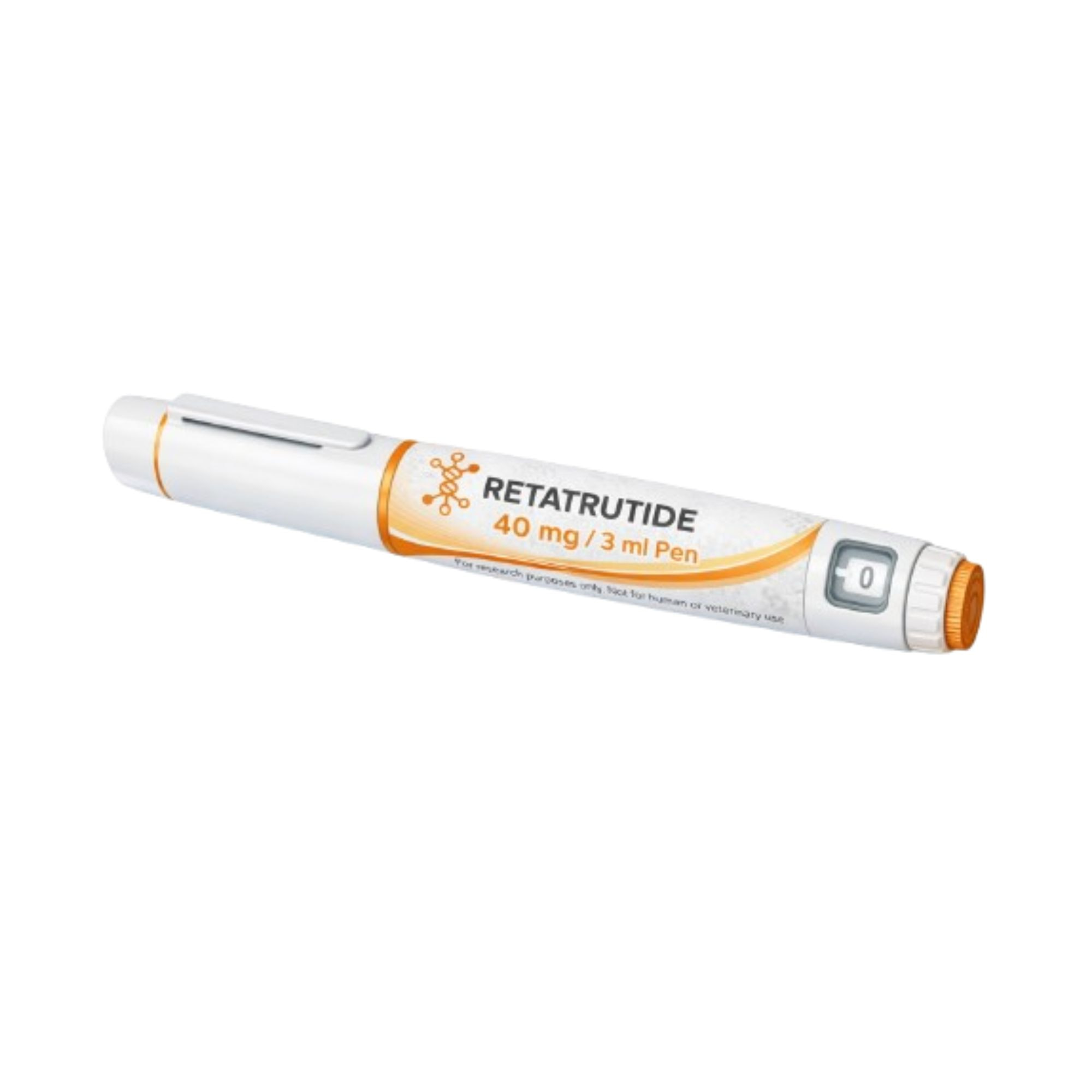
Retatrutide 40mg Pen Product Format
The Retatrutide 40mg Pen is presented in a pen-style research format.
The 40mg designation identifies the stated quantity associated with the product.
A defined product format can simplify laboratory inventory management and product identification.
For research environments, accurate documentation can support reproducibility and traceability.
Researchers may maintain records containing:
- Product name
- Batch or lot information
- Quantity
- Storage conditions
- Date received
- Research application
- Analytical documentation
- Relevant quality-control information
Good record keeping is an important part of responsible research practice.
Storage and Handling
Appropriate storage is important for maintaining the stability of research materials.
The Retatrutide 40mg Pen should be stored according to the applicable product documentation.
For this product, the supplied storage guidance specifies refrigerated conditions of approximately 2°C to 8°C.
The product should also be protected from direct light and excessive heat.
General storage considerations include:
- Store refrigerated at 2°C to 8°C.
- Do not freeze.
- Protect from direct sunlight.
- Avoid unnecessary heat exposure.
- Keep the product in its original packaging where appropriate.
- Minimise unnecessary handling.
- Keep away from children and pets.
- Follow applicable laboratory storage procedures.
Researchers should always consult the documentation associated with the specific product batch.
Quality Control and Research Reproducibility
Quality control plays an important role in scientific research.
Consistent research materials can help reduce unnecessary variability between experiments.
The Retatrutide 40mg Pen should be documented appropriately within the research environment.
Where applicable, researchers may evaluate analytical characteristics such as identity, purity, concentration, and stability.
The precise analytical requirements depend on the intended research application.
Researchers should use suitable laboratory methods and maintain appropriate documentation.
Why Receptor Combinations Matter
Biological systems rarely operate through a single pathway.
Metabolism is an interconnected network involving hormones, receptors, organs, tissues, and cellular signalling systems.
GLP-1, GIP, and glucagon represent three distinct components of this network.
Retatrutide provides researchers with a model for investigating their interaction.
The Retatrutide 40mg Pen is therefore relevant to research examining whether combined receptor activation produces a biological profile that differs from single- or dual-receptor approaches.
This is an important question within contemporary metabolic pharmacology.
Potential Research Areas
The Retatrutide 40mg Pen may be relevant to a range of scientific research areas.
Metabolic Signalling
Investigating interactions between GLP-1, GIP, and glucagon pathways.
Appetite Pathways
Studying hormonal signalling associated with food intake and appetite regulation.
Energy Balance
Examining relationships between energy intake, expenditure, and metabolic activity.
Glucose Research
Investigating hormonal pathways associated with glucose homeostasis.
Endocrine Research
Studying communication between metabolic hormones and their receptors.
Receptor Pharmacology
Investigating multi-receptor agonism and downstream signalling.
Body-Weight Research
Exploring biological mechanisms associated with body weight and energy balance.
Nutrient Metabolism
Examining how metabolic hormone signalling responds to nutrient availability.
Research Limitations
Although retatrutide has generated considerable scientific interest, it remains an investigational compound.
Several limitations should be considered when interpreting research.
First, results can vary between different experimental designs.
Second, preclinical findings cannot automatically predict human outcomes.
Third, clinical research findings do not necessarily establish long-term safety or effectiveness.
Fourth, regulatory status may change as additional research becomes available.
Finally, individual biological responses cannot be predicted from research findings alone.
For these reasons, the Retatrutide 40mg Pen should be presented accurately as a research product rather than an established treatment.
Important Distinction Between Research and Medical Use
The Retatrutide 40mg Pen is intended for research and laboratory applications.
It should not be represented as an approved medicine or replacement for prescription treatment.
Nothing in this product description should be interpreted as medical advice.
The information provided is intended to explain the scientific background and research relevance of retatrutide.
Researchers and institutions are responsible for following applicable laws, regulations, laboratory standards, and institutional requirements.
Frequently Asked Questions
What is the Retatrutide 40mg Pen?
The Retatrutide 40mg Pen is a research-format product containing the stated 40mg quantity of investigational retatrutide for laboratory and scientific research applications.
What is retatrutide?
Retatrutide is an investigational peptide-based triple receptor agonist being studied for activity at GLP-1, GIP, and glucagon receptors.
What receptors does retatrutide target?
Retatrutide is designed to activate GLP-1, GIP, and glucagon receptors.
Why is retatrutide considered a triple agonist?
It is described as a triple agonist because of its activity across three receptor systems rather than one or two.
Why is the Retatrutide 40mg Pen being researched?
The Retatrutide 40mg Pen is associated with research into metabolic signalling, appetite pathways, energy balance, glucose regulation, endocrine communication, and body-weight-related biology.
Is retatrutide the same as semaglutide?
No. Semaglutide is primarily associated with GLP-1 receptor activity, while retatrutide is being investigated for activity across GLP-1, GIP, and glucagon receptors.
Is retatrutide the same as tirzepatide?
No. Tirzepatide is a dual GLP-1/GIP receptor agonist, while retatrutide is being investigated as a triple GLP-1/GIP/glucagon receptor agonist.
Is retatrutide approved as a medicine?
Retatrutide is an investigational compound. Its research status should be distinguished from approved pharmaceutical treatments.
What does 40mg mean?
The 40mg designation refers to the stated quantity associated with the research product.
How should the Retatrutide 40mg Pen be stored?
The supplied storage guidance specifies refrigerated storage at approximately 2°C to 8°C, with protection from direct light and excessive heat. The product should not be frozen.
Is the Retatrutide 40mg Pen intended for human use?
No. This product is presented strictly for research and laboratory purposes and is not intended for human consumption or medical use.
Does retatrutide have established long-term safety?
Long-term safety remains an area of ongoing investigation. Research findings should not be interpreted as established safety information for general medical use.
Can clinical-trial results guarantee individual results?
No. Results observed in controlled research cannot guarantee outcomes for an individual.
What makes retatrutide scientifically interesting?
Its triple-receptor mechanism provides researchers with a model for studying GLP-1, GIP, and glucagon signalling simultaneously.
Retatrutide 40mg Pen Research Summary
The Retatrutide 40mg Pen represents a research-oriented product associated with an important area of modern metabolic science.
Retatrutide’s defining feature is its triple-receptor activity involving GLP-1, GIP, and glucagon pathways.
These pathways are connected to appetite signalling, glucose regulation, energy balance, nutrient metabolism, and endocrine communication.
The combination provides researchers with an opportunity to investigate metabolic regulation from a multi-pathway perspective.
The Retatrutide 40mg Pen can therefore be relevant to laboratory research involving receptor pharmacology, metabolic signalling, endocrine biology, appetite pathways, glucose research, and energy balance.
Clinical research has contributed significantly to scientific understanding of retatrutide, but the compound remains investigational.
Research findings should be interpreted according to the quality, design, duration, and limitations of the individual study.
Preclinical research, clinical research, and established medical evidence should not be treated as interchangeable.

Product Specifications
Product Name: Retatrutide 40mg Pen
Product Type: Investigational research peptide
Quantity: 40mg
Format: Pen-style research format
Primary Research Areas: Metabolic signalling, GLP-1 research, GIP research, glucagon research, appetite pathways, energy balance, endocrine research, glucose metabolism
Research Mechanism: Triple receptor activity involving GLP-1, GIP, and glucagon receptors
Intended Purpose: Laboratory and research applications only
Human Use: Not intended for human use
Veterinary Use: Not intended for veterinary use
Storage: Refrigerated at approximately 2°C to 8°C according to supplied product guidance
Light Protection: Protect from direct light
Freezing: Do not freeze
Quality Documentation: Refer to applicable product and batch documentation
Research-Only Disclaimer
The Retatrutide 40mg Pen is supplied strictly for laboratory and research purposes.
It is not a medicine, dietary supplement, or approved treatment.
It is not intended to diagnose, treat, cure, or prevent any disease or medical condition.
Nothing contained in this product description constitutes medical advice or a recommendation for human use.
The information provided is intended to describe the scientific background and research relevance of retatrutide.
Researchers, laboratories, and institutions are responsible for ensuring that research materials are handled and stored appropriately and that all applicable laws, regulations, safety requirements, and institutional policies are followed.
Final Overview
The Retatrutide 40mg Pen is an investigational research product associated with one of the most interesting developments in modern metabolic pharmacology.
Its defining characteristic is simultaneous activity across three hormone receptor systems: GLP-1, GIP, and glucagon.
This triple-receptor profile distinguishes retatrutide from many earlier compounds that primarily focused on one or two metabolic pathways.
Researchers are studying how these pathways interact and how combined receptor activity may influence metabolic signalling, appetite-related pathways, glucose regulation, energy balance, and body-weight-related biology.
The Retatrutide 40mg Pen therefore provides a research-focused format for laboratories investigating these areas under controlled conditions.
As research continues, scientists are working to understand the mechanisms, biological responses, tolerability, and long-term implications associated with triple-receptor activation.
The growing body of retatrutide research demonstrates the importance of examining metabolism as an interconnected biological system rather than a collection of isolated pathways.
For researchers interested in GLP-1, GIP, glucagon, endocrine signalling, energy metabolism, and multi-receptor pharmacology, the Retatrutide 40mg Pen represents a distinctive investigational research subject.
All findings should be evaluated according to the relevant scientific evidence, and the investigational status of retatrutide should always be clearly recognised.