

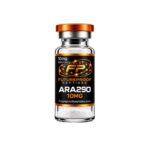
ARA-290 10mg Vial – Advanced Cibinetide Research
Our ARA-290 10mg Vial contains ARA-290, also known as cibinetide, an 11-amino-acid peptide derived from the structure of erythropoietin (EPO) and developed to investigate non-erythropoietic signalling pathways.
ARA-290 has attracted scientific interest because researchers have investigated its interaction with the innate repair receptor (IRR) and associated pathways involving cellular stress, inflammatory signalling, tissue responses and nerve biology.
Unlike conventional erythropoietin research, which primarily focuses on erythropoiesis and red blood cell production, ARA-290 research has focused on a different aspect of EPO biology. Scientific studies have investigated whether selective activation of the proposed IRR pathway can produce tissue-protective and repair-associated signalling without directly targeting the classical erythropoietic pathway.
The ARA-290 10mg Vial is supplied strictly for laboratory research, analytical testing and scientific investigation. It is not intended for human or veterinary use.
What Is ARA-290?
ARA-290, also known as cibinetide, is a synthetic 11-amino-acid peptide derived from erythropoietin.
It was developed from a region of EPO known as the helix B surface and is also described in scientific literature as pyroglutamate helix B surface peptide (pHBSP). Researchers developed ARA-290 to investigate tissue-protective signalling associated with EPO while avoiding the primary focus on erythropoiesis associated with conventional EPO activity.
This unusual relationship with EPO makes ARA-290 particularly interesting within peptide research.
Instead of investigating the hormone primarily as a regulator of red blood cell production, researchers have used ARA-290 as a tool for studying signalling associated with cellular stress, inflammation, nerve biology and tissue responses.
ARA-290 And The Innate Repair Receptor
A major area of ARA-290 research involves the proposed innate repair receptor, or IRR.
The IRR has been described as a receptor complex involving the erythropoietin receptor and the β-common receptor, also known as CD131. Research has investigated how this signalling system may become relevant during cellular stress or tissue injury.
ARA-290 has been investigated as a selective agonist of this pathway.
Experimental research has associated activation of this signalling system with changes in inflammatory and tissue-response pathways. This has led scientists to investigate whether the pathway could provide insight into how cells respond to injury and metabolic stress.
Importantly, the molecular details surrounding the IRR remain an area of scientific discussion. Some research has questioned whether EPOR and β-common receptor directly form the proposed receptor complex under all conditions.
For this reason, the IRR should be described as an investigated signalling model rather than an entirely settled biological mechanism.
Why Is ARA-290 Researched?
ARA-290 has been studied across both preclinical models and human clinical research.
Research areas have included:
- Cellular stress responses
- Inflammatory signalling
- Nerve biology
- Small-fiber neuropathy
- Tissue-protective pathways
- Metabolic research
- Vascular and neurological biology
- Experimental tissue-repair models
The compound is particularly interesting because its research history extends beyond laboratory experiments into exploratory human clinical studies.
For example, clinical studies have investigated ARA-290 in people with sarcoidosis-associated small-fiber neuropathy and in people with type 2 diabetes-associated neuropathic symptoms.
These studies provide useful scientific context, but they should not be interpreted as establishing ARA-290 as an approved treatment.
ARA-290 And Erythropoietin
Although ARA-290 is derived from erythropoietin, it should not be confused with recombinant EPO or other conventional erythropoietin products.
EPO is a naturally occurring hormone best known for regulating the production of red blood cells.
ARA-290 was designed around a specific region of the EPO structure to investigate signalling associated with tissue protection rather than primarily studying erythropoiesis.
Scientific reviews describe the distinction between classical EPO receptor signalling and the proposed tissue-protective signalling associated with the EPOR/β-common receptor complex.
This distinction is central to understanding why ARA-290 has become an interesting research peptide.
Non-Erythropoietic Peptide Research
One of the defining characteristics of ARA-290 research is its description as a non-erythropoietic peptide.
The goal of developing ARA-290 was to investigate EPO-related tissue signalling without reproducing the conventional red-blood-cell-producing activity associated with erythropoietin.
This provides researchers with a useful experimental model for examining whether biological effects associated with EPO can be separated from its classical hematopoietic activity.
The distinction is particularly relevant when studying:
- Cellular stress
- Inflammatory responses
- Tissue signalling
- Neurological pathways
- Repair-associated mechanisms
The term “non-erythropoietic” refers to the intended biological profile of the compound and should not be interpreted as a guarantee of safety or a clinical-use claim.
ARA-290 And Cellular Stress
Cellular stress occurs when cells encounter conditions that challenge normal biological function.
Research involving the EPO-derived tissue-protective pathway has investigated how cells respond to injury, inflammatory mediators and metabolic stress.
ARA-290 has therefore been used as an experimental tool for investigating whether selective activation of EPO-related signalling can influence cellular responses under stressful conditions.
Studies using experimental cell and animal systems have investigated pathways associated with inflammatory mediators, immune-cell activity and tissue integrity.
These findings provide mechanistic research opportunities but do not establish a therapeutic effect in humans.
ARA-290 And Inflammatory Signalling
Inflammatory signalling is another major area of ARA-290 research.
Preclinical research has investigated whether cibinetide can influence inflammatory pathways through signalling associated with the proposed IRR.
For example, research using an experimental mouse model of colitis reported changes in inflammatory mediators and immune-cell responses following cibinetide treatment. Laboratory experiments also investigated mechanisms involving CD131, JAK2 and NF-κB signalling.
These findings are useful for understanding possible molecular mechanisms, but results from animal and cellular models cannot automatically be translated into human therapeutic outcomes.
ARA-290 And Nerve Research
ARA-290 has received particular attention in experimental neuroscience and peripheral nerve research.
Researchers have investigated the compound in models involving neuropathic pain, small-fiber injury and neurogenic inflammatory responses.
Experimental work has examined whether activation of the proposed IRR pathway influences the interaction between immune signalling and nerve function.
This has made ARA-290 an interesting research compound for laboratories studying the relationship between inflammation, nerve signalling and tissue stress.
Small-Fiber Neuropathy Research
Human clinical research has investigated ARA-290 in small-fiber neuropathy associated with conditions including sarcoidosis and type 2 diabetes.
A randomized, double-blind pilot study in patients with sarcoidosis-associated small-fiber neuropathy reported improvements in certain neuropathy-related measures after experimental treatment.
Another clinical study involving people with type 2 diabetes and neuropathic symptoms reported changes in neuropathic symptoms and metabolic measures during the study period.
These studies are scientifically relevant because they demonstrate that cibinetide has been investigated in human subjects. However, individual clinical trials do not establish broad effectiveness or approval for general medical use.
ARA-290 And Nerve-Fiber Biology
Researchers have also investigated ARA-290 in relation to nerve-fiber structure.
A phase 2b study in people with sarcoidosis-associated small nerve-fiber loss examined corneal nerve-fiber measures alongside neuropathic pain and functional outcomes.
This research is relevant to scientists studying peripheral nerve biology and the relationship between tissue stress, inflammation and nerve-fiber integrity.
The use of nerve-fiber measurements in clinical research also illustrates the range of biological endpoints that have been explored with ARA-290.
ARA-290 And Metabolic Research
Metabolic biology represents another area of scientific interest.
In a phase 2 clinical study involving people with type 2 diabetes, ARA-290 was investigated in relation to metabolic control and neuropathic symptoms. The study reported changes in HbA1c and lipid measures alongside improvements in certain neuropathy-related outcomes.
These findings have contributed to continuing interest in the relationship between EPO-derived signalling, metabolic stress and tissue responses.
However, a research compound should not be presented as a treatment for diabetes or metabolic disease based solely on exploratory clinical findings.
ARA-290 And Tissue Protection Research
The concept of tissue protection is central to the scientific rationale behind ARA-290.
The EPO-derived peptide was developed to investigate signalling pathways associated with cellular protection and repair rather than conventional erythropoiesis.
Preclinical studies have examined tissue responses under conditions involving injury, inflammation and metabolic stress.
Researchers continue to investigate how such signalling pathways may influence cellular survival, inflammatory responses and tissue integrity.
Potential Research Effects
Scientific investigations involving ARA-290 have explored several potential biological effects.
These include:
- Modulation of inflammatory signalling
- Changes in cellular stress responses
- Investigation of nerve-fiber biology
- Tissue-protective signalling
- Experimental repair-associated pathways
- Metabolic research
- Neuroinflammatory pathways
These should be understood as areas of scientific investigation rather than established therapeutic benefits.
The results of individual studies depend on the model, experimental conditions, population and study design.
ARA-290 And Clinical Research
Unlike many experimental peptide compounds, ARA-290 has been investigated in multiple human clinical studies.
Research has included exploratory trials involving:
- Sarcoidosis-associated small-fiber neuropathy
- Type 2 diabetes-associated neuropathic symptoms
- Diabetic macular edema
For example, a small phase 2 study of cibinetide in diabetic macular edema did not demonstrate improvement in several primary ophthalmic measures, although some secondary observations warranted additional investigation.
This is an important example of why individual research findings need to be considered in context.
Clinical research can produce mixed results, and evidence from one condition or endpoint cannot automatically be generalized to other applications.
ARA-290 Research And Safety
Clinical studies have examined the safety and tolerability of ARA-290 under specific research protocols.
One early randomized study in sarcoidosis-associated small-fiber neuropathy reported no safety concerns from its clinical or laboratory assessments.
A separate type 2 diabetes study likewise reported no potential safety issues during its observation period.
However, these observations should not be interpreted as establishing the long-term safety of an unapproved research product.
Safety outcomes depend on factors including study population, formulation, exposure, protocol and duration.
Product Information
Our ARA-290 10mg Vial is supplied as a research presentation containing ARA-290/cibinetide for laboratory investigation.
The vial format is designed for laboratories that prefer conventional peptide research presentations.
Researchers should review the documentation supplied with the specific batch for applicable information regarding identity, purity, storage and analytical testing.
Product Specifications
- Product: ARA-290 10mg Vial
- Compound: ARA-290 / Cibinetide
- Peptide Type: EPO-derived peptide
- Peptide Length: 11 amino acids
- Format: Research vial
- Primary Research Areas: Cellular stress, inflammatory signalling, nerve biology and tissue-response pathways
- Intended Use: Laboratory research and analytical investigation
- Human Use: Not intended
- Veterinary Use: Not intended
Quality And Research Standards
Reproducible research depends on consistent and appropriately characterized experimental materials.
Researchers working with ARA-290 may consider analytical documentation covering:
- Compound identity
- Batch identification
- Purity
- Analytical testing
- Product specifications
- Storage requirements
Researchers should rely on documentation associated with the individual batch rather than assuming that published information about ARA-290 necessarily describes every research formulation.
Storage And Handling
The ARA-290 10mg Vial should be stored according to the product-specific requirements provided with the research material.
Researchers should protect research materials from inappropriate environmental conditions and follow established laboratory procedures for peptide storage and handling.
Avoid unnecessary exposure to excessive heat, moisture or direct light where applicable.
Storage requirements can vary according to formulation and packaging, so the applicable product documentation should always take precedence.
Research Applications
The ARA-290 10mg Vial may be relevant to laboratory investigations involving:
- Innate repair signalling
- EPO-derived peptide biology
- Cellular stress
- Inflammatory pathways
- Neuroinflammation
- Peripheral nerve biology
- Small-fiber research
- Tissue-response models
- Metabolic stress
- Cellular protection mechanisms
The suitability of ARA-290 for any specific experiment depends on the research question, experimental model and laboratory protocol.
Research Limitations
ARA-290 has a relatively extensive research history compared with many experimental peptides, including both preclinical and human studies.
Nevertheless, important limitations remain.
The evidence base includes:
- Cell-based studies
- Animal models
- Exploratory clinical trials
- Small clinical studies
- Mechanistic research
Clinical findings have not been uniformly positive across all applications. For example, a phase 2 trial investigating cibinetide in diabetic macular edema did not demonstrate improvement in several primary ophthalmic endpoints.
The scientific literature therefore supports continued investigation rather than broad claims of established efficacy.
Frequently Asked Questions
What is ARA-290?
ARA-290, also called cibinetide, is an 11-amino-acid synthetic peptide derived from the structure of erythropoietin and investigated for its interaction with the proposed innate repair receptor pathway.
What is the ARA-290 10mg Vial?
The ARA-290 10mg Vial is a research presentation containing ARA-290/cibinetide for laboratory research and analytical investigation.
Is ARA-290 the same as erythropoietin?
No. ARA-290 is an EPO-derived peptide and should not be confused with erythropoietin itself.
Why is ARA-290 called non-erythropoietic?
ARA-290 was designed to investigate EPO-related tissue signalling without primarily activating the classical erythropoietic pathway responsible for red blood cell production.
What is the innate repair receptor?
The innate repair receptor has been described in research as an EPOR/β-common receptor complex associated with tissue-protective and inflammatory signalling. Its exact molecular organization and biology remain subjects of scientific investigation.
Has ARA-290 been studied in humans?
Yes. Cibinetide has been investigated in several human clinical studies, including studies involving sarcoidosis-associated small-fiber neuropathy and type 2 diabetes-associated neuropathic symptoms.
Is ARA-290 an approved treatment?
The research product described on this page should not be represented as an approved treatment. Research findings, including clinical-trial findings, should be interpreted within the specific conditions and study designs in which they were obtained.
Is ARA-290 researched for inflammation?
Yes. Experimental studies have investigated ARA-290 and cibinetide in relation to inflammatory signalling and immune-cell responses.
Is ARA-290 researched for nerve biology?
Yes. ARA-290 has been investigated in experimental and clinical research involving small-fiber neuropathy, nerve injury and neuroinflammatory signalling.
Is the ARA-290 10mg Vial for human use?
No. This product is supplied strictly for laboratory research, analytical testing and scientific investigation.
Research Use Only
The ARA-290 10mg Vial is supplied strictly for laboratory research, analytical testing and scientific investigation.
This product is not intended for human consumption, human administration, therapeutic use or veterinary use.
The information presented on this page is educational and summarizes areas of scientific interest surrounding ARA-290/cibinetide. It should not be interpreted as medical advice, treatment guidance or evidence of established clinical efficacy.
Qualified researchers should conduct all investigations in accordance with applicable institutional procedures, laboratory safety requirements and relevant laws and regulations.
Final Overview
The ARA-290 10mg Vial provides researchers with a conventional research presentation of cibinetide, an 11-amino-acid EPO-derived peptide that has been investigated across cellular, animal and human research.
Its scientific significance stems from the effort to investigate EPO-related tissue signalling separately from conventional erythropoietic activity. Research has explored the proposed innate repair receptor pathway, cellular stress, inflammatory signalling, peripheral nerve biology and tissue-response mechanisms.
Unlike many experimental peptides, ARA-290 has also progressed into exploratory human clinical studies, providing researchers with a broader scientific literature base to evaluate. However, findings vary between conditions and endpoints, and important questions regarding mechanism, long-term safety and clinical effectiveness remain.
For qualified laboratories investigating EPO-derived peptide biology, cellular stress and tissue-response signalling, the ARA-290 10mg Vial offers a focused research material for controlled experimental investigation.
ARA-290 10mg Vial ARA-290 10mg Vial ARA-290 10mg Vial ARA-290 10mg Vial ARA-290 10mg Vial ARA-290 10mg Vial ARA-290 10mg Vial ARA-290 10mg Vial ARA-290 10mg Vial ARA-290 10mg Vial ARA-290 10mg Vial ARA-290 10mg Vial ARA-290 10mg Vial ARA-290 10mg Vial ARA-290 10mg Vial ARA-290 10mg Vial ARA-290 10mg Vial ARA-290 10mg Vial ARA-290 10mg Vial ARA-290 10mg Vial ARA-290 10mg Vial ARA-290 10mg Vial ARA-290 10mg Vial ARA-290 10mg Vial ARA-290 10mg Vial ARA-290 10mg Vial


